Tag Archives: Board Games

Boardcrafting +1

Boardcrafting

There’s going to be a bit of a change to the regular Friday Blog cycle, as I feel that I deserve a break from the routine; at least for a week. So, instead of a thousand or so words talking about something opinion-worthy, I’m going to catalogue one of my most recent creative endeavours – my homemade Munchkin Level Playing Field game board – and how one might make one, were one into creative print ‘n’ play board game projects or that sort of thing.

Munchkin has always sort of disturbed me because the essence of the game is to advance your procedurally-generated dungeon-raiding character from Level One to Level Ten (with the winner being the first player to reach Level 10 first), but no materials are supplied with the base game with which to count levels and players must instead use some random tokens, coins, or pen and paper to keep score. Steve Jackson Games does, however, manufacture playing boards and playing pieces that can be bought separately (or as a bundle in the ‘Munchkin Deluxe’ sets), but I thought that – instead of simply ordering them online – it’d be more fun to try and make my own. This post catalogues the process of trying to put them together.

So, what does this thing look like? Well, the finished article looks like this:

P1050304

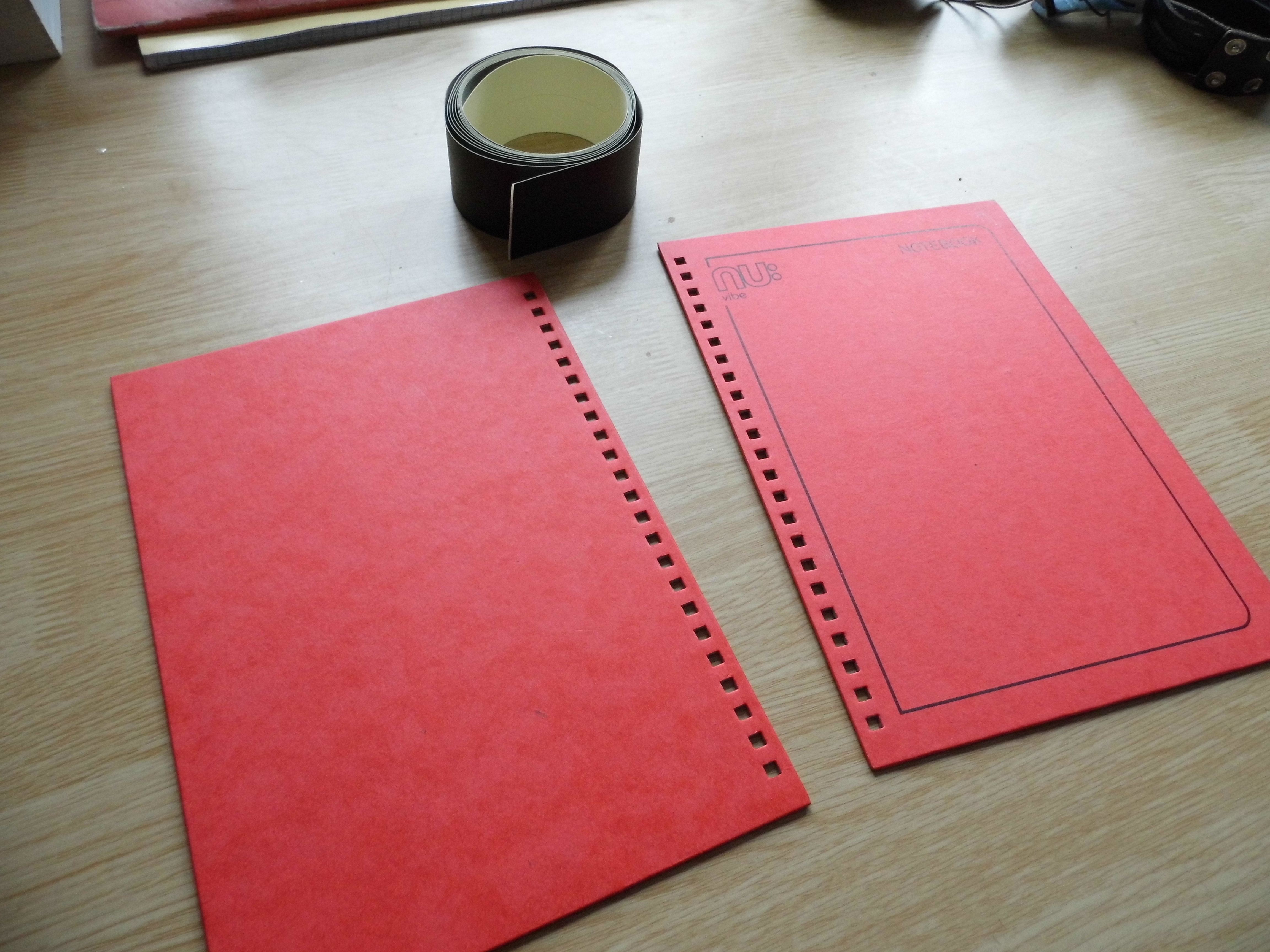
To put it together, I started with a plain hardback (A5) notebook from PoundLand (The Theatre of Dreams™) , and removed the pages and the metal spine so that I had just the front and back covers; which I (temporarily) taped together with book-binding tape to hold it together. I then sketched out a series of boxes, one to ten, along which the playing pieces would move in order to track levels.

I took the idea of replicating the Munchkin Deluxe board because I liked the idea of the board representing the dungeon that the adventurers are questing through, observed as a top-down view of a winding castle, or something. This way, it’s easier to figure out who’s in the lead and hence whether you want to either hinder them or lend a hand in return for bonus loot.

The next process was to paint up the background areas (green for grass outside the keep), and grey for the castle’s rooms. I used acrylic paints and a regular brush, and I quite wanted it to look ‘rough’ and weathered somewhat so I used quite a lot of dry-brush techniques to “scrape” paint onto the board. When I was done, I outlined the walls with a black Sharpie and then a silver-finish Sharpie for the inner section of the walls.

Munchkin_8

I wanted to add some definition to the inner walls, so I added a stone brick pattern to the outside faces of the walls with a very fine marker, just for funsies. I painted up the starting box (1) and ending box (10) up in more bright colours to reflect “Victory”, and designated each room with the relevant level number.

Because I wanted the notebook to represent a fictional dungeon-quester’s notebook (perhaps akin to a character notebook from Dungeons and Dragons), I wanted to give it a fantasy/role-playing feel so I removed the book-binding tape and replaced it with old, worn yarn that I found in the shed. I cut lots of thin strips of it (about 10-15 cm in length) and then tied them in loops through the holes of the original notebook’s spine. As a final flourish, I decorated the front of the board with the words ‘Munchkin Adventurer’s Notebook’, comme ça:


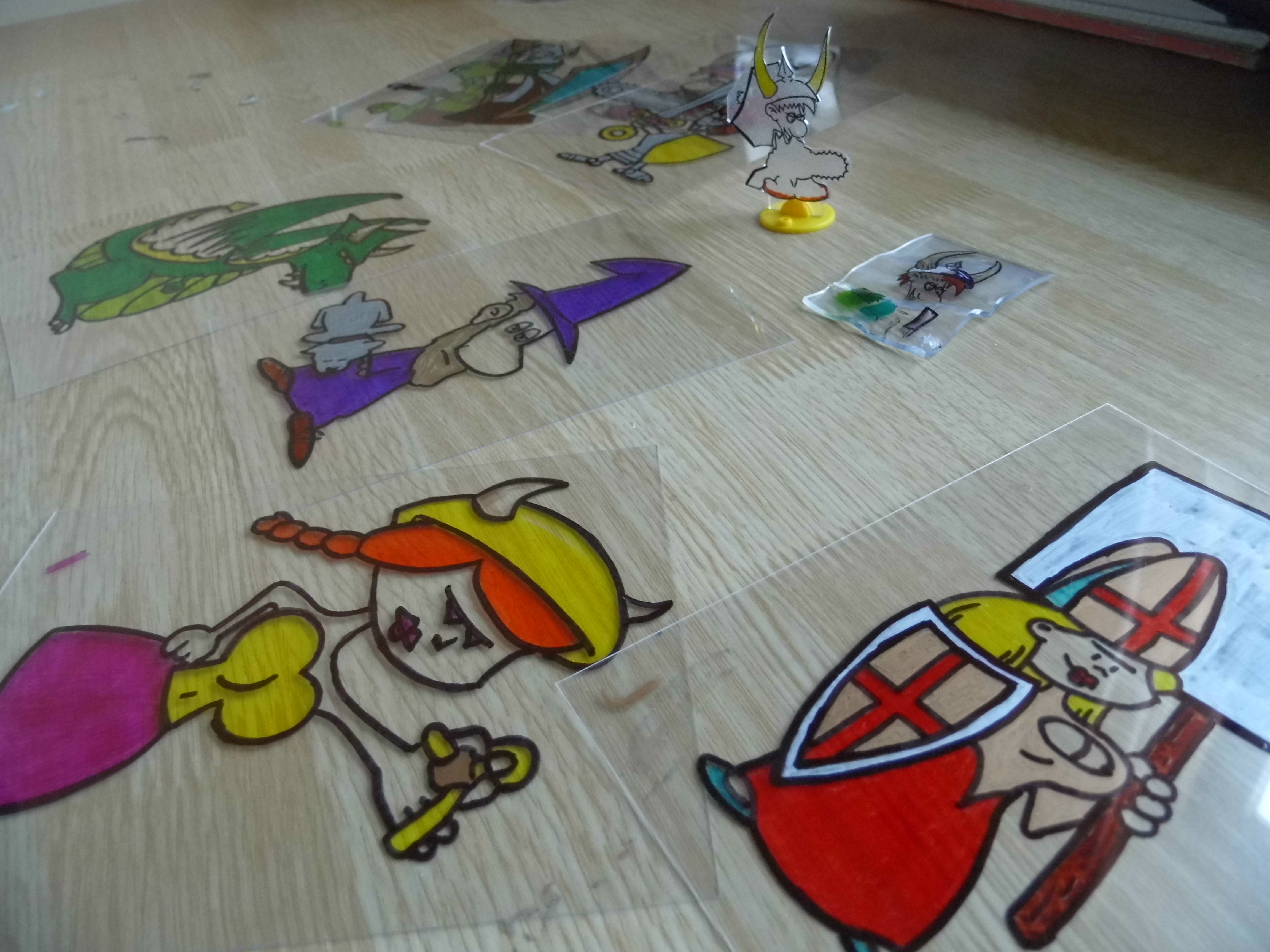
Right, so that’s the board finished, but what do we use to count? Well, instead of buying a Bag O’ Munchkins, I turned instead to shrink plastic to make some ~7 cm pieces to insert into plastic stands to represent each player.

I scoured through a bunch of cards from the base Munchkin deck to find some interesting characters, scanned the cards in and blew them up before printing them to a scale that the character was around 12 cm in size. I used Shrinkies clear shrink plastic, traced the outline with a black Sharpie and then coloured in the relevant area with other Sharpie pens. I needed 6 (because Munchkin plays three to six players), so to be sure of not screwing up, I made nine pieces and cut them out; making sure not to leave too many ‘thin’ bits because I found that these tended to warp very badly when fired in the oven.

I set the oven to “grill” (PUNS.) and lined a baking tray with tin foil. Then, one by one, placed each sheet into the oven for a few minutes (until it goes all curly, shrinks down and flattens out again) before removing it and immediately pressing it under a heavy book in order to flatten out the piece. After touching them up a little bit with the markers where the ink slightly melted and smudged, they were placed in their plastic stands. Because one or two went badly wrong in the oven, and a couple ended up noticeably out of scale with the other playing pieces, I was left with six complete pieces: two male, two female and two monster-ish; which I put in stands, ready to play with 🙂

Munchkin_7

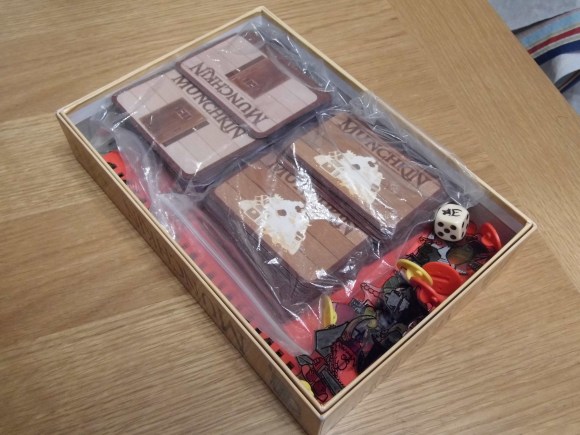
I’m pretty pleased! I think they look rad, even if no-one else agrees with me. Plus, everything still fits in my base Munchkin box, et voila:

P1050211

So yeah, GO GO GADGET CREATIVITY.

[Zinar7]

Tagged , , , , , , ,

friday_009

F009

In my entry from last Friday, I qualified my thoughts on video games and gaming by explaining that I find the process of play to be fascinating.

It’s true, I do find the act of playing to be something that’s always an interesting process – partly due to some of the more obvious excursions that play allows (role-playing as some far-flung hero; making decisions or play-acting in a way that doesn’t affect anything meaningful in real life; etc.), but also because I really enjoy engaging with other people in a ‘play’ scenario. That’s not to say that I don’t enjoy socialising with people in a normal setting or just offhand – I mean that I find it very interesting to see what other people do when they’re engaged in something that doesn’t have proper consequences in real life; to see what choices they make and what strategies they employ in winning the game or tackling the problem at hand.

For me, his fascination has, most prominently, been propagated through my expanding passion for board- and tabletop gaming; the social aspect of which still properly brings me a whole fuckton of joy. I miss the good times of the PlayStation/PS2 and Nintendo 64/GameCube console generation(s) where, routinely, four people would come together to hammer out a few rounds of GoldenEye 007, Micro Machines V3 or Mario Kart: Double Dash!!. There are, of course, exceptions to the rule but multiplayer video games now overwhelmingly force players to be separated by a connection barrier rather than just a simply sharing a multitap and a beanbag in front of the TV. Part of this feeling is borne of nostalgia, but it’s mainly a frustration at how good things used to be and how the community of gaming friends crouched around a tiny CRT monitor looking at a tinier quadrant of screen felt far more connected and social than the gargantuan, exhaustive ‘community’ that online play now elevates.

Part of the reason that I’ve grown so attached to tabletop gaming, I think, is that it helps propagate a worthwhile social aspect of play that has (rather disappointingly) all but vanished from digital gaming. Sure, text and voice chat still exists in PC and console gaming and it’s easy to arrange your friends to be connected to you in a virtual space, but it’s not the same as being able to gloat theatrically and extensively in the face of a friend – sitting right next to you – who’s just been blown up by a Blue Shell right before they cross the finish line and pipping them to the post.

In short: Sharing the same, physical, social space with a bunch of close friends while engaging in the process of play is infinitely more entertaining than getting 360noscoped and being called a homosexual by a fourteen year-old you’ve never met on the other side of the world.

The rise of German-style “designer” board games can, partly, be interpreted as a reaction to the ebbing sense of ‘social’ play in modern video games. As consoles have gained online capabilities in the last 10/12 years, (online) gaming has transitioned video gaming away from the “family” environment (with a small group of people in your own living room) to engaging with vast servers of unknown, random nodes across a gargantuan network. While board games have always been a popular activity – before and after the invention of video games –  I have definitely noticed a trend in how designer board games have swelled in number over the last six or seven years and even begun to infiltrate shelf-space in more mainstream shops (i.e. those that aren’t specialist gaming stores) on the High Street. I don’t think it’s a coincidence that these trends tally up quite so well.

Naturally, there are likely a whole lot of other reasons why these trends exist and it’s unlikely to be so simple a correlation that one can say, without question, that the shift towards online multiplayer video gaming has stoked the fires of Euro-style board gaming. But I think that there’s definitely a pattern involved, and perhaps it’s one that’s associated with gamers becoming a little disillusioned with the state of modern, AAA video games and aching to rediscover a sense of community play that seems to be growing more absent with each console generation.

In parallel, I’ve noticed a growth in the establishment of more, local tabletop gaming groups, and the population of existing ones swelling in number as more people discover the hobby. From personal experience, the genetic make-up of most of these groups tends to be formed, predominantly, of blokes in their thirties and onwards; at least, among those that aren’t based at, or very near, University campuses and the like. I might be painting with some fairly broad brush-strokes here, but I often feel like quite a proportion serious board game hobbyists are, perhaps, the kind of people that used to play video games but, perhaps, have fallen out of favour with them in the last few years; turning to tabletop gaming as more of an alternative. Of course, I haven’t canvassed the opinions of many of the board gaming community as to whether this is a 100% accurate deduction, but I’d be willing to place some stake behind being at least partially on the money.

The fact of the matter is, I still get a major kick out of engaging with people while we’re playing together; be it in digital world, or in a physical space. That passion is something that is hard-wired into me; like breathing and walking. But, the biggest buzz still comes when I collect together people into the same geographic location to play, and any method of making that happen anywhere and everywhere  is all good in my book.

[Zinar7]


If you’re into board gaming and attractive ladies – or, more specifically, attractive ladies playing board games and writing about them in an amusing and intelligent way – then you should check out The Misery Farm: How to Win Games and Alienate Meeple [themiseryfarm.com] because it has all of that and more, and blogs about board game-type stuff way better than I ever could.

Tagged , , , ,

Café Carnage: Dev Update #1

CC_1

Ahoy there! I sort of semi-mentioned Café Carnage in my last Friday blog, but since I’ve now had some time to think more about possible ways the game could be improved (as well as getting a few tabletop gaming friends to play it and see what they think), I’d like to document the results of playtesting of Café Carnage v2.0 and offer some thoughts about what changes could be made. These game dev blogs are primarily a vessel for me to screw around with ideas and develop concepts, but hopefully that’s interesting to you guys, too.

So, in that spirit: onwards!

Divider

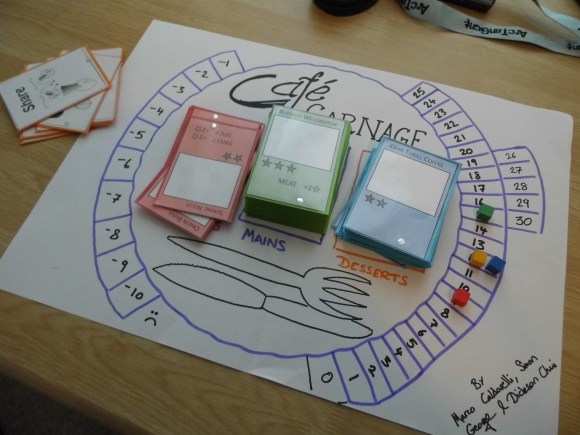
So, essentially, Café Carnage is a party game. A light, card-based game with minor elements of strategy and push-your-luck but, at its base, it is a party game (albeit – at the moment – only a party that only four people are attending). The version of Café Carnage [v1.0] that Marco, Dickson and I developed as part of the Global Game Jam 2015 (#SotonGameJam) was a very simple, party-game for four players; stripped of some of the more fancy ideas that we came up with, in order to get a workable, fun game completed in the 48 hour time limit. To download the Print ‘n’ Play version of Café Carnage [v1.0], take a look at the link below:

Print and play files: Café Carnage – Global Game Jam 2015 game by Marco Caldarelli, Simon George and Dickson Chui // Ages: 8 and above, playtime: 15-30 minutes.

In its primitive state, it’s a short, no-brain, luck-pushing game that essentially boils down to picking the right time to run from your bill-paying responsibilities: basically, picking the right day (of five) to play your “Run!” card and hoping that none of the other players play theirs at the same time – it’s a slightly amplified version of the famous Unscrupulous Diner’s Dilemma. There’s some slight more complexity and decision-making as to when to pick the best time to run, but, in essence, there’s a fairly clear way to victory that sort of becomes obvious once you’ve played it more than once.

But that’s fine: Café Carnage is intended as a party game; one in which you quickly bash out a playthrough in 15-20 minutes, call your friends “bastards” and perhaps have a chuckle or two along the way (results may vary).

CafeCarnage_3

The difficult problem now lies in how to develop Café Carnage [v2.0] and take it one step further into a more robust, more interesting game. After last week’s jamming, I’d sort of identified three key areas that I wanted to develop further in Version 2.0:

  • More players (5+)
  • More player interaction
  • More variation in the points/cost balance (and penalty for going over budget)

During #SotonGameJam, we only really tested and balanced Version One with 4 players. The idea of the game was, initially, to be a party game that could be played with a group of up to (say) 8 people who then debate over the bill; much like a large group meal IRL. The main logistical complication in adding more players lies in supplying sufficient number of cards such that, over the five rounds of the game, you’re not endlessly shuffling the discard piles and that there’s enough variety in the various dishes that diners can eat. Adding more players does, however, screw with the rules governing how diners can “Run!” from a meal and how only the ‘slowest’ diner (i.e. the player that consumed the most food that day and hence is the most out-of-shape) gets caught and all others escape without paying their bill – in a four-player game played over five rounds, the chances of 3+ players choosing to “Run!” at the same time is unlikely (in testing, rarely did more than two diners choose to “Run!” at the same time), but in a game with 6 or more players, you’re going to get multiple runners every round. How to ‘fix’ this such that one single diner doesn’t end up having to pay for 3-4 other meals (from successful escapees) is still an open question.

Regardless of any increase in players, a way of stimulating more interactions between the players is an important task. At present, players simply choose their three dishes (starter, main course, dessert) secretly from other players, and then the card showing what they choose to do when the bill arrives, before there is any engagement between the players in revealing what dishes they ate and revealing their chosen SHARE BILL/PAY SEPARATELY/RUN card. That there’s so much time spent simply doing your own thing means that there’s not only the potential for Analysis Paralysis (AP) to creep in, but also that the players are silent through this phase; which is not so fun. In Version One, what players choose to eat and choose to do when the bill arrives is in no way based on what anyone else is doing – you essentially do your own thing regardless of what other players might do, so you may as well be playing a solitaire game or playing against a droid. For Version Two, I’d love there to be more ways in which you can actually play against the other humans; be it by forcing engagement between players and revealing something about what everyone had to eat that day (perhaps, while everyone is eating their dessert, diners can choose to ‘grill’ [pun intended] a particular player about how much their starter or main course cost?), or more directly through bonus action cards or special powers that allow players to sabotage other diners’ meals.

CafeCarnage_1

One other thing that became apparent during the #SotonGameJam testing was that, even though Café Carnage Version One was incredibly well-balanced for four players (due, largely, to luck more than any tactical game design decisions), games would often end quite close in terms of the final scores of players. While this is not necessarily a massive issue, it does mean that games can be lost or won based on a single, minute decision (for example, choosing a one-star Starter dish rather than a three-star one); or worse, sheer luck. Furthermore, this also penalises heavily any player that is involved in an unsuccessful “Run!” attempt, because the requirement for them to pay for their own meal in addition to the meals of all other players who successfully escaped means that they’re near-guaranteed to end up way over their budget and heavily out of the running.

Aside from Version Two addressing the problem of multiple (3+) runners during a meal, it is fairly clear that a better cost/star ratio needs to be manufactured: in Version One, a one-star meal costs one ‘money’ (there’s no set currency for Café Carnage yet); a two-star meal costs two ‘money’; a three-star meal costs ‘three’ money, and so on. Because of this (and because any remaining budget at the end of the week contributes to Victory Points), points at the end of the game tend to vary between 35 (for winners) and 25 (for losers) – considering that players start with 30 ‘money’, this is not a huge variation (although not an unreasonable one).

There are some options for making this more interesting, and for elevating the tension as to whether the gluttonous diners successfully share the bill (thereby forcing other diners to share the burden of your expense): one is to modify the “exchange rate” between stars and ‘money’ – e.g. a one-star dish costs one ‘money’, but a two-star dish costs two ‘money’ and a three-star dish costs five ‘money’; but at the end of the game only stars count as Victory Points (not your remaining budget), but you lose Victory Points if you end up in debt at the end of the week. Alternatively, there’s the ‘Tastes’ variant that adds additional ways to earn stars/Victory Points as bonus value-for-money – each player is dealt a ‘character’ that appreciates certain types of food (e.g. Pepper Grylls likes her food to be vegetarian and/or healthy; Josh Rogan enjoys spicy foods, etc.), and bonus stars can be collected by choosing dishes that meet your diner’s requirements.

I don’t know what the solution is to this problem yet, but it’s good to have ideas.

CafeCarnage_4

Anyway, last Sunday, I gathered a bunch of my gaming friends ‘round my place to give Café Carnage a few rounds (with differing variants) to bash out some new ideas and brainstorm. I’m still thinking about the findings and feedback of that endeavour so I’ll leave those thinkings to the next post; but suffice to say that, after playtesting, I would like to add the following goals to the initial three that I laid out earlier in this post:

  • Less downtime/AP/potential for decision-making (and less shuffling time)
  • Action cards and during-dinner hijinks (e. stuff happening between courses)
  • Physical money (instead of a money-track)

So yeah, there you have the basis for Café Carnage Version Two. I’m still working hard on thoughts for Penny Black and my binary game, Bit Pattern, but I’m fairly pleased with the progress with “café game” as well 😀 Until next time, then. Godspeed!

[Zinar7]

Tagged , ,

friday_004

f004

Last weekend, in less than 48 hours, I helped design a novel café-based card game from scratch.

I can scarcely believe that it’s been a whole seven days since the beginning of the whirlwind Global Game Jam 2015 / #SotonGameJam tsunami that wiped out 48 hours of my life last weekend but, evidently, it has. I’ve got a bigger game dev-based post in the works in which I want to write about my various board game projects (Penny Black, Babbage and, now, Café Carnage), so I won’t take up too much time here with them, but yes, in 48 hours Marco, Dickson and I came up with a brand new card game called Café Carnage as part of #GGJ15, and you can download the print ‘n’ play files here ~

Print and play files: Café Carnage – Global Game Jam 2015 game by Marco Caldarelli, Simon George and Dickson Chui // Ages: 8 and above, playtime: 15-30 minutes.

Café Carnage is a party, bluffing-type game where yourself and three friends decide to visit five restaurants with an initial budget of £30, and attempt to eat the most food whilst trying screw your friends over by getting them to share the bill when you’ve eaten heartily, or running away when it’s time to pay the bill. In the end, we actually managed to pretty much come up with the whole of Café Carnage in less than 20 hours after a false start where we focussed on a different concept, which sort of makes it even more surprising that we actually have a game to show at the end of it. And it works! It’s not the world’s best tabletop game nor is it free from minor problems and limitations, but it’s a playable game and (at least from the playtesting we managed to get done during #SotonGameJam) people seemed to be enjoying it 😀

There’s more work that can be done on it towards refining it, but it’s totally playable as it is for four players looking to have a quick, light-hearted bit of fun ordering food and trying to bluff your way out of the bill. So yes: overall, in between the panic-designing and epic exhaustion that were sort of hallmarks of the jam, I had a good time at #SotonGameJam. It certainly proved a dramatic, rollercoaster way of spending a weekend; even if it did – at times – help to fuel the raging inferno of insecurity in my own abilities and ideas.

Recently, a lot of my insecurities have (sort of) come to the forefront of my mind and hammered away at my sanity more often than I’d like. Over the years, I’ve become quite good at burying the insecurity and covering it up with distractions or occupations or (more genuine) stresses and strains; but, with my current situation of being between-jobs and on my own at home for most of the time, there’s considerable time for the insecurity to chisel its tiny way into your sanity and start tinkering away into your confidence and self-belief. I’ve never been particularly affluent in self-confidence and self-esteem but, recently, things have sort of accidentally conspired to erode what faith I did have in myself; causing me to doubt the confidence in my outward persona and the things that I say, make and create. The general result, essentially, is that I’ve had too much time to overthink a lot of things, and to reflect on where I am in life/love/legacy and whether I measure up to the imaginary standards I’ve concocted that I think the world is expecting me to live up to.

Whenever I’m faced with a question of “whether I’m good enough”, I naturally end up comparing myself to unrealistic benchmarks (famous people, fictional characters, people that I perceive to be “winning at life”) and conveniently forgetting about the millions of other people around me that have normal lives and normal expectations set of them; as well as the flaws & imperfections that my beloved ‘benchmarks’ inevitably possess in addition to their positive qualities. My brain knows that, rationally, there is no point in comparing my physical appearance with that of Tom Hiddleston but, for some reason, it seems to interpret the fact that Tom Hiddleston exists – and is uncomfortably pretty and charming – as some sort of sleight on myself and my own looks. I can sort of understand where it’s coming from, though: when Hiddlesexy is wandering about on the same celestial body as I am, who the hell would be physically attracted to me?

The thing is, such thoughts are far from helpful. I might be wholly unconvinced by my physical looks and (most of the time) think that I’m some sort of hideous troll, but that’s not to say that everyone else thinks the same, too. Naturally, I see my flaws and my imperfections because I’m looking for them, and I see them every day in the mirror or in my brain or in my hands and am continually reminded that they’re there. They’re there, right in front of me, all of the time and, because of the way my brain works, they blot out all of the good bits that aren’t flawed or opaque and cause me to forget all that’s good about me and the confidence I have in myself & my abilities. Deep down, I have trust that I’m not a terrible person nor possess the world’s most repulsive appearance, and that I have qualities that People value and want to have around them, but the brain sometimes has rather unhelpful ways of trying to be ‘helpful’.

It’s been a bit of a choppy sea that I’ve been sailing in these last six months out of long-term relationship, and I’m still finding my sea legs. I’m still properly figuring out where I stand in the world, now that I’m standing in it on my own; and, in trying to establish my comfort zone, I’m sort of still feeling around for signs that I’m doing things right and that everything is okay. I’m the sort of person that wears their heart not only on their sleeve but on their every facet, and so it’s sometimes easy for my exposed heart to find itself injured in the process of everyday life – in the absence of corrective feedback or affirmations of “yes, you’re doing things right”, my brain tends to interpret the neutrality as indications of my visible failures or inadequacies. Again: not helpful, brain.

I need to let go of who I think I’m supposed to be, and embrace everything that makes me, me; imperfections and all. Just because I am not some famous, swooning celebrity who’s solved cold fusion and won a Best Actor Oscar and climbed Everest does not mean that I am not still a kind, generous, intelligent, thoughtful, funny person that’s – in his own way – unique and talented and beautiful.

I can do a lot of things that a lot of other people couldn’t even consider doing: I mean, last weekend, in less than 48 hours, I helped design a novel café-based card game from scratch. I bet Tom Hiddleston couldn’t do that, even if he would look infuriatingly pretty whilst trying.

[Zinar7]

Tagged , , , ,

friday_003

F003

On Wednesday, I resurrected an old friend and restarted the bi-weekly (ish) ritual of sitting down with a few friends and watching some crappy, cheesy, low-budget horror films. This used to a regular thing that we did a few years ago and many good times were had but, in more recent years, life sort of got in the way and we kind of forgot about it. Anyway, with the turn of the New Year, I felt it was time to shamble down to cemetary again and dig up the corpse of the magnificent ScareFest such that we may, once again, marvel at unconvincing acting, horrendous special “effects” and terrible storylines in the company of snacks, drinks and good friends.

The original idea was to establish a night dedicated to watching pairs of horror B-movies: one properly in the realm of Z-movie horror with crappy budgets; one relatively good one with a moderately bigger budget and fair critical acclaim. Such fun was kicked off on Wednesday with ScareFest #01: Dolls and Dogs, which married the low-budget Doll Graveyard with the minorly-higher-budget-but-still-not-a-huge-budget Dog Soliders. It turns out that both performed pretty much as expected; with much commentary on low-budget actors trying to ‘do’ the ‘acting’ thing, confusion as to why the back of the DVD box for Doll Graveyard recounts a completely different premise for the film than the one shown onscreen, and excitement at the appearance of Davos Seaworth from Game of Thrones as a Special Forces Captain in Dog Soliders.

Anyway, the proposed schedule for ScareFest: Season One is thus:

ScareFest #01: Dolls and Dogs
Doll Graveyard (Charles Band, 2005) and Dog Soldiers (Neil Marshall, 2002)

ScareFest #02: Creaturezoids
Creepozoids (David DeCoteau, 1987) and Feast (John Gulager, 2005)

ScareFest #03: Biohazard Detected
Spiders (Gary Jones, 2000) and The Rage (Robert Kurtzman, 2007)

ScareFest #04: You Had Me in Stitches
Skinned Deep (Gabriel Bartalos, 2004) and Stitches (Conor McMahon, 2012)

ScareFest #05: Cradle of Flesh
Cradle of Fear (Alex Chandon, 2001) and MindFlesh (Robert Pratten, 2008)

If you would like to join in the horror movie fun, then you are very welcome to – give me a shout or something and I’ll add you to the next event! Also, if you have any crappy B-movie suggestions then I’ll add them to the rota 😀

Anyway, onto less horror-film climes: today marks the start of #SotonGameJam, which is part of the Global Game Jam 2015; an initiative to have a whole bunch of people, scattered across the planet, to design a game (digital or tabletop) in 48 hours. The Southampton portion of #GGJ15 is being co-organised by a few people I know, and the jam itself will be happening all weekend in one of the computing labs at the University of Southampton. I don’t really know what my game will end up being about, but thinking about it has already sparked some ideas about designing some kind of card game that revolves about binary numbers and bit patterns – Of course, maybe that’ll go completely out the window when we learn the (as-yet unannounced) theme of #SotonGameJam, but it’s still exciting stuff and I’m mega looking forward to getting involved.

Whilst I’m clearly already getting excited about my next board game design project, it’s notable that I still haven’t gotten much further with my other game-design opus, Penny Black, since I last blogged about it – largely, I’m too scared to play-test it and discover its flaws, lest it shake my confidence in what my creative juices can help to lubricate. Like many artists, I’m often too much of a perfectionist to fully relinquish control of what creative output(s) I manage to spew forth and, likewise, am very sensitive to criticism (even If it’s constructive). I suppose that I should just fucking do it and set up a playtest night with a few friends to give it a try with four players, and see what happens. I’m not sure what I’m really scared of (perhaps it’s finding something game-breaking or fundamentally wrong with what I’ve dreamed up), but I trust the opinions – and compassion – of my tabletop friends not to completely slam it, so I really should just roll the dice, deal the cards and see what happens. Hey, who knows, maybe it’ll be really good? And hey, if it’s not, then the feedback will be constructive and make the game better and, maybe, somewhere along the line, something awesome might happen with it. You never know ‘til you try, do you?

On the subject of game dev that I’m totally taking undue credit for, this week Citizens of Earth came out on Steam and pretty much every console ever, and towards which I very minorly contributing by doing some beta-testing way back in 2014. I’ve not played the most recent build and haven’t played it all the way through (I was involving in bug-testing of the very early section of the story and in combat and stuff), but from what I was involved in, it looked exactly my kind of turn-based (J)RPG-type game and I’m heavily looking forward to actually giving it a bash. I didn’t delve into any code and I was mainly looking at playtesting and usability and in-game bugs/crashes, but it’s nice to feel like I helped to make it better in some way. I considered making a proper video game for #SotonGameJam, but my coding skills are totally not in prime physical fitness for making anything other than a very simple, turn-based/logical strategy-game-thing, and I figured that I could have more fun doing the same sort of thing in the physical realm (with cardboard tokens! And wooden cubes! And 3D-printed Cthulhu meeples!) anyway.

Anyway, I’d better get shiftin’; I’ve got game-jamming to do. Let’s get to it.

[Zinar7]

Tagged , , , , , ,

Special Delivery

SpecialDelivery

I’ve been playing a new game recently.

It’s called “When Will My Package Arrive?” and, for almost three weeks, I remained locked in battle with a deliveryperson from MyHermes in a conflict as old as time. But, after a rollercoaster of emotion and a tidal wave of confusion, the battle is finally over.


The game had been going on for over three weeks, ever since I ordered a package from Ebay not long after Christmas from a very pleasant Man in The North. However, despite the best efforts of The Man in The North, my beautiful parcel-child seemed destined never to materialise at my doorstep due to an array of factors that I’m still yet to comprehend. Like many of the problems that exist in my life, the source of bother was board game-related; although, unlike most of said board game-based problems (i.e. that I don’t have enough), it was one caused mainly by the wrath of the Gods themselves.

This all started on Christmas Day 2014, when I decided to try and remedy the ailment of ‘Not Receiving Any New Board Games For Xmas’-itis by picking up a copy of the third expansion to Dirk Henn’s Alhambra from Ebay because, by happy coincidence, someone (the aforementioned ‘The Man in The North’) was selling a German copy of the expansion and I need a version of it in German so that it fits in with my German copy of the original Alhambra game. So far, so straightforward.

Fast-forward a few days, and it’s New Year’s Eve 2014 and I’ve popped out at lunchtime to go and grab some food and coffee. Upon my return, I discover a ‘Sorry I Missed You’ card from the MyHermes person waiting for me, jammed in the metal shrouding surrounding the buzzer system to my block of flats. The truth is, I wasn’t expecting my package to arrive so soon (estimated delivery placed it at around the 4th-10th of January), and so had I known there was a chance of it arriving then I would’ve probably stayed in to receive it. Never mind, though; surely they would try again on the next working day to bring me my package, and I’d soon be whisking myself to Gametown to build my Alhambra with a few friends.

Alas, the next working day was New Year’s Day 2015; a national holiday in the UK. Friday came and went without an appearance from my package [snigger], and the weekend proved equally fruitless. With the coming of Monday, though, I felt sure that the days of my package being neglected [snigger] were numbered and that I would soon be fondling my package [snigger] in the comfort of my own home.

However, Monsieur/Madame Hermés seemed to have a difficult time in finding my house. Despite the fact that they had found it successfully once, I discovered that they had a penchant for listing the parcel as ‘Out for Delivery’ on the MyHermes tracking facility, but never coming to my flat to attempt delivery. Quite naturally, I took to social media to express my frustration, in an open letter:

Dear MyHermes delivery person,

I don’t wish to tell you how to do your job or nothin’, but I think you’ll find that the easiest way of actually delivering my package is to just come to my house and give it to me, rather than listing it as ‘Out for Delivery’ each day and then not bothering to come anywhere near my flat.

I know that it’s likely not that big or bulky, but it’s still going to get pretty boring to see that same package in the back of your van every day. Plus, think of the pennies of fuel consumption and tyre wear you’ll save by it not being in there and having a van that’s 250g lighter.

I appreciate that my package probably hasn’t seen enough of the world, and that you’re doing a sterling job of driving it around and letting it see the sights of Southampton – I imagine the postcards of its exciting trips to St. Mary’s, Millbrook and perhaps even Chandler’s Ford will be something to show the grandchildren.

Perhaps it is simply that you have forgotten where I live, and can’t remember where you were supposed to be bringing my package to after it’d been on its round-the-world adventures. An easy mistake, we all do it sometimes. If that was the case, if you look on the back of my package, there should be – somewhere – a little tracking device called ‘An Address’ that you pop into this thing called ‘A Map’ and where it tells you where my flat is.

I know that that’s not as fun as playing ‘Hot or Cold’ with my package as you drive around Southampton for days on end, trying to get closer to ‘Warm’, but my package is late for his tea and he’s got school in the morning so it’s probably best that he come home now and do all his homework and everything. If you’re having trouble convincing him, tell him his mum said that if he comes home now then he can stay up for another hour and watch another episode of “Monsoon Poultry Hospital” as a special treat.

Anyway, sorry to bother you, hope to see you soon,

Si x

A day or so then passes before I once again remember to check the MyHermes tracking service, and realise that the courier had apparently tried to come round earlier in the day whilst I was briefly out meeting a friend for lunch. Confusingly, the MyHermes tracker lists as being “Not Del’d – 3rd and Final Attempt” (despite it being only the second try) and, even more confusingly, neither did the courier leave a ‘Sorry I Missed You’ card (nor on the imaginary second delivery attempt) so there was no way of contacting the deliveryperson to re-arrange the delivery for a more convenient time or to arrange to collect it myself from somewhere.

Because it’s fairly usual in these circumstances (after, say, 3 deliveries have been attempted to no avail) for the parcel to be returned to the sender, I leapt onto Ebay to message The Man in The North in order to explain the problem and to let me know if/when it turned up at his house so that we could re-arrange a different way of delivery. Speaking to His People™, he was informed that the parcel was – once again – listed as ‘Out for Delivery’ that day, and that I should wait and see if it turned up that day.

I waited in all of that day. I did not leave the house.

Granted, at one point I put one foot outside of my back door to lean out to see if there was someone in the car park because I’d heard a van and wondered if Captain(ess) Hermes had appeared but the door buzzer hadn’t worked for some reason [SPOILERS: they hadn’t]. But no, I waited in all day; driving myself slightly mental and paranoid in the process. And no-one came.

Nor did they come the next day. Or the next day. Or the next day after that.

“This is it,” I thought. “All is Lost.” Gone forever. Swallowed into the void. Fallen over the precipice. I would never see my beautiful package again. I would never know its loving caress. With a tear dribbling down my cheek, I wrote to The Man in The North, explaining that the fruits of our union would never be savoured, and that it was likely that our charming offspring would probably be returned to his address. Since The Man in the North was a lovely man, he immediately refunded my PayPal payment, and promised that he would re-arrange another delivery (via a more reliable carrier) once it turned up with him again.

It was with immense surprise, then, that I returned from a brief shopping trip yesterday afternoon to find a “Sorry I Missed You” card from Hermes, apparently from a driver called ‘Andy’. Was I dreaming? Was this merely a hallucination? Was there going to be a happy ending after all?

Well: this lunchtime, ‘Andy’ dropped by again with a sparkling blue package nestled in his grasp. There was no fanfare; no chorus of angels. I looked to the sky, in case a beacon of light was deigned to shine down from the heavens, but I didn’t see one. Perhaps the Gods had forgotten to set their alarms. ‘Andy’ and I stood, staring at each other, in the rain outside my front door. Looking in each other’s eyes, we both knew that we had found each other. The harsh reality of the modern world may place many obstacles in the way of progress but, in the words of the great Dr. Ian Malcolm: “Life, uh, finds a way.”

Out of the darkness, my package had burst forth, bringing light and hope to hitherto black corners of existence. As I cradled my long-lost package in my arms, the tear once again materialised on my cheek and I felt my lips tremble like the legs of a baby deer as it struggles, hopelessly, to open the blister packaging of a new Black & Decker cordless drill.

“Thank you,” I whispered.

And, in that moment, we both knew that everything would now, forever, be all right. The game might now be over, but a spiritual connection would forever exist between the both of us; a product of our combined journey and our growth as people. With nary a parting word or goodbye embrace, we went our separate ways; destined for diverging paths but always retaining the memories of our beautiful game.

We entered the arena as but footsoldiers, but left as generals. Let’s hope we never have to do battle again.

[Zinar7]

Tagged , , ,

friday_001

F001

I used to keep a regular, daily (ish) blog back in 2004-2008ish over at the almighty LiveJournal. In it, I would write down all sorts of random rubbish that would help vacate my brain of all the useless junk that clutters it up on a day-to-day basis.

I thought that I would resurrect that ethos for the year 2015, and maintain some sort of Friday Blog thing where I can just talk about random stuff that I’ve seen or played or done over the week, rant about the Star Wars prequels and salivate over board games that I want to buy but can’t afford. I’ll jot down things during the week and/or blog down little sections each day, and then collect them all into a Friday Blog (inspired by Friedemann Friese’s Friday project) which summarises some of the things that are going on in my own little world. Basically, it’ll just be a little catalogue of whatever’s hitting my brain at the time and what’s important to me.

Since this is the first proper Friday of 2015 (the last one doesn’t count since it only had a day to get prepared, and it sort of overslept), here is Friday_001. Let’s get shifting.


So: 2015, then. For all kinds of reasons, 2014 was a bit of a strange year. Lots of things happened across it; both good, and bad. The climax of the year sparked in me a noble goal of making the best of 2015 and for creating some sort of fresh start; at least, mentally. 2014 was plagued with a variety of struggles and stresses, and so I vowed to make the new year one in which struggle and stress would be minimised, if not eradicated. I see it as an opportunity to make myself a better person – not materially, or in terms of who I socialise with or who is in my life, but as a chance to align myself more closely to the ‘me’ that I’d like to be; better at keeping in touch with people, less susceptible to procrastination, resistant to worry. Simon 3.0, if you will.

I suppose that the success of this endeavour will only become measurable over time, but hopefully it will be measurable, eventually. 2015 marks the beginning of a variety of new journeys for me, so the time is as good as any to embark on a fresh page of ‘me’ and to decouple the feelings, troubles & regrets of the past from the adventures of the future. Too often, I’m my own harshest critic and will chastise myself far harder for my mistakes than I would do for literally anyone else in the world. Well, Twenty-One-Five is my chance to be 100% more awesome and 100% less rubbish, and those aren’t just hollow words. This calendar year will be one in which I cross over the threshold into my fourth decade, and so naturally it lends itself to a convenient excuse to let go of the past and its plethora errors & regrets to think only of the positives that the future will hold. I’m by no means a perfect person, but – again, perhaps with time – I can finally approach the asymptote of the well-rounded, mentally-strong, good person that I strive to be.

So yeah, my Resolutions for 2015 are generally just: be better at stuff; spend less money; eat less crap. Y’know, all the normal stuff that people resolve to do in the New Year, but with a genuine sense of incremental, noticeable change. Simon 2.0 was a solid release but still had a few bugs; Simon 3.0 aims to ship with fewer glitches, more documentation and better usability. Let’s crack on.


Anyway, that’s enough boring talk. What else in new in January?

Well, I’m horribly addicted to board games again. Those people that know me will say: “But…you’re always horribly addicted to board games!” Yes, this is true. I think it’s just amplified at the moment because [a] I’m in between jobs and therefore have a heck of a lot of time to think about them; [b] I’ve still got a bunch of new-ish ones on my shelves that I still haven’t played but would like to; and [c] I’m in the process of designing my own (Penny Black) that my brain is constantly being bombarded with new ideas and potential mechanics to introduce to the game. Furthermore, one of my best friends in Southampton has also just picked up the ‘designer board games’ virus (albeit, from me) and hence we’re spending much time and conversation in playing, and talking about what we want to play next.

Just before Xmas, I picked up Camel Up at Dave’s Comic Shop in Brighton, and it’s badass: not sure yet how it’ll stand up to repeated plays, but it certainly seems to be fun so far. In the pre-Xmas sales I bought The Witches: A Discworld Game and, only yesterday, put in an order for Stefan Feld’s lightweight strategy game La Isla; which is about searching for rare and exotic animals on a newly-discovered isolated island. Put this in the context of the other games that I own but still haven’t played in anger (Lewis and Clark: The Expedition, Asgard, Jamaica, Shipwrights of the North Sea, The Lord of the Rings) and those that I want to break out again (Village, Priests of Ra, Vasco da Gama), and I’m a bit wrapped up in the cardboard world at the moment.

Which reminds me: I would quite like to go to SPIEL ’15 in Essen this year.  Please?

Furthermore, I’m well back into the swing of point-and-click adventure games again. They’ve come and gone in my life, but always been a staple of my most memorable gaming experiences. After a bit of a false start this time last year (I only managed one; in Indiana Jones and the Last Crusade: The Graphic Adventure), I’m vowing to get back into both adventure gaming and video game reviews; starting with the highly enjoyable 20th Anniversary Edition of Gabriel Knight: Sins of the Fathers. In my ample spare time recently I’ve been drafting a review summary, penning some of my thoughts about the game and its comparative ‘good’ and ‘bad’ points. Hopefully it’ll materialise on here at some point in the next week or so.

Anyway, that’s probably enough words for now. Friday_001 is finished; in time, Friday_002 will rise to take its place. All power to the Friday.

[Zinar7]

Tagged , ,

Penny Black: Dev Update #1

PennyBlack_1

For those that aren’t aware, I’ve been working on a board game. It’s been boiling around in my head since May or so; where it initially saw a great flurry of activity but, due to various other things, kind of got put on the backburner until a few weeks ago. However, in the last month I’ve focussed more time on it and into getting it to a position where I (and perhaps a group of friends) might be able to actually give it a try. Hooray!

The title of the game is Penny Black, which some of you might recognise as the name of the world’s first postage stamp designed by Sir Rowland Hill in 1840 for the Royal Mail. As you can therefore imagine, Penny Black is themed around a fictional Post Office; not in Victorian England but in the fictional Republic of Sinestria. So, what’s it all about? 

PB1


SUMMARYPenny Black is a strategy board game with a postal theme. Players take the roles of trainee sorting-office workers in the Mighty Republic of Sinestria, where the postal system has recently been introduced. In this role, players compete to serve customers, stamp their letters and process them into the Post-Bot’s mailbag in order deliver these to the intended recipients and earn points. However, the citizens of Sinestria are sceptical of this new postal system, and players will need to meet their various demands and expectations in order to secure the success of the Sinestria Republic Post.

The more letters that are picked up and delivered, the more trust players will acquire from the public (measured in terms of Victory Points) and, at the end of 7 days of training, the performance of the new trainees will be rigorously assessed. If players misplace letters or deliver them late, they will lose trust from the public. Furthermore, fellow players will be aiming to hinder each other or engage in outright sabotage, so players must maintain awareness of the competition.

Due to a malfunction, the Stamp Machine does not output the correct stamps but instead spews them out randomly onto the Sorting Office counter. Players will need to collect the correct stamps, pick the most viable customer letters, and make sure that they are in the Post-Bot’s mailbag at the correct time in order to score Victory Points.

The Chief of Post for the Government of Sinestria has vowed to permanently hire the most successful worker to be elevated to the position of Post-Office Manager, a highly respected position, based on players’ performance in efficiently collecting stamps, sorting letters and getting them into the mailbag at the correct time.

Divider

I’ve just reached a point of having the rules for v0.1 of Penny Black pretty much shaped up and written down. I’m yet to get round to playtesting, but I’ll look into doing so at some point over the Xmas period. If you would like to know what the hell Penny Black is all about (and, indeed, what the hell I’m talking about during the rest of this post), then a .PDF of the rules is here:

PennyBlack_v0.1 (December 2014, .pdf)


DISCUSSIONThe main concept of Penny Black is similar to a number of games that require collection of tiles/resources in order to purchase other cards, which require a varying combination of resources – these include titles like Unexpected Treasures (by Friedemann Friese) and Felinia (by Michael Schacht). In Penny Black, these, purchased, cards must then be redeemed by placing them in the mailbag at the appropriate time (and in competition with other players who are looking to do the same, perhaps with some amount of skulduggery) in order to score points.

Hopefully what is unique about Penny Black, when compared to other games based on collecting stuff and using it to buy other stuff (even so far as Alhambra by Dirk Henn), is that there is a ‘timing’ aspect to having the right things at the right time, and in the right place: the mechanic of having a semi-random method of dictating when a letter delivery takes place (defined by a dice roll which may mean that the Post-Bot moves at a steady 1-step pace [most likely], a rapid 2-step pace or does not move at all [least likely]) means that there is, hopefully, unpredictability as to when points are scored; wrestling complete control from the players and adding more tension along with incentive for skullduggery. The unpredictability of what exact delivery conditions (i.e. what earns bonus points for players when a delivery happens) also, hopefully, adds to the variation between games and leaves players guessing as to what will earn them points.

PB2

The main method of how players collect stamps is one of the key parts of Penny Black that I still don’t yet have a solid ‘feel’ for. I expect that over various iterations of the game, how stamps are collected by players will likely evolve a bit; perhaps taking cues from other games. For example, Felinia lets you collect similar tiles based on a ‘bidding’/market system, although this requires application of some sort of currency system which would add extra complexity to the game. I thought about some sort of worker-placement mechanic, but this seemed like an overly elaborate way of simply collecting resources. Maybe I’ll look into playing other games with similar mechanics, and see if there’s anything I can borrow or adapt if the current mechanic doesn’t feel quite ‘right’.

In the first iteration of Penny Black, the mechanic to collect tiles is largely similar to that of Ticket to Ride (by Alan R. Moon), yet with some similarities with Splendor (by Marc André): there is a general pool of stamp tiles, drawn randomly from a bag, that occupy six stamp spaces on the game board. On a turn, players may choose an action to activate the Stamp Machine, which re-fills any empty stamp spaces (left empty after previous players have taken stamps), and then choose three stamps to take from the available pool. Players may hold seven stamp tiles at a time. From their collection, players then trade the correct stamps with those depicted on an available customer letter in order to ‘stamp’ it and to prepare it for delivery, or use certain combinations of their stamps to influence the motions of the Post-Bot to speed up or slow down the time until delivery, or to kick out another player’s letter from the mailbag and replace it with one of their own. Yes, I know the Post-Bot is currently R2D2, shut up.

PB3

Another aspect that isn’t currently in place in Penny Black is the concept of having ‘special’ stamp cards. In addition to the way that basic stamp tiles are drawn from the bag and players may pick from them, I’m toying with the idea of having additional stamp cards that either allow a player to use them as any individual stamp, or perhaps as a double-stamp of a single colour. Further to this, something that isn’t yet fully-formed in my head is the method by which the Post-Bot either adds incentive (or penalises players) when it has reached the end of the Delivery Track yet the mailbag is not sufficiently prepared. It might be that an elegant way of killing both birds with a single stone would be to have the Post-Bot give special ‘one-shot’ stamp cards to all players that succeed in delivering a letter; although I’m aware that this might leave certain things overpowered, or lead to situations with runaway winners. In the current iteration (v0.1) of Penny Black there’s no facility for this yet, but it might be worth considering in a later iteration to see how it works. Certainly, I feel like a technique whereby players are rewarded for putting letters in the mailbag (not necessarily just for delivering them) could be an option; which might be as simple as taking a stamp tile from the available stamps on the Sorting Office Counter.

Divider

So, in a nutshell, that’s Penny Black. Of course, it’s going to take a lot more shaping up and refining before it’s something that could potentially be released to the outside world but, even at this very early stage, I’m bloody proud of how far I’ve gotten with it.

The next stage, really, is to test the game with some actual play. After I’ve fiddling with it myself and an imaginary table of gamers, I’m going to look into recruiting a few friends to giving it a go and providing some feedback on the game (in addition to identifying the glaring holes or errors in design). With a game like this that will require a significant amount of balancing in terms of how many points successful deliveries should be worth, how long there should be between deliveries, how easy or hard it is to collect the right stamps and purchase letters, etc. I feel that there will be a lot of tweaking necessary to weigh out the game so that it brings a balanced atmosphere. I’m intending on documenting the progress fairly methodically to establish what’s working and what’s not, so expect more posts in this series on the continuing development of the game and my thoughts on it.

If you’ve got ideas on thoughts on the status of Penny Black, then I’d love to hear what you think. Hey, maybe it inspires you to think about designing your own game; or just creativity in general. If I can spark some imagination surrounding interesting board game themes or creativity, then that’d be awesome.

[Zinar7]

Tagged , ,

Sinister Sevens: Designer Board Games

BoardGamesSevens

I admit it; I’m a desperate, ravenous tabletop board gamer. This frenzy has been sweeping over me for many years now, but it’s only within the last 3-4 that it’s truly taken over every sense and synapse, and led to full-on obsession.

Since I’ve been a kid, I’ve absorbed myself in games: both console and tabletop. Whilst most of my intervening years have been dominated by video games, the recent resurgence of family-based, tabletop strategy board games in the last decade has led to Euro-style physical games falling evermore into the mainstream and many games store being drowned in an avalanche of high-quality wooden pieces and plastic/linen cards; and, consequently, my living room.

In tribute to this passion, then, I’m going to run down my favourite seven games on the market and detail a little bit about why they mean so much to me. Perhaps, through my amateurish words, I can inspire yet more people to absorb themselves in my rampaging hobby. Let’s go for it.

Divider


1. Carcassonne (Klaus-Jürgen Wrede, 2000; published by Hans in Glück)

In almost every respect, Carcassonne is my favourite tabletop game of all time, and that will likely never change. Dismissed by some as simply a gateway game offering passage to more complex titles, one should not confuse simplicity and elegance with adolescence. A tale of tiles, Carcassonne revolves around drawing land pieces at random, placing them on an ever-expanding ‘board’, and assigning miniature wooden people (“meeples”) to be knights, farmers, robbers and priests to score points for your growing empire. However, other players are aiming to do the same, and will interfere with your progress; either by trying to steal cities, roads and farms from your possession, or placing tiles inconveniently to block your developments.

Whilst the main game mechanic opens up a significant of luck (coming down to the tile you draw on your turn), you rarely feel completely at the mercy of misfortune and there is still plenty of opportunity for backstabbing and hindering of other players, even if you continually draw unhelpful tiles. Despite the compactness of the base version of Carcassonne, there’s also a supreme amount of expansion available to elaborate on the vanilla game if you so wish, with new features and expansion sets still regularly being released.

It may be passé to claim adoration of such a simple or ‘plain’ game in a world of complex titles but, to be honest, I’m having so much fun that I couldn’t care less.
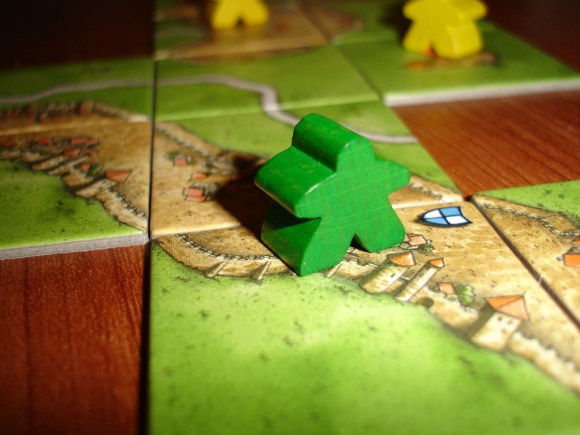
Carcassonne

Divider


2. Takenoko (Antoine Bauza, 2011; Asmodee)

A modern classic (ish) by Antoine Bauza, Takenoko, to me, is known by only one name: Pandas.

Pandas is…a difficult game to describe: it has elements of tile-placement, hidden goals and random interference, yet fits ideally into none of these formats. The primary success of Pandas, though, lies in it daring to be different. From theme to mechanics to player engagement, it feels fresh; unburdened by restrictive gaming customs, and bringing something genuinely ‘new’ to the table (pun intended). Players build an expanding bamboo field, tended by a moving gardener and devoured by a roaming panda, aiming to complete ‘goal’ cards that are based on varying conditions. Complete seven goal cards, and it’s the end of the game.

The game is superb for player interaction, with an expanding playing area upon which bamboo pieces grow on on irrigated field tiles, and the unhelpful movements and culinary habits of the eponymous panda can destroy your finely-honed bamboo field whilst benefitting someone else. A further bonus to the main mechanics are the wonderful design strokes and charming artwork: delightfully colourful playing pieces, tiles bamboo pieces being lovely to both sight and touch, and cartoon-like miniatures representing the roving panda and gardener. Takenoko is a triumph, and one that I would introduce to any gaming environment; an entertaining romp for both newbies and seasoned gamers alike. Pandas!

Takenoko

Divider


3. Agricola (Uwe Rosenberg, 2007; Lookout Games)

Agricola is a behemoth in the tabletop world; both in influence/acclaim and its actual, physical bulk. A game about the driest of the dry (farming in the 17th Century), it’s a heavy worker-placement game played over thirteen turns where you can do never do everything you’d like to, and compromise is the order of the day. Since its release, it’s been acclaimed as one of the greatest modern designer board games, routinely holding position near the summit of BoardGameGeek’s top 100 games. However, it’s totally an experience that takes time to drink in and appreciate; perhaps one reason why it never won Spiel des Jahres upon its release, but instead was given a special prize as “Best Complex Game”. Certainly, I don’t feel that I’ve spent enough time with Agricola to come anywhere near truly mastering its art but, one day, I will and that will be a glorious epiphany.

There’s an outstanding amount of range and variability that can be present between successive plays, thanks to huge decks of cards that dictate what occupations can be taken on and what farm improvements can be built – make no bones about it, this is a delightfully complex game that rewards those who explore every aspect, think logically and react to changing circumstances. It can be mightily brutal though, too: making sure you can feed your family, when there are a bunch of other things that you’d like to do too, can be a heartbreaking decision.

In Misery Farm, everyone dies.

Agricola

Divider


4. 7 Wonders (Antoine Bauza, 2010; Repos Production)

As is probably becoming clear from my selections for this list, I totally have a soft spot for games designed by Antoine Bauza. To date, 7 Wonders is probably his most acclaimed game title, winning the Kennerspiel award at Spiel des Jahres 2011 for “best complex game”, and there’s a valid reason for that. It’s wonderfully put-together and crafted, with simple (concurrent) turn mechanics, fast & engaging player interactions and lovely artwork; making each player’s (of which there may be up to seven, or eight with the ‘Cities’ expansion) process of building a Wonder of the ancient world an absolute pleasure.

It’s rapidly quick; the concurrent turn order keeping things active and away from tedious Analysis Paralysis (AP); and the points salad options for points-scoring means that there’s plenty to think about in each turn/round/game. Spread over three Ages, in each one players begin with a hand of (n + 1) cards; taking one and playing it, then passing the hand to their neighbour, whereby the process continues until all cards are played. Players must build up resources, use them to construct cities with marketplaces, cultural focal points, commerce, military strength and, of course, their individual Wonder.

It’s elegant in every conceivable way, short in terms but not in terms of complexity, and with a heap of replayability that makes it a great choice for a medium-weight ‘filler’ game that makes city-building an absolute delight.

7 Wonders

Divider


5. Tokaido (Antoine Bauza, 2012; Funforge)

Tokaido is, categorically, the prettiest designer board game ever designed (FYI: the Kickstarter collector’s edition is even more a delight), for which we have Xavier Gueniffey Durin to thank. Yes, it’s yet another Antoine Bauza title in this seven-strong list, but it accurately typifies his penchant for deriving completely novel themes and abstract (yet sensible) game mechanics, as players take on the role of Dynasty-era travellers migrating up the eponymous Tokaido Road on Japan’s coast; visiting picturesque view, hot springs and teahouses, and meeting a swathe of friendly characters and merchants.

In essence, it’s a ‘race’ game, but one which is full of charm and quirks – players cannot occupy the same ‘spot’ and the rearmost player always moves, therefore compromise must be made as to whether to jump ahead to guarantee visit to special locations, or to maximise visits by moving to the next available space. Points are awarded based on a variety of goals, with a ‘Points Salad’ approach allowing players to tackle different strategies (focussing, perhaps, on visiting particular locations or collecting certain souvenirs) and to react to other players’ circumstances. The fact that this is wrapped up in the most aesthetically-pleasing artwork is, admittedly, a bonus; but one which simply adds to the overall feel and gives the genuine feel of players going on a scenic, rewarding journey over the course of the game.

Tokaido is, at heart, a delight. Wonderful.
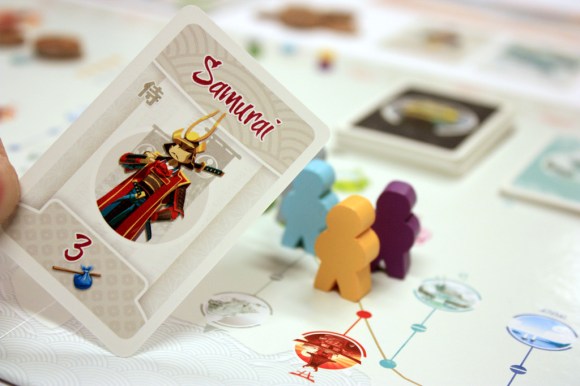
Tokaido

Divider


6. Love Letter (Seiji Kanai, 2011; AEG)

Elegance is the only word that can be used to adequately describe Seiji Kanai’s microgame, Love Letter. Mechanics, artwork, components; it’s all simple, streamlined and with solid pick-up-and-playability. Formed of only sixteen cards, a beautiful velvet bag and a handful of cubes representing ‘tokens of affection’ from the Princess Annette, players must play cards until the deck runs out, attempting to draw favours from a range of colourful characters in order to deliver a letter of love to the Princess at the end of the day. The winner of the round is the player holding the highest-valued character card once there a no more cards to draw, and in the face of other players attempting to eliminate and backstab one another out of contention.

In a grand best-of-thirteen, the first player to accumulate 7/5/4 tokens of affection (for 2/3/4 players) secures the Princess’ heart and wins the game. It’s wonderfully simple and compact, and takes only minutes to pick up before players are guessing, bluffing and socially-engineering their way to the royal heart. It’s quick, easy to teach, simple to master and yet open to a wide range of strategies and opportunities for bluffing. I love it, so hard.
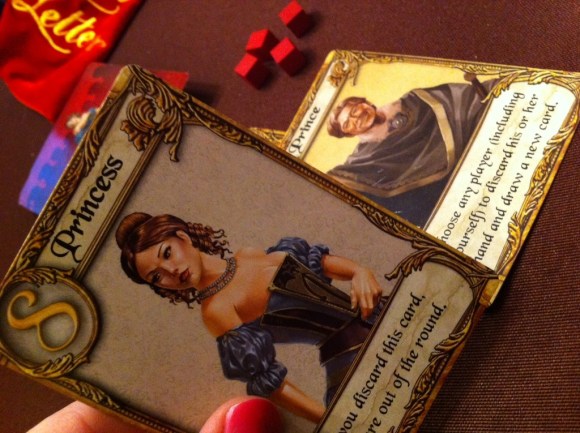
Love Letter

Divider


7. Rampage [aka Terror in Meeple City] (Antoine Bauza & Ludovic Maublanc, 2013; Repos Production)

For my final choice, what remains to be selected but yet another Antoine Bauza game? Furthermore, one that is about as far removed from a traditional modern designer board game as it is possible to get, whilst still retaining a board, power cards, and wooden meeples.

Unlike all of the other titles on this list which require strategy and brainwork, Rampage is all about dexterity. Taking on the role of city-smashing monsters, (up to) four players must systematically destroy the buildings and towers of Meeple City, topple all of the resident meeples and gobble them up, using a choice of four different actions: moving your monster (by ‘flicking’ its feet across the board), smashing a building (by dropping the wooden monster pawn onto a building), breathing toxic fumes (by resting chin on monster pawn and blowing buildings down) and by lobbing vehicles (by placing a wooden vehicle on top of the monster’s head and ‘flicking’ it into buildings or other monsters).

It’s a dazzlingly physical game, and the natural antidote to the tedious end of the cube-shunting Euro game genre. In Rampage, Bauza and Maublanc have created the ideal bridge between hardcore tabletop action and the family, party game. You can’t help but be engaged by Rampage, and get sucked into the sheer fun and lunacy of a very interactive, hands-on game that’s in full flight. The snobs may dismiss it as merely a sideshow, but once you’ve played it it’ll change your mind about how tabletop games can truly bring people together in laughter.

Rampage

Divider


So, there we have it. My top seven tabletop board games ever (or, at least, until some other awesome get released and bump some of these out of the charts). Mention should also go to some other games, which I list here for the sake of completeness:

Alhambra – Dirk Henn, 2003; Queen Games.

Thurn und Taxis  – Andreas & Karen Seyfarth, 2006; Hans im Glück.

Coloretto – Michael Schacht, 2003; Abacus Spiele.

Le Petit Prince: Fabrique-moi une Planète (The Little Prince: Make Me a Planet) – Antoine Bauza & Bruno Cathala, 2003; Ludonaute.

Splendor – Marc André, 2014; Space Cowboys.

Revolution! – Phillip duBarry, 2009; Steve Jackson Games.

[Zinar7]


Images from BoardGameGeek: (Carcassonne – Robert Hawkins; Takenoko – Johnathon Er; Agricola – Will McDonald; 7 Wonders – Babis Tsimoris; Tokaido – Henk Rolleman; Love Letter – Casey Lynn; Rampage – Henk Rolleman).

Tagged , , , , , , , , , ,