Author Archives: zinar7

friday_003

F003

On Wednesday, I resurrected an old friend and restarted the bi-weekly (ish) ritual of sitting down with a few friends and watching some crappy, cheesy, low-budget horror films. This used to a regular thing that we did a few years ago and many good times were had but, in more recent years, life sort of got in the way and we kind of forgot about it. Anyway, with the turn of the New Year, I felt it was time to shamble down to cemetary again and dig up the corpse of the magnificent ScareFest such that we may, once again, marvel at unconvincing acting, horrendous special “effects” and terrible storylines in the company of snacks, drinks and good friends.

The original idea was to establish a night dedicated to watching pairs of horror B-movies: one properly in the realm of Z-movie horror with crappy budgets; one relatively good one with a moderately bigger budget and fair critical acclaim. Such fun was kicked off on Wednesday with ScareFest #01: Dolls and Dogs, which married the low-budget Doll Graveyard with the minorly-higher-budget-but-still-not-a-huge-budget Dog Soliders. It turns out that both performed pretty much as expected; with much commentary on low-budget actors trying to ‘do’ the ‘acting’ thing, confusion as to why the back of the DVD box for Doll Graveyard recounts a completely different premise for the film than the one shown onscreen, and excitement at the appearance of Davos Seaworth from Game of Thrones as a Special Forces Captain in Dog Soliders.

Anyway, the proposed schedule for ScareFest: Season One is thus:

ScareFest #01: Dolls and Dogs
Doll Graveyard (Charles Band, 2005) and Dog Soldiers (Neil Marshall, 2002)

ScareFest #02: Creaturezoids
Creepozoids (David DeCoteau, 1987) and Feast (John Gulager, 2005)

ScareFest #03: Biohazard Detected
Spiders (Gary Jones, 2000) and The Rage (Robert Kurtzman, 2007)

ScareFest #04: You Had Me in Stitches
Skinned Deep (Gabriel Bartalos, 2004) and Stitches (Conor McMahon, 2012)

ScareFest #05: Cradle of Flesh
Cradle of Fear (Alex Chandon, 2001) and MindFlesh (Robert Pratten, 2008)

If you would like to join in the horror movie fun, then you are very welcome to – give me a shout or something and I’ll add you to the next event! Also, if you have any crappy B-movie suggestions then I’ll add them to the rota 😀

Anyway, onto less horror-film climes: today marks the start of #SotonGameJam, which is part of the Global Game Jam 2015; an initiative to have a whole bunch of people, scattered across the planet, to design a game (digital or tabletop) in 48 hours. The Southampton portion of #GGJ15 is being co-organised by a few people I know, and the jam itself will be happening all weekend in one of the computing labs at the University of Southampton. I don’t really know what my game will end up being about, but thinking about it has already sparked some ideas about designing some kind of card game that revolves about binary numbers and bit patterns – Of course, maybe that’ll go completely out the window when we learn the (as-yet unannounced) theme of #SotonGameJam, but it’s still exciting stuff and I’m mega looking forward to getting involved.

Whilst I’m clearly already getting excited about my next board game design project, it’s notable that I still haven’t gotten much further with my other game-design opus, Penny Black, since I last blogged about it – largely, I’m too scared to play-test it and discover its flaws, lest it shake my confidence in what my creative juices can help to lubricate. Like many artists, I’m often too much of a perfectionist to fully relinquish control of what creative output(s) I manage to spew forth and, likewise, am very sensitive to criticism (even If it’s constructive). I suppose that I should just fucking do it and set up a playtest night with a few friends to give it a try with four players, and see what happens. I’m not sure what I’m really scared of (perhaps it’s finding something game-breaking or fundamentally wrong with what I’ve dreamed up), but I trust the opinions – and compassion – of my tabletop friends not to completely slam it, so I really should just roll the dice, deal the cards and see what happens. Hey, who knows, maybe it’ll be really good? And hey, if it’s not, then the feedback will be constructive and make the game better and, maybe, somewhere along the line, something awesome might happen with it. You never know ‘til you try, do you?

On the subject of game dev that I’m totally taking undue credit for, this week Citizens of Earth came out on Steam and pretty much every console ever, and towards which I very minorly contributing by doing some beta-testing way back in 2014. I’ve not played the most recent build and haven’t played it all the way through (I was involving in bug-testing of the very early section of the story and in combat and stuff), but from what I was involved in, it looked exactly my kind of turn-based (J)RPG-type game and I’m heavily looking forward to actually giving it a bash. I didn’t delve into any code and I was mainly looking at playtesting and usability and in-game bugs/crashes, but it’s nice to feel like I helped to make it better in some way. I considered making a proper video game for #SotonGameJam, but my coding skills are totally not in prime physical fitness for making anything other than a very simple, turn-based/logical strategy-game-thing, and I figured that I could have more fun doing the same sort of thing in the physical realm (with cardboard tokens! And wooden cubes! And 3D-printed Cthulhu meeples!) anyway.

Anyway, I’d better get shiftin’; I’ve got game-jamming to do. Let’s get to it.

[Zinar7]

Tagged , , , , , ,

Special Delivery

SpecialDelivery

I’ve been playing a new game recently.

It’s called “When Will My Package Arrive?” and, for almost three weeks, I remained locked in battle with a deliveryperson from MyHermes in a conflict as old as time. But, after a rollercoaster of emotion and a tidal wave of confusion, the battle is finally over.


The game had been going on for over three weeks, ever since I ordered a package from Ebay not long after Christmas from a very pleasant Man in The North. However, despite the best efforts of The Man in The North, my beautiful parcel-child seemed destined never to materialise at my doorstep due to an array of factors that I’m still yet to comprehend. Like many of the problems that exist in my life, the source of bother was board game-related; although, unlike most of said board game-based problems (i.e. that I don’t have enough), it was one caused mainly by the wrath of the Gods themselves.

This all started on Christmas Day 2014, when I decided to try and remedy the ailment of ‘Not Receiving Any New Board Games For Xmas’-itis by picking up a copy of the third expansion to Dirk Henn’s Alhambra from Ebay because, by happy coincidence, someone (the aforementioned ‘The Man in The North’) was selling a German copy of the expansion and I need a version of it in German so that it fits in with my German copy of the original Alhambra game. So far, so straightforward.

Fast-forward a few days, and it’s New Year’s Eve 2014 and I’ve popped out at lunchtime to go and grab some food and coffee. Upon my return, I discover a ‘Sorry I Missed You’ card from the MyHermes person waiting for me, jammed in the metal shrouding surrounding the buzzer system to my block of flats. The truth is, I wasn’t expecting my package to arrive so soon (estimated delivery placed it at around the 4th-10th of January), and so had I known there was a chance of it arriving then I would’ve probably stayed in to receive it. Never mind, though; surely they would try again on the next working day to bring me my package, and I’d soon be whisking myself to Gametown to build my Alhambra with a few friends.

Alas, the next working day was New Year’s Day 2015; a national holiday in the UK. Friday came and went without an appearance from my package [snigger], and the weekend proved equally fruitless. With the coming of Monday, though, I felt sure that the days of my package being neglected [snigger] were numbered and that I would soon be fondling my package [snigger] in the comfort of my own home.

However, Monsieur/Madame Hermés seemed to have a difficult time in finding my house. Despite the fact that they had found it successfully once, I discovered that they had a penchant for listing the parcel as ‘Out for Delivery’ on the MyHermes tracking facility, but never coming to my flat to attempt delivery. Quite naturally, I took to social media to express my frustration, in an open letter:

Dear MyHermes delivery person,

I don’t wish to tell you how to do your job or nothin’, but I think you’ll find that the easiest way of actually delivering my package is to just come to my house and give it to me, rather than listing it as ‘Out for Delivery’ each day and then not bothering to come anywhere near my flat.

I know that it’s likely not that big or bulky, but it’s still going to get pretty boring to see that same package in the back of your van every day. Plus, think of the pennies of fuel consumption and tyre wear you’ll save by it not being in there and having a van that’s 250g lighter.

I appreciate that my package probably hasn’t seen enough of the world, and that you’re doing a sterling job of driving it around and letting it see the sights of Southampton – I imagine the postcards of its exciting trips to St. Mary’s, Millbrook and perhaps even Chandler’s Ford will be something to show the grandchildren.

Perhaps it is simply that you have forgotten where I live, and can’t remember where you were supposed to be bringing my package to after it’d been on its round-the-world adventures. An easy mistake, we all do it sometimes. If that was the case, if you look on the back of my package, there should be – somewhere – a little tracking device called ‘An Address’ that you pop into this thing called ‘A Map’ and where it tells you where my flat is.

I know that that’s not as fun as playing ‘Hot or Cold’ with my package as you drive around Southampton for days on end, trying to get closer to ‘Warm’, but my package is late for his tea and he’s got school in the morning so it’s probably best that he come home now and do all his homework and everything. If you’re having trouble convincing him, tell him his mum said that if he comes home now then he can stay up for another hour and watch another episode of “Monsoon Poultry Hospital” as a special treat.

Anyway, sorry to bother you, hope to see you soon,

Si x

A day or so then passes before I once again remember to check the MyHermes tracking service, and realise that the courier had apparently tried to come round earlier in the day whilst I was briefly out meeting a friend for lunch. Confusingly, the MyHermes tracker lists as being “Not Del’d – 3rd and Final Attempt” (despite it being only the second try) and, even more confusingly, neither did the courier leave a ‘Sorry I Missed You’ card (nor on the imaginary second delivery attempt) so there was no way of contacting the deliveryperson to re-arrange the delivery for a more convenient time or to arrange to collect it myself from somewhere.

Because it’s fairly usual in these circumstances (after, say, 3 deliveries have been attempted to no avail) for the parcel to be returned to the sender, I leapt onto Ebay to message The Man in The North in order to explain the problem and to let me know if/when it turned up at his house so that we could re-arrange a different way of delivery. Speaking to His People™, he was informed that the parcel was – once again – listed as ‘Out for Delivery’ that day, and that I should wait and see if it turned up that day.

I waited in all of that day. I did not leave the house.

Granted, at one point I put one foot outside of my back door to lean out to see if there was someone in the car park because I’d heard a van and wondered if Captain(ess) Hermes had appeared but the door buzzer hadn’t worked for some reason [SPOILERS: they hadn’t]. But no, I waited in all day; driving myself slightly mental and paranoid in the process. And no-one came.

Nor did they come the next day. Or the next day. Or the next day after that.

“This is it,” I thought. “All is Lost.” Gone forever. Swallowed into the void. Fallen over the precipice. I would never see my beautiful package again. I would never know its loving caress. With a tear dribbling down my cheek, I wrote to The Man in The North, explaining that the fruits of our union would never be savoured, and that it was likely that our charming offspring would probably be returned to his address. Since The Man in the North was a lovely man, he immediately refunded my PayPal payment, and promised that he would re-arrange another delivery (via a more reliable carrier) once it turned up with him again.

It was with immense surprise, then, that I returned from a brief shopping trip yesterday afternoon to find a “Sorry I Missed You” card from Hermes, apparently from a driver called ‘Andy’. Was I dreaming? Was this merely a hallucination? Was there going to be a happy ending after all?

Well: this lunchtime, ‘Andy’ dropped by again with a sparkling blue package nestled in his grasp. There was no fanfare; no chorus of angels. I looked to the sky, in case a beacon of light was deigned to shine down from the heavens, but I didn’t see one. Perhaps the Gods had forgotten to set their alarms. ‘Andy’ and I stood, staring at each other, in the rain outside my front door. Looking in each other’s eyes, we both knew that we had found each other. The harsh reality of the modern world may place many obstacles in the way of progress but, in the words of the great Dr. Ian Malcolm: “Life, uh, finds a way.”

Out of the darkness, my package had burst forth, bringing light and hope to hitherto black corners of existence. As I cradled my long-lost package in my arms, the tear once again materialised on my cheek and I felt my lips tremble like the legs of a baby deer as it struggles, hopelessly, to open the blister packaging of a new Black & Decker cordless drill.

“Thank you,” I whispered.

And, in that moment, we both knew that everything would now, forever, be all right. The game might now be over, but a spiritual connection would forever exist between the both of us; a product of our combined journey and our growth as people. With nary a parting word or goodbye embrace, we went our separate ways; destined for diverging paths but always retaining the memories of our beautiful game.

We entered the arena as but footsoldiers, but left as generals. Let’s hope we never have to do battle again.

[Zinar7]

Tagged , , ,

friday_002

F002

I’m a strange collection of parts.

I don’t mean physically; although, you’d not be entirely wrong if you thought of me as a sack of mis-shapen, incongruent limbs through together in same geographical location and fixed together with sticky tape and drawing pins. I mean, in terms of the various aspects of things that I enjoy or which send a buzzing, electrical signal through my body. I suppose, if you conducted the same process of dissection on anyone, you’d find the same broadness of interests and thoughts that inhabit my own flesh and blood…yet somehow, though, I often feel like I’m a bizarre conglomeration of passions and hobbies that don’t often go naturally together, and which I sometimes feel don’t match up with most people that I know.

For instance, I’m a music hound and devour music of all shapes and sizes over a vast array of genres and styles: I have extreme fondness for such diametrically-opposed acts as Cradle of Filth and Ke$ha; chiptune to classical. But then, I’m hugely into movies and cinema, and games of all sizes from digital to tabletop. And then, I’m massively into motorsport: Formula One, touring cars and rallying. And what about the other things that I enjoy, like photography and reading and collecting and eating and and and ? My problem is that I’m literally insane with curiosity about most things in the world, and I have a yet bigger problem in coming to terms with the fact that I cannot do everything.

Thinking about all this sort of makes my brain hurt.

Thinking about all this, though, does make me question how well I ‘fit’ into the world within my arms’ reach, and the people in it. Of course, I have friends that enjoy the same things that I do; at least, aspects of the same things that I do – I have some friends with which I share musical interests; others with which I share passion for motor racing, and others that I discuss cinema and television with at length. Then again, I have friends with which I share very few interests, but get on with very well because we’re similar people or share mutual sense(s) or humour(s). But when I’m meeting new people – particularly those that I would like to make friends with because I respect or are attracted to them – I often feel like I’m an aloof, nervous weirdo that has little in common with Joe or Janet Everyperson.

When people ask me what I do for a living, invariably they respond with something like “Woah, that’s really cool!” and are impressed when I explain that I have a Ph.D in something so awesome as ‘space stuff’. I’m often embarrassed to tell people what I do, in case it makes them build up a picture of ‘me’ that isn’t accurate; that I’m some high-functioning android that’s super-intelligent, or that I am actually a character from The Big Bang Theory. I’m just a regular guy that got lucky with genes and opportunities; not someone that was always built for success. I want people to like me for me, not just for being impressed by the letters after my name or for the career that I’ve lucked into. In any case, I tend to find that other people’s lives and careers are far more interesting than my own, even if my day job is essentially building spaceships for a living.

I get it – I’m a geek. The hobbies that I tend to have the strongest passion(s) for are those that perhaps aren’t the most common or accepted among twenty-something lads and lasses: sure, everyone likes music but most people won’t have heard of the kind of bands I like; there’s no-one these days that doesn’t play video games to some extent, but the ones I enjoy are the more aloof, artful, interesting ones with complex storylines or mechanics and not Call of Duty or Angry Birds. It’s not like I chose to ignore the mainstream: I’m quite happy with many things in the mainstream and don’t feel any urge to condescend on anything that’s socially popular; I just like to appreciate the things outside of it as well.

In short: yes, I enjoy the cinematic works of Sidney Lumet, Akira Kurosawa and Werner Herzog, but I also like watching Clerks II and Dumb and Dumber and Transformers.

The end result, though, is that I feel like I need to try too hard in order to demonstrate the existence of a connection between myself and others, and tend to get disheartened when there’s not an overlap. Perhaps that’s because I feel slightly ashamed that I’m slightly different and have my own, unique interests and ideas; perhaps because I’ve always been on the outside of popular friend groups and have therefore always felt that I was at fault, or that there was something wrong with me. Hence, I’m always nervous and quiet around new people because I assume that they’re going to be judging me and rating me and marking me according to some list of mythical criteria that governs whether they will let me be their friend or not. Invariably they are not (because, in general, People™ are not so fickle) and, in actual fact, would probably prefer that I emerge from my chrysalis in order to reveal the beautiful butterfly that lies beneath.

SPOILERS: I am not a beautiful butterfly, but thanks for asking.

The reality is: I’m far too much of a gangly, awkward, over-analysing bundle of wires to ever truly relax in front of anyone that’s not already an established, close friend that won’t misinterpret my weird sense of humour or judge me for my unconventional interests and facets. Despite all this, I’m a far more confident, ballistic person than I ever used to be and I imagine my trajectory in this manner will, evermore, continue climbing; even if there are often fluctuations about the mean, and that I may never truly reach the summit. But I’ll keep trying, keep evolving, and maybe one day I’ll be comfortable in my own, weird skin. Maybe.

So, dear friends: yes, I’m a weirdo. But if you’ll let me, I’ll be your weirdo.

[Zinar7]

Tagged ,

Sinister Reviews #14: Gabriel Knight – Sins of the Fathers

GKSotF

Genre: Point-and-Click Adventure
Platform: PC (version tested), Mac
Release Date: October 2014 remake
Developer: Pinkerton Road Studios
Publisher: Phoenix Online Studios

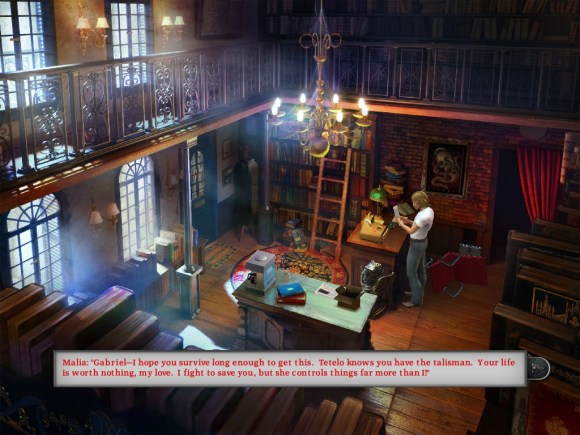
I missed Gabriel Knight: Sins of the Fathers (GKSotF) the first time around. Y’see, I was always a LucasArts brand of adventure-hound rather than a Sierra one; craving the comedy adventures in the vein of Monkey Island, Grim Fandango and Full Throttle (along with other, non-LucasArts games like Simon the Sorceror and Broken Sword) rather than more serious titles, like Gabriel Knight. However, since 2014 marked the twentieth anniversary of GKSotF’s release and saw release of an anniversary remake by Pinkerton Road Studios, the time seemed as good as any to leap into the world of Gabriel Knight and his roguish brand of amateur crime-solving.

GabrielKnight_1

Jane Jensen’s Gabriel Knight series still remains a heralded classic in the point-and-click canon, touching upon a tale of murder-mystery stuffed with conspiratorial happenings, secret voodoo cults and suspicious events. The titular Mr. Knight is a brash, book shop-owning novelist from New Orleans, who becomes increasingly involved in police investigation of a case known as the Voodoo Murders through his friend Detective Moseley, before getting in far over his head. Over the course of ten game-days, the player must manoeuvre Knight around various scenes and locales of New Orleans (and, later, Germany and Africa); examining objects, harassing the townsfolk and using objects with other objects in the time-honoured point-and-click fashion. However, what sets GKSotF aside from the average is Jensen’s superb narrative: where my childhood adventuring through the LucasArts catalogue mainly stroked the soft underbelly of light-hearted storylines and comedic set-pieces, GKSotF tackles far more dense subject matter; a true crime thriller, with its fair share of grisly crimes and decidedly ‘grown-up’ themes. It’s reminiscent of a page-turning detective novel, with some excellent story pacing and an array of suspicious characters all, inevitably, involved in a complex web of mystery that maintains a respectable level of tension throughout the experience.

A key part of maintaining this atmosphere lies in the engaging, well-balanced, puzzle design. While some puzzles will have you scratching head for a while, they rarely feel unsolvable; yet, never facile, either. Solutions are never made too obvious (nor is the player ever steered toward them using petty hand-holding), yet pose a median level of difficulty that don’t challenge either the player’s intelligence or stupidity. Furthermore, the puzzles all maintain relevance to the ongoing storyline and police/spiritual investigation, meaning that the game largely doesn’t feel padded out with extraneous hoop-jumping or completely bizarre, shoehorned puzzles. To my knowledge, there was only one occasion where I hit a puzzle that I would never, ever have solved without the hint system (spoilers: it was the exact wording for what I was supposed to write on the tomb wall in the voodoo code) and, of course, the ‘engage with the mime’ puzzle near the beginning of the game is possibly the most tedious puzzle that I’ve ever encountered in an adventure game, but we all make mistakes.

GabrielKnight_2

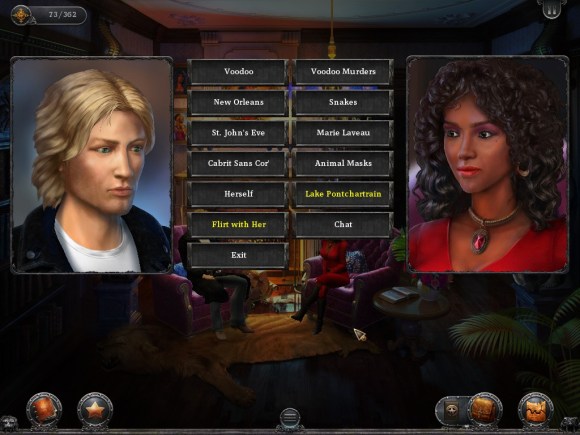
GKSotF should also be commended for not relying too much on the adventure games staple of constant back-and-forth between characters or scenes to progress the action; not that engagement with NPCs feels too much like a chore. Aside from the game’s abrasive voiced narration (which, thankfully, it is possible to mute), voice acting varies from ‘really good’ to merely just ‘acceptable’, and the initially-tedious dialogue animations certainly endear and lose their irritation. Dialogue trees are also well-constructed to avoid too much repetition and deliver the ongoing narrative in a focused, natural way. In this respect, the presence of a physical narrator of Gabriel’s actions feels like an alien concept (at least when compared to the LucasArts style of having the main character comment, narrate and break the fourth wall) since it disengages the player from Gabriel himself, but adds to the feeling of being involved in a detective serial or TV movie. Pretty much all of the dialogue, scenery and storyline are – I’m led to believe – faithfully recreated from the 1993 original version of Gabriel Knight: Sins of the Fathers (except now rendered in prettier high-definition graphics and cut-scenes) and it’s satisfying to find that GKSotF has aged commendably in the intervening two decades.

In general, the updated character models are well-rendered; faithfully-recreated scenes are packed with prettiness to look at and it all represents a fairly solid modern take on Gabriel Knight: Sins of the Fathers. If there’s a weakness in the visual and atmospheric update, it’s in the game engine – the commitment to re-drawing scenes from the original leads to the limiting decision to use high-definition, 2D backgrounds with 3-D Unity-driven character models walking overtop, rather than fully-3D scenes. 99% of the time this raises no issues, but occasionally presents unfortunate graphical glitches and evidence that the gameworld is merely a 2D plane with characters pacing around atop a stationary texture. It’s not a game-breaker, but merely leads you to occasionally feel like you’re playing an adventure game version of The Sims.

[FYI, if you want to get hold of the original version of GKSotF, then head over to GOG.com]

GabrielKnight_3

But, I’m nitpicking: the fact that you notice such mild gremlins and glitches is simply because the rest of GKSotF is so solid and enjoyable. Sure, the storyline drifts off a little in the last third – away from the more interesting ‘police’-type investigation and toward a more linear path of “do this, then do this, then do this”, which feels just a teeny bit padded out – but it’s because the majority of the game feels so well-paced and –balanced in terms of both narrative and gameplay.

In truth, I was expecting to be a little disappointed by Gabriel Knight: Sins of the Fathers. My curiosity had been piqued by Yahztee & Gabe’s playthrough of the first hour or so on Let’s Drown Out, and I’d expected to be mildly engaged by the storyline but to find fault with the game’s mechanics and object/NPC interaction. Imagine my pleasant surprise, then, to discover that it’s one of the best adventure games that I’ve played in recent years. Despite a few flaws, it’s still a masterclass in adventure game design and well worth a visit for the narrative exposition alone. Perhaps it’s testament to the forward-thinking innovation of the original, or the persistence of the point-and-click genre in being stuck in the mid-Nineties, but if ever there were a time to discover the world of Gabriel Knight (or perhaps just revisit it), then it’s now.

[Zinar7]

Tagged , , , ,

friday_001

F001

I used to keep a regular, daily (ish) blog back in 2004-2008ish over at the almighty LiveJournal. In it, I would write down all sorts of random rubbish that would help vacate my brain of all the useless junk that clutters it up on a day-to-day basis.

I thought that I would resurrect that ethos for the year 2015, and maintain some sort of Friday Blog thing where I can just talk about random stuff that I’ve seen or played or done over the week, rant about the Star Wars prequels and salivate over board games that I want to buy but can’t afford. I’ll jot down things during the week and/or blog down little sections each day, and then collect them all into a Friday Blog (inspired by Friedemann Friese’s Friday project) which summarises some of the things that are going on in my own little world. Basically, it’ll just be a little catalogue of whatever’s hitting my brain at the time and what’s important to me.

Since this is the first proper Friday of 2015 (the last one doesn’t count since it only had a day to get prepared, and it sort of overslept), here is Friday_001. Let’s get shifting.


So: 2015, then. For all kinds of reasons, 2014 was a bit of a strange year. Lots of things happened across it; both good, and bad. The climax of the year sparked in me a noble goal of making the best of 2015 and for creating some sort of fresh start; at least, mentally. 2014 was plagued with a variety of struggles and stresses, and so I vowed to make the new year one in which struggle and stress would be minimised, if not eradicated. I see it as an opportunity to make myself a better person – not materially, or in terms of who I socialise with or who is in my life, but as a chance to align myself more closely to the ‘me’ that I’d like to be; better at keeping in touch with people, less susceptible to procrastination, resistant to worry. Simon 3.0, if you will.

I suppose that the success of this endeavour will only become measurable over time, but hopefully it will be measurable, eventually. 2015 marks the beginning of a variety of new journeys for me, so the time is as good as any to embark on a fresh page of ‘me’ and to decouple the feelings, troubles & regrets of the past from the adventures of the future. Too often, I’m my own harshest critic and will chastise myself far harder for my mistakes than I would do for literally anyone else in the world. Well, Twenty-One-Five is my chance to be 100% more awesome and 100% less rubbish, and those aren’t just hollow words. This calendar year will be one in which I cross over the threshold into my fourth decade, and so naturally it lends itself to a convenient excuse to let go of the past and its plethora errors & regrets to think only of the positives that the future will hold. I’m by no means a perfect person, but – again, perhaps with time – I can finally approach the asymptote of the well-rounded, mentally-strong, good person that I strive to be.

So yeah, my Resolutions for 2015 are generally just: be better at stuff; spend less money; eat less crap. Y’know, all the normal stuff that people resolve to do in the New Year, but with a genuine sense of incremental, noticeable change. Simon 2.0 was a solid release but still had a few bugs; Simon 3.0 aims to ship with fewer glitches, more documentation and better usability. Let’s crack on.


Anyway, that’s enough boring talk. What else in new in January?

Well, I’m horribly addicted to board games again. Those people that know me will say: “But…you’re always horribly addicted to board games!” Yes, this is true. I think it’s just amplified at the moment because [a] I’m in between jobs and therefore have a heck of a lot of time to think about them; [b] I’ve still got a bunch of new-ish ones on my shelves that I still haven’t played but would like to; and [c] I’m in the process of designing my own (Penny Black) that my brain is constantly being bombarded with new ideas and potential mechanics to introduce to the game. Furthermore, one of my best friends in Southampton has also just picked up the ‘designer board games’ virus (albeit, from me) and hence we’re spending much time and conversation in playing, and talking about what we want to play next.

Just before Xmas, I picked up Camel Up at Dave’s Comic Shop in Brighton, and it’s badass: not sure yet how it’ll stand up to repeated plays, but it certainly seems to be fun so far. In the pre-Xmas sales I bought The Witches: A Discworld Game and, only yesterday, put in an order for Stefan Feld’s lightweight strategy game La Isla; which is about searching for rare and exotic animals on a newly-discovered isolated island. Put this in the context of the other games that I own but still haven’t played in anger (Lewis and Clark: The Expedition, Asgard, Jamaica, Shipwrights of the North Sea, The Lord of the Rings) and those that I want to break out again (Village, Priests of Ra, Vasco da Gama), and I’m a bit wrapped up in the cardboard world at the moment.

Which reminds me: I would quite like to go to SPIEL ’15 in Essen this year.  Please?

Furthermore, I’m well back into the swing of point-and-click adventure games again. They’ve come and gone in my life, but always been a staple of my most memorable gaming experiences. After a bit of a false start this time last year (I only managed one; in Indiana Jones and the Last Crusade: The Graphic Adventure), I’m vowing to get back into both adventure gaming and video game reviews; starting with the highly enjoyable 20th Anniversary Edition of Gabriel Knight: Sins of the Fathers. In my ample spare time recently I’ve been drafting a review summary, penning some of my thoughts about the game and its comparative ‘good’ and ‘bad’ points. Hopefully it’ll materialise on here at some point in the next week or so.

Anyway, that’s probably enough words for now. Friday_001 is finished; in time, Friday_002 will rise to take its place. All power to the Friday.

[Zinar7]

Tagged , ,

Penny Black: Dev Update #1

PennyBlack_1

For those that aren’t aware, I’ve been working on a board game. It’s been boiling around in my head since May or so; where it initially saw a great flurry of activity but, due to various other things, kind of got put on the backburner until a few weeks ago. However, in the last month I’ve focussed more time on it and into getting it to a position where I (and perhaps a group of friends) might be able to actually give it a try. Hooray!

The title of the game is Penny Black, which some of you might recognise as the name of the world’s first postage stamp designed by Sir Rowland Hill in 1840 for the Royal Mail. As you can therefore imagine, Penny Black is themed around a fictional Post Office; not in Victorian England but in the fictional Republic of Sinestria. So, what’s it all about? 

PB1


SUMMARYPenny Black is a strategy board game with a postal theme. Players take the roles of trainee sorting-office workers in the Mighty Republic of Sinestria, where the postal system has recently been introduced. In this role, players compete to serve customers, stamp their letters and process them into the Post-Bot’s mailbag in order deliver these to the intended recipients and earn points. However, the citizens of Sinestria are sceptical of this new postal system, and players will need to meet their various demands and expectations in order to secure the success of the Sinestria Republic Post.

The more letters that are picked up and delivered, the more trust players will acquire from the public (measured in terms of Victory Points) and, at the end of 7 days of training, the performance of the new trainees will be rigorously assessed. If players misplace letters or deliver them late, they will lose trust from the public. Furthermore, fellow players will be aiming to hinder each other or engage in outright sabotage, so players must maintain awareness of the competition.

Due to a malfunction, the Stamp Machine does not output the correct stamps but instead spews them out randomly onto the Sorting Office counter. Players will need to collect the correct stamps, pick the most viable customer letters, and make sure that they are in the Post-Bot’s mailbag at the correct time in order to score Victory Points.

The Chief of Post for the Government of Sinestria has vowed to permanently hire the most successful worker to be elevated to the position of Post-Office Manager, a highly respected position, based on players’ performance in efficiently collecting stamps, sorting letters and getting them into the mailbag at the correct time.

Divider

I’ve just reached a point of having the rules for v0.1 of Penny Black pretty much shaped up and written down. I’m yet to get round to playtesting, but I’ll look into doing so at some point over the Xmas period. If you would like to know what the hell Penny Black is all about (and, indeed, what the hell I’m talking about during the rest of this post), then a .PDF of the rules is here:

PennyBlack_v0.1 (December 2014, .pdf)


DISCUSSIONThe main concept of Penny Black is similar to a number of games that require collection of tiles/resources in order to purchase other cards, which require a varying combination of resources – these include titles like Unexpected Treasures (by Friedemann Friese) and Felinia (by Michael Schacht). In Penny Black, these, purchased, cards must then be redeemed by placing them in the mailbag at the appropriate time (and in competition with other players who are looking to do the same, perhaps with some amount of skulduggery) in order to score points.

Hopefully what is unique about Penny Black, when compared to other games based on collecting stuff and using it to buy other stuff (even so far as Alhambra by Dirk Henn), is that there is a ‘timing’ aspect to having the right things at the right time, and in the right place: the mechanic of having a semi-random method of dictating when a letter delivery takes place (defined by a dice roll which may mean that the Post-Bot moves at a steady 1-step pace [most likely], a rapid 2-step pace or does not move at all [least likely]) means that there is, hopefully, unpredictability as to when points are scored; wrestling complete control from the players and adding more tension along with incentive for skullduggery. The unpredictability of what exact delivery conditions (i.e. what earns bonus points for players when a delivery happens) also, hopefully, adds to the variation between games and leaves players guessing as to what will earn them points.

PB2

The main method of how players collect stamps is one of the key parts of Penny Black that I still don’t yet have a solid ‘feel’ for. I expect that over various iterations of the game, how stamps are collected by players will likely evolve a bit; perhaps taking cues from other games. For example, Felinia lets you collect similar tiles based on a ‘bidding’/market system, although this requires application of some sort of currency system which would add extra complexity to the game. I thought about some sort of worker-placement mechanic, but this seemed like an overly elaborate way of simply collecting resources. Maybe I’ll look into playing other games with similar mechanics, and see if there’s anything I can borrow or adapt if the current mechanic doesn’t feel quite ‘right’.

In the first iteration of Penny Black, the mechanic to collect tiles is largely similar to that of Ticket to Ride (by Alan R. Moon), yet with some similarities with Splendor (by Marc André): there is a general pool of stamp tiles, drawn randomly from a bag, that occupy six stamp spaces on the game board. On a turn, players may choose an action to activate the Stamp Machine, which re-fills any empty stamp spaces (left empty after previous players have taken stamps), and then choose three stamps to take from the available pool. Players may hold seven stamp tiles at a time. From their collection, players then trade the correct stamps with those depicted on an available customer letter in order to ‘stamp’ it and to prepare it for delivery, or use certain combinations of their stamps to influence the motions of the Post-Bot to speed up or slow down the time until delivery, or to kick out another player’s letter from the mailbag and replace it with one of their own. Yes, I know the Post-Bot is currently R2D2, shut up.

PB3

Another aspect that isn’t currently in place in Penny Black is the concept of having ‘special’ stamp cards. In addition to the way that basic stamp tiles are drawn from the bag and players may pick from them, I’m toying with the idea of having additional stamp cards that either allow a player to use them as any individual stamp, or perhaps as a double-stamp of a single colour. Further to this, something that isn’t yet fully-formed in my head is the method by which the Post-Bot either adds incentive (or penalises players) when it has reached the end of the Delivery Track yet the mailbag is not sufficiently prepared. It might be that an elegant way of killing both birds with a single stone would be to have the Post-Bot give special ‘one-shot’ stamp cards to all players that succeed in delivering a letter; although I’m aware that this might leave certain things overpowered, or lead to situations with runaway winners. In the current iteration (v0.1) of Penny Black there’s no facility for this yet, but it might be worth considering in a later iteration to see how it works. Certainly, I feel like a technique whereby players are rewarded for putting letters in the mailbag (not necessarily just for delivering them) could be an option; which might be as simple as taking a stamp tile from the available stamps on the Sorting Office Counter.

Divider

So, in a nutshell, that’s Penny Black. Of course, it’s going to take a lot more shaping up and refining before it’s something that could potentially be released to the outside world but, even at this very early stage, I’m bloody proud of how far I’ve gotten with it.

The next stage, really, is to test the game with some actual play. After I’ve fiddling with it myself and an imaginary table of gamers, I’m going to look into recruiting a few friends to giving it a go and providing some feedback on the game (in addition to identifying the glaring holes or errors in design). With a game like this that will require a significant amount of balancing in terms of how many points successful deliveries should be worth, how long there should be between deliveries, how easy or hard it is to collect the right stamps and purchase letters, etc. I feel that there will be a lot of tweaking necessary to weigh out the game so that it brings a balanced atmosphere. I’m intending on documenting the progress fairly methodically to establish what’s working and what’s not, so expect more posts in this series on the continuing development of the game and my thoughts on it.

If you’ve got ideas on thoughts on the status of Penny Black, then I’d love to hear what you think. Hey, maybe it inspires you to think about designing your own game; or just creativity in general. If I can spark some imagination surrounding interesting board game themes or creativity, then that’d be awesome.

[Zinar7]

Tagged , ,

Sinister Sevens: Designer Board Games

BoardGamesSevens

I admit it; I’m a desperate, ravenous tabletop board gamer. This frenzy has been sweeping over me for many years now, but it’s only within the last 3-4 that it’s truly taken over every sense and synapse, and led to full-on obsession.

Since I’ve been a kid, I’ve absorbed myself in games: both console and tabletop. Whilst most of my intervening years have been dominated by video games, the recent resurgence of family-based, tabletop strategy board games in the last decade has led to Euro-style physical games falling evermore into the mainstream and many games store being drowned in an avalanche of high-quality wooden pieces and plastic/linen cards; and, consequently, my living room.

In tribute to this passion, then, I’m going to run down my favourite seven games on the market and detail a little bit about why they mean so much to me. Perhaps, through my amateurish words, I can inspire yet more people to absorb themselves in my rampaging hobby. Let’s go for it.

Divider


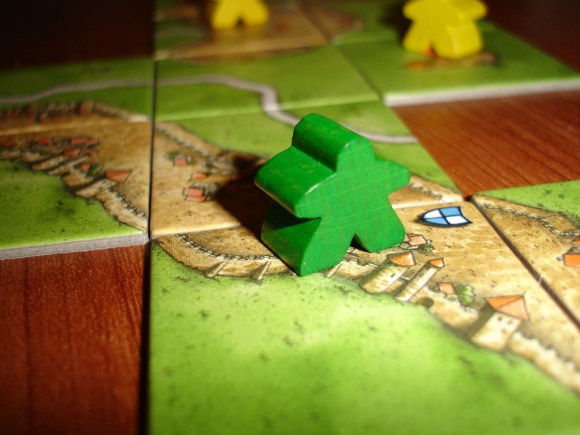
1. Carcassonne (Klaus-Jürgen Wrede, 2000; published by Hans in Glück)

In almost every respect, Carcassonne is my favourite tabletop game of all time, and that will likely never change. Dismissed by some as simply a gateway game offering passage to more complex titles, one should not confuse simplicity and elegance with adolescence. A tale of tiles, Carcassonne revolves around drawing land pieces at random, placing them on an ever-expanding ‘board’, and assigning miniature wooden people (“meeples”) to be knights, farmers, robbers and priests to score points for your growing empire. However, other players are aiming to do the same, and will interfere with your progress; either by trying to steal cities, roads and farms from your possession, or placing tiles inconveniently to block your developments.

Whilst the main game mechanic opens up a significant of luck (coming down to the tile you draw on your turn), you rarely feel completely at the mercy of misfortune and there is still plenty of opportunity for backstabbing and hindering of other players, even if you continually draw unhelpful tiles. Despite the compactness of the base version of Carcassonne, there’s also a supreme amount of expansion available to elaborate on the vanilla game if you so wish, with new features and expansion sets still regularly being released.

It may be passé to claim adoration of such a simple or ‘plain’ game in a world of complex titles but, to be honest, I’m having so much fun that I couldn’t care less.
Carcassonne

Divider


2. Takenoko (Antoine Bauza, 2011; Asmodee)

A modern classic (ish) by Antoine Bauza, Takenoko, to me, is known by only one name: Pandas.

Pandas is…a difficult game to describe: it has elements of tile-placement, hidden goals and random interference, yet fits ideally into none of these formats. The primary success of Pandas, though, lies in it daring to be different. From theme to mechanics to player engagement, it feels fresh; unburdened by restrictive gaming customs, and bringing something genuinely ‘new’ to the table (pun intended). Players build an expanding bamboo field, tended by a moving gardener and devoured by a roaming panda, aiming to complete ‘goal’ cards that are based on varying conditions. Complete seven goal cards, and it’s the end of the game.

The game is superb for player interaction, with an expanding playing area upon which bamboo pieces grow on on irrigated field tiles, and the unhelpful movements and culinary habits of the eponymous panda can destroy your finely-honed bamboo field whilst benefitting someone else. A further bonus to the main mechanics are the wonderful design strokes and charming artwork: delightfully colourful playing pieces, tiles bamboo pieces being lovely to both sight and touch, and cartoon-like miniatures representing the roving panda and gardener. Takenoko is a triumph, and one that I would introduce to any gaming environment; an entertaining romp for both newbies and seasoned gamers alike. Pandas!

Takenoko

Divider


3. Agricola (Uwe Rosenberg, 2007; Lookout Games)

Agricola is a behemoth in the tabletop world; both in influence/acclaim and its actual, physical bulk. A game about the driest of the dry (farming in the 17th Century), it’s a heavy worker-placement game played over thirteen turns where you can do never do everything you’d like to, and compromise is the order of the day. Since its release, it’s been acclaimed as one of the greatest modern designer board games, routinely holding position near the summit of BoardGameGeek’s top 100 games. However, it’s totally an experience that takes time to drink in and appreciate; perhaps one reason why it never won Spiel des Jahres upon its release, but instead was given a special prize as “Best Complex Game”. Certainly, I don’t feel that I’ve spent enough time with Agricola to come anywhere near truly mastering its art but, one day, I will and that will be a glorious epiphany.

There’s an outstanding amount of range and variability that can be present between successive plays, thanks to huge decks of cards that dictate what occupations can be taken on and what farm improvements can be built – make no bones about it, this is a delightfully complex game that rewards those who explore every aspect, think logically and react to changing circumstances. It can be mightily brutal though, too: making sure you can feed your family, when there are a bunch of other things that you’d like to do too, can be a heartbreaking decision.

In Misery Farm, everyone dies.

Agricola

Divider


4. 7 Wonders (Antoine Bauza, 2010; Repos Production)

As is probably becoming clear from my selections for this list, I totally have a soft spot for games designed by Antoine Bauza. To date, 7 Wonders is probably his most acclaimed game title, winning the Kennerspiel award at Spiel des Jahres 2011 for “best complex game”, and there’s a valid reason for that. It’s wonderfully put-together and crafted, with simple (concurrent) turn mechanics, fast & engaging player interactions and lovely artwork; making each player’s (of which there may be up to seven, or eight with the ‘Cities’ expansion) process of building a Wonder of the ancient world an absolute pleasure.

It’s rapidly quick; the concurrent turn order keeping things active and away from tedious Analysis Paralysis (AP); and the points salad options for points-scoring means that there’s plenty to think about in each turn/round/game. Spread over three Ages, in each one players begin with a hand of (n + 1) cards; taking one and playing it, then passing the hand to their neighbour, whereby the process continues until all cards are played. Players must build up resources, use them to construct cities with marketplaces, cultural focal points, commerce, military strength and, of course, their individual Wonder.

It’s elegant in every conceivable way, short in terms but not in terms of complexity, and with a heap of replayability that makes it a great choice for a medium-weight ‘filler’ game that makes city-building an absolute delight.

7 Wonders

Divider


5. Tokaido (Antoine Bauza, 2012; Funforge)

Tokaido is, categorically, the prettiest designer board game ever designed (FYI: the Kickstarter collector’s edition is even more a delight), for which we have Xavier Gueniffey Durin to thank. Yes, it’s yet another Antoine Bauza title in this seven-strong list, but it accurately typifies his penchant for deriving completely novel themes and abstract (yet sensible) game mechanics, as players take on the role of Dynasty-era travellers migrating up the eponymous Tokaido Road on Japan’s coast; visiting picturesque view, hot springs and teahouses, and meeting a swathe of friendly characters and merchants.

In essence, it’s a ‘race’ game, but one which is full of charm and quirks – players cannot occupy the same ‘spot’ and the rearmost player always moves, therefore compromise must be made as to whether to jump ahead to guarantee visit to special locations, or to maximise visits by moving to the next available space. Points are awarded based on a variety of goals, with a ‘Points Salad’ approach allowing players to tackle different strategies (focussing, perhaps, on visiting particular locations or collecting certain souvenirs) and to react to other players’ circumstances. The fact that this is wrapped up in the most aesthetically-pleasing artwork is, admittedly, a bonus; but one which simply adds to the overall feel and gives the genuine feel of players going on a scenic, rewarding journey over the course of the game.

Tokaido is, at heart, a delight. Wonderful.
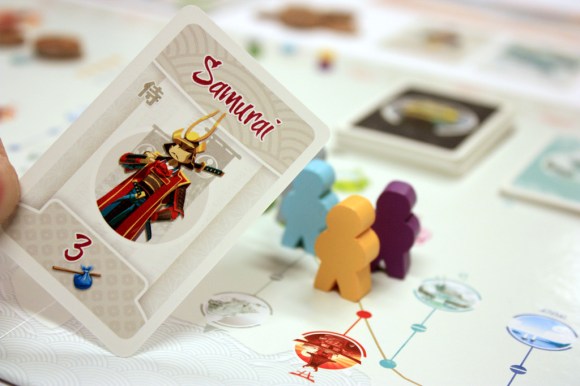
Tokaido

Divider


6. Love Letter (Seiji Kanai, 2011; AEG)

Elegance is the only word that can be used to adequately describe Seiji Kanai’s microgame, Love Letter. Mechanics, artwork, components; it’s all simple, streamlined and with solid pick-up-and-playability. Formed of only sixteen cards, a beautiful velvet bag and a handful of cubes representing ‘tokens of affection’ from the Princess Annette, players must play cards until the deck runs out, attempting to draw favours from a range of colourful characters in order to deliver a letter of love to the Princess at the end of the day. The winner of the round is the player holding the highest-valued character card once there a no more cards to draw, and in the face of other players attempting to eliminate and backstab one another out of contention.

In a grand best-of-thirteen, the first player to accumulate 7/5/4 tokens of affection (for 2/3/4 players) secures the Princess’ heart and wins the game. It’s wonderfully simple and compact, and takes only minutes to pick up before players are guessing, bluffing and socially-engineering their way to the royal heart. It’s quick, easy to teach, simple to master and yet open to a wide range of strategies and opportunities for bluffing. I love it, so hard.
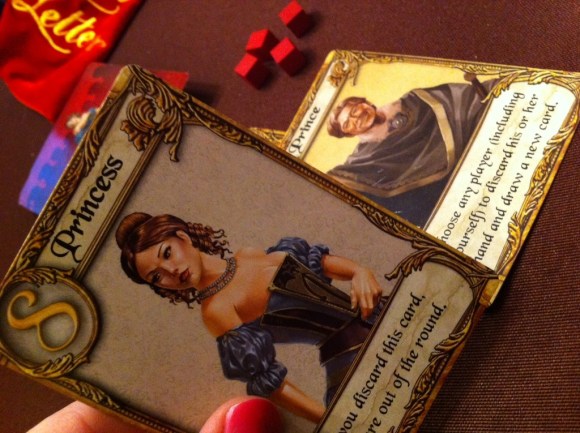
Love Letter

Divider


7. Rampage [aka Terror in Meeple City] (Antoine Bauza & Ludovic Maublanc, 2013; Repos Production)

For my final choice, what remains to be selected but yet another Antoine Bauza game? Furthermore, one that is about as far removed from a traditional modern designer board game as it is possible to get, whilst still retaining a board, power cards, and wooden meeples.

Unlike all of the other titles on this list which require strategy and brainwork, Rampage is all about dexterity. Taking on the role of city-smashing monsters, (up to) four players must systematically destroy the buildings and towers of Meeple City, topple all of the resident meeples and gobble them up, using a choice of four different actions: moving your monster (by ‘flicking’ its feet across the board), smashing a building (by dropping the wooden monster pawn onto a building), breathing toxic fumes (by resting chin on monster pawn and blowing buildings down) and by lobbing vehicles (by placing a wooden vehicle on top of the monster’s head and ‘flicking’ it into buildings or other monsters).

It’s a dazzlingly physical game, and the natural antidote to the tedious end of the cube-shunting Euro game genre. In Rampage, Bauza and Maublanc have created the ideal bridge between hardcore tabletop action and the family, party game. You can’t help but be engaged by Rampage, and get sucked into the sheer fun and lunacy of a very interactive, hands-on game that’s in full flight. The snobs may dismiss it as merely a sideshow, but once you’ve played it it’ll change your mind about how tabletop games can truly bring people together in laughter.

Rampage

Divider


So, there we have it. My top seven tabletop board games ever (or, at least, until some other awesome get released and bump some of these out of the charts). Mention should also go to some other games, which I list here for the sake of completeness:

Alhambra – Dirk Henn, 2003; Queen Games.

Thurn und Taxis  – Andreas & Karen Seyfarth, 2006; Hans im Glück.

Coloretto – Michael Schacht, 2003; Abacus Spiele.

Le Petit Prince: Fabrique-moi une Planète (The Little Prince: Make Me a Planet) – Antoine Bauza & Bruno Cathala, 2003; Ludonaute.

Splendor – Marc André, 2014; Space Cowboys.

Revolution! – Phillip duBarry, 2009; Steve Jackson Games.

[Zinar7]


Images from BoardGameGeek: (Carcassonne – Robert Hawkins; Takenoko – Johnathon Er; Agricola – Will McDonald; 7 Wonders – Babis Tsimoris; Tokaido – Henk Rolleman; Love Letter – Casey Lynn; Rampage – Henk Rolleman).

Tagged , , , , , , , , , ,

Dear Secret Santa

SecretSanta

Later this month, I will be attending a Fake Xmas Day with a few friends, in which we will be participating in the years-old tradition of giving gifts to other people in a clandestine and covert fashion according to the official rules for International Secret Santa-ball.

Since one participant has already remarked upon how I deserve little but coal this Christmas, I write here a heartfelt letter to my Clandestine Claus to discuss and develop the consequences of getting me nothing but some lumps of black Carbon this Wintermas festival. If you’re up for the journey, I’d love for you to join me.


Divider

Dear Secret Santa, 

According to housefuel.co.uk and their standard coal sale price of £0.24/kg (based on a rate of £240 for 1 tonne), for my Secret Santa present of up to £10 value, I can be looking forward to (at best) 41.67 kg of coal from you this Christmas. This is, of course, assuming that you spend the whole £10 allocation, and that you also purchase this in the context of another £230 worth of coal – let’s say that you don’t like me quite that much or I’ve been annoying to you recently, so let’s round that down to 40 kg of coal for my £10 gift.

According to euronuclear.org, 1 kg of coal burns to give 8.13 kWh so with my 40 kg, I can look forward to getting 325.20 kWh of electricity for my money (or, more accurately, my Secret Santa’s money). Of course, I don’t have an coal-burning generator, but there’s teething troubles with any plan.

Given that my living room has two primary lightbulbs, each using 42 W (energy-saving equivalent of 60 W), then I can use my 40 kg sack of coal to fully illuminate my living room for 3,871 hours; or 161 full days. However, since I don’t generally need to have the lights on for at least 8 hours a day, I could afford to fully illuminate my living room for 16 hours a day for 241 days. Assuming that I don’t need to heat my flat (it’s okay, I’ve got lots of jumpers), eat anything (I guess if I get hungry, I could start eating the coal) or provide any additional entertainment or amusement (I have books and board games that don’t need any power), then my £10 sack of coal would likely keep me basking in photons until at least June, depending on solar conditions. I guess I could burn the empty sack as well when the coal runs out, to give me an extra hour or two of brightness.

Of course, the coal-burning generator will probably take up a significant amount of my living room and make it very difficult to invite guests over (the noise and heat and smoke will also not be good for dinner parties), but since I will want to be saving all the available photons for myself, it is likely that I wouldn’t be inviting friends around anyway. Given that using some of the coal to heat water would also be an extravagant waste, I likely wouldn’t be able to take any baths or showers anyway, so guests may not want to be in my company in any case. The diet of cold beans and Ryvita crackers that I would have to embark upon would also probably not help to endear myself to those around me.

How will £10-worth of of coal compare with my standard electricity tariff though, I hear you ask? Well, according to average electricity tariffs from ukpower.co.uk, 1 kWh would cost me approximately 10 pence, therefore the equivalent coal price would equate to an extra 14 pence per kWh; or £1.14 more than simply using the standard National Grid input for 8.13 kWh. I suppose that this is an added expense for my Secret Santa that accurately embodies the festive spirit and goodwill to all men.

But what about wrapping? Either my gift-giver wraps the entire sack of coal (which contains the 40 kg of coal itself), or wraps each lump of coal individually. Let’s take a look at the relative expense of doing each option:

1. Wrap the Entire Sack

– For this, I am going to assume that the coal is going to be held in a 50 kg jute/hessian sack, along the lines of (http://www.ebay.co.uk/itm/Jute-Hessian-Sacks-25kg-50kg-Potato-Storage-Sacks-Easy-Carry-Veg-Storage-Bags-/231381893840?pt=LH_DefaultDomain_3&var=&hash=item35df6f82d0). This sack is 43×23.5″, or 109x59cm. Theoretically, this would then require a minimum of 0.64 square metres of wrapping paper to wrap the sack; perhaps more if the sack bulges/stretches due to the weight of coal. For the sake of argument, let’s say that you need 0.7 square metres.

According to amazon.co.uk, one 2×0.7 m roll of wrapping paper (1.4 square metres) costs approx. £1; therefore to wrap the sack itself, you would need to use half a roll, at a cost of around 50 pence. In this calculation, I have not included the cost of sellotape and/or bows/ribbons, which I assume that everyone keeps in bulk at home and close-at-hand for any wrapping emergency.

The gift is now complete.

2. Wrap Each Lump Individually

– To investigate this, I went to my parent’s shed and looked at their stocks of coal. Taking a single lump at random, I found that it was approx. 4.5 cm in diameter (assuming roughly spherical, which is a big assumption) and weighed approx. 52 g. Extrapolating, this would mean that there are approximately 770 lumps of coal in the sack, each with a surface area of (6.36 x 10^-3) square metres, giving a total surface area of 4.9 square metres.

Using the same maths as for Option 1, this would require around 3.5 rolls of wrapping paper, costing £3.50. Naturally, I have not taken into account the wrapping time taken to embark upon this endeavour, which would of course be considerable, unless my you are able to delegate this task to your resident House-Elf. I would, of course, rate how much my you like me as a friend based upon whether you decide to wrap the sack or wrap each lump individually, and base all future gift-giving to them on this observation. The quality of wrapping will, of course, also be ruthlessly judged and scrutinised and a total score returned to you at some point in the New Year.


So, what’re the conclusions?

Well, the primary one is that – for the purpose of making use of my gift of 40 kg coal – I will be required to invest in a coal-burning electricity generator. In conducting this research, I had considerable difficulty in finding any available power plants for sale. Apparently Battersea Power Station was last sold for £400Million according to Wikipedia, but since Battersea is out of commission and would require significant refurbishment in order to make it coal-running again, I would estimate that a cost in excess of £500Million would be necessary in order for me to translate my 40 kg of coal into available electricity. Since Battersea could apparently consume over 1 Million tonnes of coal per year, this gives a hourly coal consumption rate of 114 tonnes. This would mean that it would take approximately 1.26 seconds to burn 40 kg. Therefore, your very kind gift of £10-worth of coal would take the same amount of time to be consumed by heat as it takes for light to travel from the Moon’s surface to the Earth.

Of course, you could just buy me Trent Reznor’s and Atticus Ross’ glorious soundtrack for Gone Girl instead, which would provide me with many more hours or entertainment and amusement, but I guess it’s really up to you.

Yours tediously,

[Zinar7]

Tagged , , , , , , , ,

A Lament for the Video Game Manual

Lament

Next time you’re playing a new video game on one of those spangly-new, current-generation consoles, spare a thought for the poor, humble, forgotten video game manual. In this age of digital releases where physical copies of games are more at a premium, and pieces of floating paper coming bundled with the game disc are becoming more and more unwieldy and rare; the presence of printed DLC (Downloadable Content) codes, etc. aside. Even then, where disc-based games still come with some sort of instruction booklet, in many cases it’s woefully inadequate in providing context to the main game, given that many AAA-franchises now have so many complex facets of gameplay and control mechanics that you’d need most of a rainforest’s-worth of papyrus to catalogue them all. The days of gaming instructions being “press right to move right, press x to jump; jump on the enemy’s head to kill the enemy” are, sadly, behind us.

So: given that it’s someone’s job to reminisce about these archaic forms of printed communication and – in the absence of anyone else – that ‘someone’ may as well be me, let me take you on a journey of discovery and revelation about the mythical artform of the video game instruction manual. Together, perhaps, we can reclaim this forgotten land for the generations ahead.

P1030868

In the distant past, the instruction manual supplied with a video game was there to do one thing: to teach you how to play the game. Back in the 1980s and early 1990s, a game would rarely have any introductory backstory, let alone hints as to how to get along, before thrusting you headlong into some gameplay. Haunting back to the idea of the game being a machine and the means operation of that machine needing to be communicated to the user by means of some sort of instructive text, manuals were included in video game boxes as the conduit by which the user understood what the game was and how it worked, and also where to find contact information and telephone numbers to call when the software inevitably failed or caused her ZX Spectrum to spew out little bits of cartridge tape in a very violent manner.

As video games grew and became more cinematic and three-dimensional during the 1990s, the instruction manual became a way for more information about the plot, characters and universe to be documented, in addition to how to press the right buttons at the right time. Perhaps the reasons for this are down to the increasing ambition of video games to rival full-blown movie entertainment in terms of story and lore, and perhaps to save the developers time and money on creating extra hours of Full-Motion Video (FMV) cut-scenes or expensive animation by filling the instruction booklet with bonus information and history in written form (cf. Final Fantasy VII, Puppeteer, Chrono Trigger).

As a player who has passionately grown up amongst video games for twenty years now, I still reminisce about the thrill of buying a new video game at the shops and devouring the instruction manual (not literally; I’m not a monster) during the car ride home because, until I got home and could boot it up, reading the manual was the next closest thing to actually playing the game. This heritage naturally inspires me to view a game’s instruction manual more as a taster for the game itself than a simple set of operation codes for playing it; whetting the appetite with exciting artwork, design and (sometimes) additional game lore. As an aside, it’s worth noting that I’m like this with music, and physical media, too – I love leafing through an album’s sleeve flyer, awaiting what music will to come meet my ears and throwing myself headlong into the band’s artwork and lyrics.

However, whenever I’ve bought a pre-owned console game, particularly from the last couple of console generations, the manual is – with alarming regularity – often in mint condition and unsullied by human hand(s). It’s equally alarming how many pre-owned games are still delivered with pristine DLC/download codes hidden away in/with the user manual: a broad conclusion that may be drawn is that their owners are simply unaware that they exist; a symptom of gamers simply too impatient to get playing to investigate the other manual guff before they dive in. In these modern times, if a game isn’t packaged with an in-game tutorial teaching the user, step-by-patronising-step, how to do every little thing in the game, many players are likely to head to the internet at the first sign of confusion rather than consult the manual; or worse, ragequit and abandon the game entirely. Gamers expect a playable tutorial; not a written set of the rules and limits of the game and the primary operators and actions used to navigate it (unless it’s an in-game version that can called up from a start menu prompt). As a result, I’d wager that only a small proportional of video game manuals ever feel the touch of human flesh; merely the fleeting fondle of an excited gamer’s fingers as they scrabble through it.

Ain't Nobody Got Time Fo' That

In the last decade, I’ve noticed an increasing propensity for video game manuals (particularly from Western developers and publishers) to exist merely as a few sheets of paper held by some ragged staples; hastily thrown together to print the primary control mappings but with scant pickings of game-enhancing content. They’re now no longer a necessity, but a luxury; perhaps supplied in order to meet console licencing requirements or out of some, long-forgotten obligation to give the player something to look at before they properly delve into the game itself.

A manual is, by and large, one of the last things that will be created for a game’s release. It’s something to be done at the end, and with little effort spent on it in order to maximise the man-hours that are spent on the game itself. This means that plans for an engaging, informative instruction manual are often the first things to be cut from a development budget that’s pushing its time or financial deadline; with publishers typically finalising their printed material at the very last minute (right before shipping), seemingly assigning the task to the resident intern or work experience kid. Some culprits may be guilty of throwing a user guide together seemingly at random, with random or out-of-date concept art presented as the real thing, out-of-date screenshots and typos still embedded in the text, with no quality control. Also, some developers/publishers may eschew the opportunity to publish more of the games’ development/etc art in the manual; instead, choosing to use such content in coffee-table ‘art’ books for which the consumer may often pay a pretty penny for (Ubisoft, I’m looking at you).

Of course, game manuals must serve an important, legal purposes – details of guarantee, warranty, licencing details, epilepsy warnings, [ yada yada ] must all be presented to the consumer. For health/safety/Quality Assurance reasons, it is still – largely – necessary for every major video game to be packaged with something paper-based on which warranties, blah etc. are written for the consumer’s benefit. As such, a large number of manuals are merely this; no frills, just the facts. And, often, not even any facts about how to play the game at all: the user manual for the PlayStation 3 version of the BioShock – Ultimate Rapture Edition simply says: “Consult [url] for game instructions,” somewhat defeating the purpose of encouraging players to engage with the complex, rich world and artwork of the BioShock and Rapture universe. THANKS, 2K.

VideoGameManualNotes

But, despite the bleak message of this post so far, it’s good to see that some developers still like go to town on the accompanying user guide; seeing the instruction manual as a part of the game’s package and an equal part of the art and aesthetic of it as the game itself. Although this adds time and cost to the production of the final game, as a conscientious (and academic) gamer, this adds to my experience of the game and the value that I obtain from its universe:

Assassin’s Creed II (PlayStation 3 version tested) uses its instruction manual to enhance the experience of the game as a whole, being laid out in the form of a set of research notes from Abstergo Industries explaining how to operate the Animus 2.0 (the in-game ‘machine’ allowing Desmond Miles access to the memories of the historical assassin, Ezio Audiotore da Firenze) and annotated by Desmond’s Abstergo refugee, Lucy Stilman. For example, in one such annotation, the AC II manual makes fun of its preceding game and the insta-death the player experience upon landing in water by mentioning: “Please make sure to remove that annoying bug preventing swimming.” It may be just a small in-joke, but it rewards the stolid adventurer that delves into the user manual, and adds some local colour to an otherwise perfunctory explanation of the game’s operations and features.

More archaic instruction manuals also reflect other curiosities of gaming’s history: the ‘Notes’ section of pages which are common in many instruction guides, for example. These hark back to a time when it was necessary for players to write down level passwords or codes, when savegame functions weren’t a widespread feature of most console games and in-game cheat modes were abound. Back in the day, the instruction manual was also an important barrier against software piracy – I recall the efforts of publishers like LucasArts doing their best to stop pirates from distributing pirated games (copied from floppy disks) by requiring users to look up a code in the manual (randomised each time you play­; e.g. “page 34, line 3 ……….”) in order to access the game. Of course, there would be nothing to stop large-scale pirates simply reproducing the manual, as well, but it may have halted the disk-copying of bedroom pirates.

"Piracy harms consumers as well as legitimate developers, publishers and retailers."

Page one of the manual for Assassin’s Creed IV: Black Flag ~ “Piracy harms consumers as well as legitimate developers, publishers and retailers.” /FAIL

What place do instruction manuals have, though, in a world where control schemes for many video games can be edited and mapped to a player’s particular tastes? If the primary operators for in-game control are not fixed, then what worth is there in publishing a list of them in hard copy form? Furthermore, with future consoles likely to ditch physical game discs altogether (Microsoft nearly managed to get away with doing it in the current console generation, but not quite), will we see an absence of all printed materials, with a reliance purely on download-only games a la PC gaming on Steam?

Of course, I have nothing against tutorials an in-game manuals per se – if they can be presented in the context of the coherent storyline and with due care and attention, then a tutorial is a highly effective way of inducting the user into the gameworld and setting up the rest of the game. But why waste the opportunity to present extra content to the consumer? Maybe I’m in a minority. Perhaps the evidence that many players don’t look at modern game manuals is evidence that they’re an archaic artform that should be retired; perhaps alongside physical copies of videogames altogether, I don’t know. But if I’m a last bastion of a bygone era where the physical world still musters a round of applause, then I’m happy to be its final pillar of support. Godspeed.

[Zinar7]

Tagged , , , ,

Scary Monsters and Nice Sprites

Scary
Since tomorrow is the 2014 edition of the Capitalism-fest that is Hallowe’en and the “scary things” closet has already been opened once again and a whole bunch of horror media sent barrelling our way, I thought I’d consider the role that video games play in our annual celebration of creepiness. Hurrah!

I’m a sucker for horror movies: creepy ones, silly ones, gory ones; you name it, I’ll devour it. Horror video games, on the other hand, can GET THE FUCKING HELL AWAY FROM ME.

Joel Cuddles

Largely, horror films completely fail to give me the creeps: perhaps it’s the knowledge that it’s all just a big scam, and the girl being chased by the guy with the big axe isn’t really being chased, and the guy with the big axe doesn’t really want to examine the girl’s internal organs in minute detail and with the complete opposite of surgical precision. Like everything in the movies, it’s just a big ol’ fake and there’s really nothing to be scared about at all.

At best, a surprise set-piece will give a brief shock, but never nightmares: the only things in recent memory to actually, properly, scare me were the Spanish original of [.REC] (which, incidentally, I will never ever watch again; not because it was too scary, but because the next time I see it will be a disappointment and I want to maintain it as one of my favourite horror films of all time) and pretty much all of The Descent (which was largely an hour and a half of Scary Things Jumping Out at You in the Dark™). Aside from that, I’m pretty unshakeable even in the face of maddening terror. When it comes to horror video games though, then you can rewrite all the rule books and Consequences Will Never Be the Same.

It’s here that I should probably define what I mean when I say “horror game”:

Horror Game [hawr-er geym]

n.  A video game whose predominant function is to scare, or thrill, above and beyond a regular ‘action’ game.

“I played this horror game last night and it was so scary that I accidentally vomited out my internal organs.”

It’s not a necessary prerequisitive for horror-games to be action-based, but most fall under the well-trodden banner of ‘survival horror’: your Resident Evils, your Silent Hills and your Alone in the Darks. These (almost universally) place you in the scope of some city-wide outbreak of nasties keen to chew on your face; away from which you must navigate your way (from fixed camera angles) in a third-person manner whilst simultaneously trying to find your wife/daughter/dog and understand what the hell’s gone wrong with the world. Even so, there are plenty of other horror-filled titles that meander away from the standard ‘shoot at and run away from the monster things chasing you’ to encompass psychological horrors, as well as the physical ones. I can categorically say that I will never, ever ever ever play Amnesia: The Dark Descent: I may own it on Steam, thanks in some manner to some Humble Indie Bundle somewhere along the line, but I’ll never install it.

Broadly, I watch horror films to be amused (usually by their shocking production values, hilariously bad dialogue and entertaining special effects), not to sit on the edge of my seat. but I can at least appreciate that some find horror films “scary” in some way. Horror video games, on the other hand, require direct input and often an emotional attachment (likely with the main character or perhaps for a “damsel” in “distress” that provides the key focal point for the story slash action) which amplifies the terror through your desire to see them survive the ordeal.

With a horror film, you know everything’s on rails and that the horror will progress without your direct involvement; you’re just along for the ride until the credits roll. If you do get scared, the action will progress regardless and you’re safe in the knowledge that, in 1-2 hours’ time, it’ll be over; no matter how much (or little) you engage with the scares. Where horror movies largely stick to the same sort of tropes (meaning you can largely predict how and when the scares are going to take place, who’s going to die, when something’s going to jump out, yada yada), proper horror games don’t have the same heritage and traditions and are tend to be far more innovative and inventive with how they give you the creeps. Aside from the more direct input that the player has on the action in a horror game than horror movie, this might also arise because of the relative infancy in which horror games inhabit, at least when compared to the 100-odd-year history of cinema.

Around this time last year, Naughty Dog unleashed one of the defining games of the PS3 generation in the form of The Last of Us; a survival-horror (ish) adventure game combining tension, emotion and zombie-ish things into a snowball of praise and Game of the Year (GotY) nominations from gaming critics. A year on (and with its recent re-release on PS4 in the form of a ‘remastered’ edition), many critics still view it as the high point of the previous console generation, drawing comparison with some of the ‘greats’ of cinema and banding around nicknames like “the Citizen Kane of games”. Still, given that the first, proper, piece of horror cinema is almost a century old now (widely accepted to be the creepy, unsettling The Cabinet of Dr. Caligari), it’s unsurprising that video game developers have caught on to the main tricks of making a survival-horror game scare both physically and psychologically, becoming genuinely innovative with its horror engagement and leaving much of cinema’s generic horror output writhing in the dust.

LastOfUs

Given the immense (and almost universal) acclaim in which it is still held, I kind of feel I should play The Last of Us, but it just doesn’t grab me enough to give it a go (pun very much intended). I don’t go overboard for survival horror, and never have been: I think one reason why I dislike survival horror is that it takes itself so darned seriously (that Silent Hill dog ending aside), whereas all my favourite horror films (The Evil Dead, Saw, The Happiness of the KatakurisZombieland) are those ones that blow things over the top and deploy entertainment and/or comedy to complement the terror. The slow, tense styles of most survival horror titles hold no sway: the prospect of having to tensely save ammo/health and be frightened to death around every corner is often not the greatest motivator.

Instead, I prefer to be far more ‘gung-ho’ in my gaming style: it’s much more enjoyable to be charging around levels at full-tilt, full unloading clips of ammo in every available direction and trying to have as much fun (and cause as much chaos) as possible; preferably to a soundtrack delivered by Andrew W.K. or Turbonegro or something equally mental. This does, however,tend to make me a bit rubbish at stealth-based games like Thief and Hitman, let alone standard survival-horror games where you’re encouraged to save every last bullet and avoid alerting the entire zombie horde by careering around throwing grenades at the scenery. For shoot ’em ups of every colour and creed, I far prefer those that distribute copious amounts of ammunition and supply copious hordes of ghoulies/baddies to use it on; such as the glorious Bulletstorm or the masterpiece of Halo. “Saving some ammo for later” just isn’t in my dictionary, and I wouldn’t have it any other way.

When I do stray into the darkened realms of horror gaming, I tend to to fall back on my love for zombies and zombie movies as a crucial pivot and gossamer connection to the world I know and love. And, even then, I like my zombie games to be entertaining struggles rather than bleak journeys of mere survival based on scavenging for crumbs of survival; the likes of Dead Rising and Left 4 Dead providing far more amusement than any number of repetitive, po-faced Resident Evils. I’ve recently been playing through Organ Trail (Director’s Cut) once again; clocking ever more hours into its cheesy, tongue-in-cheek conversion of the classic Oregon Trail into a homage-filled zombie survival adventure and enjoying every minute of it. And even then, if Plants vs. Zombies still isn’t the best zombie game ever made, then I’m a giant heron.

Okay, so enough about full-on ‘horror’ games; what about scary monsters and nice sprites in mainstream gaming at large? There’s an increasing trope for so-called ‘regular’ (non-scary, or mainly non-horror-based) games to artificially use ‘scary’ sequences to add to the drama or tension of a regular ‘action’ game, particularly in first-person person shooters, to varying degrees of success. Half-Life 2‘s superlative Ravenholm sequence is still one of the scariest (and most memorable) sequence in a modern first-person shooter, whilst the Sander Cohen section from BioShock – with all of its weeping angel-style mannequin-splicers and haunted theatre props – is one of gaming’s most expertly-executed creep-fests. Whilst Treyarch’s Call of Duty titles – with their schlocky zombies and undead Nazi footsoldiers – just feel like a tired resurrection of the same old trope of taking a standard game and trying to shoehorn some shocks into it, Red Dead Dedemption‘s glorious DLC/story expansion ‘Undead Nightmare‘ managed to implement a superlative zombie mode with infinite more care and grace.

Aside from traditional survival-horror games, there’s still a whole bunch of originality to be found within the ‘horror’ genre; resisting the mainstream horror genre’s tropes of endless wandering through endless dark, tight, grey corridors shooting zombies and collecting herbs. The likes of Project Zero (multi-platform, 2001-), Eternal Darkness (GameCube, 2002) and Cursed Mountain (Wii, 2009) come critically acclaimed by those in the know, demonstrating that there’s innovation to be found if players wander off the beaten survival-horror path, and the indie community also seems to be leading the charge in horror gaming of late; with particular successes such as the aforementioned Amnesia series, Penumbra: Black Plague and, this Hallowe’en’s breakout hit, Five Nights at Freddy’s. The equally-fascinating and terrifying Slender: The Eight Pages (which I have played; although not for long) demonstrate that terror can be inflicted without a bullet ever being fired.

So, despite the fact that I’m active only in the fringes of horror gaming, I’d wager that the genre is in fair health; so long as you steer clear of the kind of trash that The Evil Within appears to be peddling. With the growing success of Oculus Rift and true-VR gaming, I can only imagine that the successes of immersive, truly scary video games will also go interstellar. Schlocky, jumpscare games might not be my exact cup of tea, but I’m fully in favour of the injection of psychological, unsettling horrors into video gaming as a whole and engaging stories that place less emphasis on shooting space marines and more on tapping into the brain’s psychological fears. Game designers, take note plz.

Anyway, since this post has mainly been about scary things and personal gripes, I thought I’d leave you with a wonderful scene of beauty and harmony and everything that is ‘right’ with the world; don’t have nightmares.

MemeCenter_1375716630592_653

[Zinar7]

Tagged , , , , , ,