Tag Archives: Research

PhD Fraud #10: Welcome to Plight Club

PhD10

It’s come to my attention that, in these intermittent posts about my trials and tribulations of PhD research, I’m usually complaining about the research process or releasing some of the negativity and frustrations of it all.

Well, for a change, I thought that I’d offer a few tips for current and prospective PhDers (what I’m going to tentatively call ‘Plight Club’): if you’re someone just starting on the path to a PhD, or even a grizzled veteran like me who’s going through a rough time, then maybe there’ll be something useful in here for you. Welcome to Plight Club.

1 (a). Talk to your Fellow Plighters.

If you’re having difficulties in your PhD or research, there is absolutely no shame in talking to others about it or admitting that you’re struggling. Often, with a PhD, such a personal relationship is developed with the research and it can be hard to admit that things aren’t going well. Likewise, when it comes to talking to others (other postgrads, family, friends, supervisors), it can often be easy to pretend that things are going swimmingly as you don’t want to seem like you’re ‘behind’ or not as successful as everyone around you (SPOILERS: no-one is ‘WINNINGS’ at their PhD, no matter how much they might say or pretend they are).

Much of the time, everyone is so wrapped up in their own research that it can be difficult to find to talk about personal matters beyond “how’s your research going?” or ” did your conference paper get accepted? “. Get to know the people who  sit and work around you – not only will it make the project less lonely, but they’ll also be able to reassure that no PhD is easy, and that they’re probably having just as many problems, and suffering just as many setbacks, as you are. It’s also good to have time each day to ‘reset’ and come back to your work feeling refreshed after a quick coffee and a piece of cake or something. And hell, even if you don’t feel any better about your work, at least you have cake, and that’s never a bad thing, right?

1 (b). Talk to Other Researchers.

As I already mentioned, a lot of the time spent doing a PhD is done alone, usually facing a computer screen trying to make your code work, mending some broken piece of experimental equipment or trying to work out what the hell your results mean. Since a PhD is usually a very specialised area of research, this means that, invariably, there aren’t that many people around who can help fix your problems or dig you out of a sticky situation. So, don’t be afraid to randomly send emails to other academics/researchers studying elsewhere. They’re not monsters; they won’t bite. They’re real human beings, and if they’re worth their salt as academics of a particular field, then they’ll be happy to help out someone if they’re struggling. Don’t forget that even seasoned academics probably struggled through the PhD process, and so will inevitably relate to your woes when you send a ballsy email  saying “ZOMG THIS STUFF IS TOO HARD, I’M REALLY STUCK CAN YOU HELP ME PLEASE THANK YOU 😥 .” Also, putting your name (and/or face) out there will come in mega-handy when you start jetting off to various conferences/workshops to present your research, as you’ll at least meet familiar faces/names when you’re making your first steps into the the ‘public eye’ of research.

It’s not a foolproof system, as you’ll likely get the odd academic who either ignores all communication (or just gets so much in their inbox that they can’t keep up) or comes across a little gruff, but most academics are SHOCK HORROR actually kind of nice. As long as you’re polite, clear and concise with your requests and/or problems, then even noted experts will be happy to at least point you in the right direction to how you track down a solution. In a world where even the most distant fellow researcher is accessible via email or Skype, then there’s no harm in reaching out. Who knows; maybe you’ll get through your stickiness and find answers to your problems, or at least feel that you’re not alone.

2. Use Mendeley.

One of the constant battles of a PhD is squaring up against the tens/hundreds/thousands (delete as applicable) of academic papers relevant to your field, and being able to efficiently locate citations or reference other academics’ work in your own writing. In the digital age, gone are the prospects of having to maintain a well-catalogued library of paper copies and books, as everything is in PDF form these days; however, efficient management of these files is still tricky, and can lead to lots of headaches when trying to find a particular paper or piece of information.

In this vein, Mendeley is a staggering piece of kit. It keeps all your papers in one place (it has a PDF viewer as well so you don’t need to use Adobe Acrobat) and lets you make notes, highlights, annotations or download referencing data from the web. You can sort by authors, publication; you can add your own tags and keywords, and collect similar papers in folders; plus, you can access papers in your library from the web and from any location. It has a Word/LaTeX plugin as well, letting you ‘Insert Citation’ from your word processor and it’ll include the reference; then when you’ve finished your paper/thesis, just hit ‘Insert Bibliography’ and it’ll compile your reference list for you. Oh, did I mention that it’s free?

Essentially, it does for PDFs what iTunes (etc.) does for mp3s, and while other programs like EndNote offer similar experiences, Mendeley is just better. Download it here, you can thank me later.

3. Write EVERYTHING Down.

A PhD is, naturally, epic. You’ll cover so much material, think about so many things and touch on so many concepts, that you’ll quickly lose track of minute details.

– Done a new experiment? Document it properly so you can go back and check your results, or you can repeat it again if you need to.

– Had an idea in the middle of the night? Write it down in case you’ve forgotten by the morning.

– Have a deadline or somewhere you need to be? Write it down, as you don’t want to miss a supervisor meeting if he/she has a busy schedule and is not in their office for most of the time.

Keep some paper with you at all times; from a notebook you carry around with you everywhere, to a pad of paper and a pen when you inevitably reach a ‘EUREKA!’ moment in the middle of the night[*], to maybe even some shower crayons you can use to write out mathematical equations on the bathroom tiles during your daily bathtime routine. And if you’re slightly more 21st century than writing things down, get a dictaphone or use a sound recorder app on your smartphone; even an desktop/mobile app like Evernote are kind of handy, and have the added benefit that you’ll remember to write down your ideas but then go ahead and lose your notebook in the pub or something.

[* It’s worth bearing in mind that I’ve never had a ‘EUREKA!’ moment, despite my best efforts to instigate one by spending as much time as possible in the bath, bah.]

4. Try some Tomatoes

My major failing is procrastination (future PhD Fraud post coming on that subject very soon), and it’s usually a constant battle to avoid getting distracted from my work by the plethora more interesting things that exist on our watery, blue sphere. I’ve tried many techniques and methods to combat this but with minimal success, but found solace in the wonderfully simple MyTomatoes tool based on the Pomodoro method.

It doesn’t work so well with experimental PhDs, or those that aren’t desk-based or involve other activities that mean you’re not in one place for long stretches, but if you’re involved in a lot of reading, writing or programming during your studies, then a time management technique like Pomodoro can be good for structuring your time such that you focus on the job at hand, but are given lots of small breaks (in which you can quickly check Facebook, news or whatever) as a reward for 25 minutes’ hard work.

There are lots of free resources all over the web for Pomodoro stuff, and you can easily find a tracker/application/browser-based site that suits you. MyTomatoes is good insofar that it tracks both your work-periods and your breaks, and also lets you write down what you did in each tomato period, which can be very helpful for cataloguing  progress and reminding you how much you’ve achieved throughout the day.

As I said, it doesn’t work for everyone, but for those who have a difficult time concentrating on the task at hand it can be a godsend. Give it a whirl.

5. Don’t Let the Bastards Grind You Down.

If you ever feel that your research is causing you more stress, worry or frustration than is good for your health, then stop. Life is really too short to let work-related matters define your well-being,

Your supervisor should not be your master; they do not own you, so if you’re being pressured into taking on extra work or doing other stuff that you don’t want to, and which distracts from your PhD (which is likely causing you enough stress as it is), then learn how to say no to extra work, student teaching or supervision. Focus on your own work, and making it the best that it can be.

No-one ever said that doing a PhD had to be easy, but it shouldn’t rule your life; no matter what your supervisor might think. If things are genuinely tough or you can’t cope, then there’s no shame in getting out of things for a while or seeking professional help. Finishing the PhD might feel like it’s life-or-death, but in the grand scheme of things, it really isn’t. Just give things your best shot, or at least the best shot under the circumstances. If you don’t (or can’t) make it out of the PhD process with what you wanted, then don’t stress over it; life has far more to offer, and you’ll still be able to find something fantastically fantastic to do with your life, and unless you’re desperate to waste away live your life in academia, then chances are it won’t stop you getting a pretty rad job.

And if you ever feel alone, just think about all the other Plighters across the globe – all struggling to make traction in the research world but who will ultimately get there in the end: I’m certainly one of them. I still haven’t figured out a way to ‘WIN’ at the PhD process, but hopefully I’ve passed on a few of the things I’ve learnt to keep me at least on even keel. Let me know if you have any success trying them out, or have other Words of Wisdom that you’d like to share. Peace out.

[Zinar7]

Tagged , , , , ,

PhD Fraud #09: At World’s End

PhDfraud09

Around a month ago, I received news about a journal paper I submitted nine or so months back: following a significant period of open discussion and peer review, it was “with regret” that the paper “would not be accepted for publication”. I’ve presented papers and oral presentations at conferences before, but this was my first submission to an academic journal, and I’m technically still to have something properly published at this point. As a late-stage thesis student (heck, I’m supposed to be submitting by October, eep) with ever-decreasing time to focus on PhD work, that’s a bit of a concern and it’s been rather difficult to figure out how I dig myself out of the misery-hole. Oddly enough though, despite a brief period of nervousness and dejection, I’m keeping fairly buoyant.

Perhaps I’m just coming to the realisation that, regardless of the quality of my thesis or whether I actually get awarded a PhD or not, all of this will be over by November and I’ll be able to move on with my life. I’ve been doing the same research for four years, and it’s probably not a massive surprise that I’m kind of bored with it. For a long time, I’ve not been able to see an end in sight, and I’ve always felt so far away from any sort of situation that I’d be confident (and happy) enough in my work to submit it for scrutiny. But since I now have a firm, fixed deadline of the 1st October that I must submit my thesis by, I’m coming to terms with the fact that I can’t keep going indefinitely, no matter how much more I feel I need to do. There’s no time for al of that ‘extra work’ that I keep thinking I need to do, so all I can realistically do is put together everything I’ve done already and manoeuvre it into some sort of order. At the moment, my efforts are focussed on whipping my thesis into shape and trying to plan what little ‘jobs’ it’s feasible to complete in the remaining few months. There’s no sense getting overly worried about failing, since my fate has largely been decided by this point – if what I have will only give me an MPhil, then so be it; irrespective of the outcome of the viva, I’ll be free to do something else, and I’ll be ready to take on the next challenge.  And with that comes a sense of pseudo-closure.

Strangely for an academic (and even more strangely for an engineer), I kind of enjoy the writing process. I certainly find it more satisfying than wandering around in the fog of genuine research: I’ve always enjoyed being creative, particularly in the form of writing, so I quite look forward to exploring the word-space and trying to communicate things in a readable, interesting way. Over the last couple of years, I’ve tried to resurrect my passion for creativity as a method of jettisoning some of my extraneous frustrations.

Not so long ago, I used to write a bunch of video game reviews (e.g. Prince of Persia: the Fallen KingSuper Paper Mario and No More Heroes) as a method of expressing myself creatively. Even longer ago, I used to play guitar regularly (at least, privately in my own room), but I haven’t practiced regularly for like four years, which correlates almost exactly with starting the Dreaded PhD; I don’t doubt that the two are directly related. Through college and undergraduate stuides, I used to find that bashing away at my Fender Double-Fat Stratocaster at the end of a busy day would dissipate many of the worries and stresses of study and research. It was never to achieve musical stardom or monetary return; the passion was just to play. Quite why expressing myself musically seemed to be so effective for me in ‘killing’ off some of life’s stresses, I’ve never really been able to explain: I kinda always just put it down to the fact that I’m not very good at multi-tasking, so if I’m busy trying to keep up with fast chord changes and remember what note I have to play next, then I can’t possibly be stressing over research work or exam preparation. For whatever reason, this fact has largely been forgotten over the course of my PhD study, so it’s perhaps unfortunate that it’s only sunk in now, when I’m desperately close to wrapping up The Thesis for good.

Anyway, this has highlighted the appearance of a Stratocaster-shaped void in my life that I actively intend to patch up. Over the course of a few months, I’ve tried to re-forge my commitment to guitar-based noodling, although it turns out that four years of very little practice (maybe an hour total a month rather than an hour total every day or two) is not good for keeping your hands and reflexes in shape and it’s surprisingly hard to do even some of the basics. That, and the fact that I’ve probably managed to destroy my fingers and wrists with RSI in the intervening period probably doesn’t help. Either way, the upshot is that I (currently) can’t play at near the same capacity that I used to and that’s kind of a bummer, but hopefully only a short-term issue that can be remedied with just some Dedication and Willpower sprinkled over top.

It’s not like I was ever some kind of guitar virtuoso anyway – my flavour was always rhythm guitar; providing the backing sound for an imaginary set of remaining band members whose roles were never filled. No-one has ever showed me how to play guitar (not even in the days of YouTube tutorials), and everything that I’ve figured out how to do was figured out purely by ear, usually by listening to Green Day songs and trying to play along. For me, this is a very minor source of pride and I’d kind of like to think that I still have some sort of natural talent AT SOMETHING buried deep inside me somewhere; even if it isn’t academic research or scientific fame.

Anyway, I’m hoping that picking up my axe  more often will be a positive influence on both Work and Play; even if I do it just for my own ears and not anyone else’s. Heck, if I can’t be a stellar research student with a huge library of publications to his name, then I may as well use that empty library to turn my good mood up to eleven and make one hell of a racket, right? Rock on.

[Zinar7]
Tagged , , , , , ,

Big Bang Solent Science Fair 21/03/2013 – Personal Debrief

Further to my previous update (Science & Engineering Day 2013), last Thursday presented the Astronautics Research Groups’ second event in in National Science and Engineering Week (NSEW) 2013, with the arrival of the Big Bang Solent science fair to the Garden Court at the University of Southampton. This post documents the major goings-on of the day, what we can do to improve for next time, and also to share a few photos from our activities and exhibits. So, without further ado, onwards!

P1180813

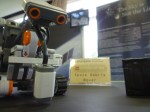
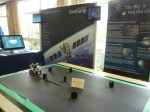
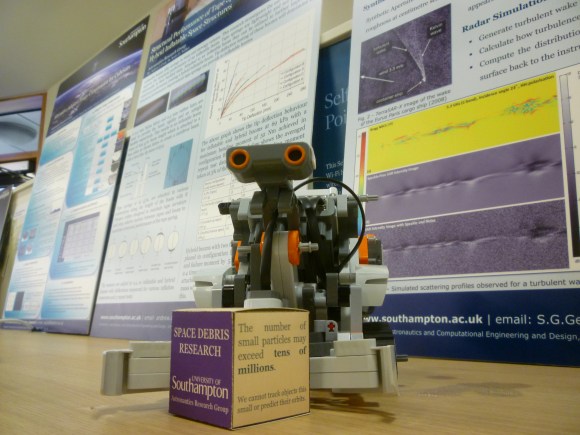
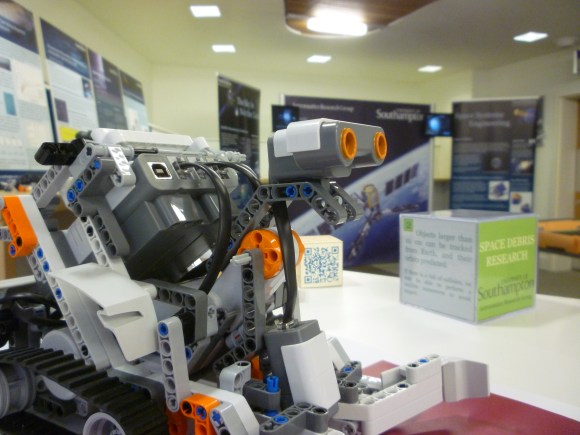
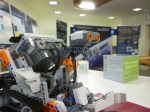
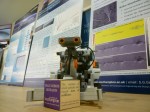
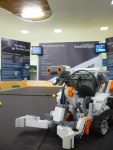
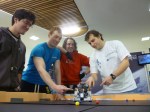
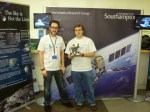
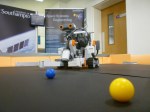
Our stand and presenting team (Ben [spaceman_ben] and I, plus a few other stragglers) were once again out in full force at a brisk 0845 on Thursday morning  to put our stand and kit together; smugly earlier than most of the other stands exhibiting that day, leaving us plenty of time to soak up the free coffee and biscuits and to gently rib the other delegations who’d scheduled considerably less time to sort out their kit. Our setup was largely the same as for the previous Saturday, albeit with a few modifications to our LEGO Mindstorms demonstration, resulting in the substitution of Aquabot with a new, space-debris themed rover, Debrisbot:

P1180798

Saturday’s headaches were largely derived from the fact that Aquabot‘s mission of collecting coloured balls into its jaws provided unexpected sources of unpredictability: for example, our demonstrations of placing balls in Aquabot‘s path meant that visiting children were inclined to try picking up the balls and rolling them (sometimes with great force) into the rover’s maw. This was fine, except when it happened just as Aquabot approached the edge of the ‘green’ area, such that a ball would get stuck under the NXT colour sensor when the rover reached the  green card and hence would not detect that it was imminently going to crash into the makeshift (albeit perhaps with one less ‘f’) cardboard wall we constructed to make sure balls did not roll everywhere. In addition, we hadn’t accounted for the fact that children would ‘lean’ on the cardboard wall and bend it completely out of shape, meaning that its ability to contain both Aquabot and the coloured balls to the table area was severely impaired.

Given these points, it’s not only a miracle that we did not have balls rolling loose all over Building 85 but that we actually managed to get to the end of the day without any of our balls inadvertently going home in children’s pockets (or worse, mouths) for a permanent holiday away from the University. So, to remedy these, we decided to get rid of both the balls and the cardboard wall – by eliminating the other functionalities of the NXT colour sensor aside from the ‘am I near the edge of the table?’ detection using the green card, we could reinstate our previously-abandoned ‘is there object in the way?’ detection function using the NXT ultrasonic sensor to make the rover recognise any solid objects that we placed in its path (which we couldn’t use before because it kept detecting the balls themselves and tried to avoid them rather than trying to collect them). So with that, Aquabot was gracefully retired and replaced with Debrisbot; a rover programmed to sense nearby objects (which we assumed were nearby space debris fragments) and perform “collision-avoidance” manoeuvres to avoid impact. And in most senses, Debrisbot worked pretty well.

P1180827

Not brilliantly well, though. There were still quite a lot of issues arising due to the NXT ultrasonic sensor’s narrow field-of-view meaning that there would be an object to the left- or right-side of the sensor that wouldn’t be detected; or other cases where there was too little energy being reflected back to the sensor (where it was sometimes absorbed by the object, or reflected in a different direction), and the the rover didn’t detect object properly and would drive into it anyway. The idea was for Debrisbot to be roving around, avoiding bits of junk as necessary, but sometimes it would just clatter into it anyway, or turn around and get objects stuck under the tracks; doing ungainly pirouettes and wheelies before falling over like a boss.

So, an executive decision was made to transform Debrisbot from a debris-avoiding rover into a debris-sweeping rover; charging around the ‘black’ area, pushing the ‘junk’ objects into the ‘green’ zone like a giant space snowplough. And with that, a significantly greater level of success was observed, as within minutes, all of the bits of ‘junk’ (made from Tic Tac boxes stuck together and wrapped in black duct tape) would be pushed to the edge, leaving the black region of ‘space’ safe for satellite operations. Debrisbot was essentially just driving around in straight lines until it encountered the edge of the ‘green’ (and hence wasn’t aiming for objects at all, just ploughing them if they happened to be in the way) so it would be even better if Debrisbot was able to ‘look around’ for bits of junk and then explicitly move towards them, but that’s a larger task for another time. For the moment, though, Debrisbot demonstrated pretty much what we wanted it to in a nicely simple way and leaves plenty of room for improvement. Not bad, little buddy.

P1180832

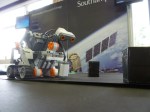
The event itself was pretty enjoyable – essentially an event to get schoolchildren interested in doing science and engineering, and involved around 600 children from the nearby area visiting for the day to do some fun, science-based activities, talk to people in college/academia/industry [delete as applicable] who ‘do’ science and stuff for a living and to get an idea about future careers and stuff.

Our main drive for exhibiting was to demonstrate our research activities and show the youngsters that activities in ‘space’ are happening here in the UK, and to prod them towards taking up such work in their future education, if they want to. It was also interesting to find out how many young people are aware of the  space debris problem, and to ask them for ideas about how we could go about resolving it: while Debrisbot was hardly the most efficient (or successful) method of demonstrating how a space debris sweeper system might work, it did the job and (I hope) gave the visiting public a new perspective of the space debris problem and the ‘sort of thing’ that could be done to manage it.

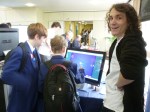
Anyway, an enjoyable day: the Space Junker stuff went down pretty well as usual, with some visiting students managing some staggeringly high scores, and we certainly gave out of a lot of our ‘Space Systems Engineering’ worksheets which contain information on our research, details of how to access Space Junker online, and also a few puzzles and stuff. So, to round off the event and, indeed, this post, here are a few of my other photographs from the day: we’re not sure when we’ll be taking Aquabot/Debrisbot out on the road again, but I’m sure he won’t be in the garage for too long. Hooray!

[Zinar7]
EDIT – Our activities were recently published as a blog post from LEGO Education UK! You can find it here: http://legoeducationuk.wordpress.com/2013/03/27/space-research-with-a-little-help-from-lego-mindstorms/

Tagged , , , , , , , , , ,

Science & Engineering Day 16/03/2013 – Personal Debrief

As part of the Astronautics Research Group‘s outreach and public engagement, last Saturday marked our first adventure in this year’s National Science and Engineering Week (NSEW), with our annual involvement in the University of Southampton’s Science & Engineering Day on campus. Each year, we’ve managed to significantly increase our display stand and materials, and this year marked our biggest and best exhibit yet. Here follows a short summary of the day’s events, what we had on show and some photographs from the day.

P1180707

Having set up most of our banners and posters the night before, Ben (spaceman_ben) and myself (zinar7) arrived at a deathly-quiet Building 85 at 0800 hours prompt to set up the rest of our kit and get everything up and running. Thankfully for my sanity (and probably the safety of the general public), the University had elected to open the cafe in Building 85 at 8:00 am, and we were able to procure caffeine-filled beverages and sugary goods straight away to fortify us for the rest of the day, which was due to begin at 10:30 am and run until 4:30 pm, followed by packing up all the kit and hauling back to our offices for storage. A long day, then, but all in the name of science and trying to encourage the youngsters of today to get excited about all things ‘Space’.

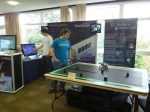
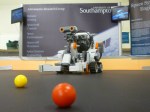
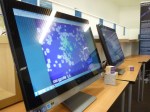
Our touch-screen PCs were unpacked and booted up, our digital photo frames secured to our 2 m x 2 m backdrop banner, and the rest of our display materials dotted around our allocated ‘zone’, leaving us the remaining time to sort out the major new addition to our exhibit: Aquabot, the water-collecting Mars rover made from LEGO Mindstorms NXT 2.0:

P1180683

Aquabot was conceived, built and programmed in the ten or so days prior to the event, after Ben and I had gotten hold of a current-generation Mindstorms kit in order to evaluate its usefulness in outreach for the Astro Research Group and in undergraduate teaching/projects: we’re hoping to use multiple kits when the next-generation is released later this year, to allow students to develop simple group projects looking at spacecraft control and formation flying (among other things). Our main focus, at least for NSEW, was on making something cool and vaguely space-related to encourage youngsters towards the space industry, and getting them excited about engineering in general. The result, then, was a rover of our own design (and vaguely anthropomorphic qualities) constructed to ‘rove’ around a table (without falling off), collecting up balls and doing some basic colour-sorting; something like this:

P1180673

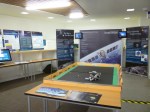
Attached to the front of the rover, pointing downwards between the ‘jaws’ of Aquabot‘s maw, was the NXT colour sensor. To simulate the Mars environment, we used black card as a base, placed on a few large tables to make an area around 7 x 5 feet of black landscape. The colour sensor was programmed to catalogue the colour of the table surface and also of any balls that happen to roll into Aquabot‘s gape; and to ‘carry on as normal’ if sensing a black response. The rover was powered using two motors, and was run on caterpillar tracks to aid manoeuvrability and response. At the front of the vehicle, a funnel was placed to collect balls as the rover moved around the environment (although it kind of just ‘punted’ balls across the landscape rather than funneling them in, but oh well). The third motor from the kit was installed at the front of the rover, to which was attached an arm with the NXT colour sensor: when a blue ball rolled into the ‘jaws’ and was detected by the sensor, the arm retreated to allow the “water molecule” into a storage area beneath the rover; when a yellow or red ball was collected, the arm rapidly swung forwards to ‘kick’ the unwanted “martian rock” away. When it worked, it worked pretty well; although if multiple balls rolled in at the same time, it would still be doing the operation for the first ball when the second ball arrived, and so wouldn’t accept/reject the second. Still, such times were comparatively rare, and it was always satisfying when the rover detected an unwanted ball and punted it away with great force.

P1180729

Around the edges of the black card, we made a border of green card to make a ‘buffer’ around the edge of the table, which Aquabot would detect and subsequently turn round and return to the black region. But, because sometimes Aquabot would decide to choose its own fate and plough on through the green area regardless (for example, when there was already a ball in the jaws, and the sensor couldn’t see the ‘green’), we put up a barrier (of more card) around the edge to stop the rover (also any stray balls) from leaping off the table and plummeting to the floor. We managed to get to the end of the day with Aquabot pretty intact (minus the sum of around 12 fresh batteries) and all of the balls we started with, so I call that a success.

P1180721

All in all, I think our LEGO Mindstorms experiment were rather well: the publicity of the recent Mars Science Laboratory (Curiosity) mission has highlighted the current activities using autonomous rover in space, and many visitors were familiar with this mission and could draw comparisons with our simple reconstruction of a Mars rover. It was also encouraging that so many children (and parents) grasped the basic concepts of the system, and how even a simple robot could be programmed to carry out a range of functions without human interaction.

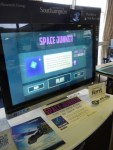
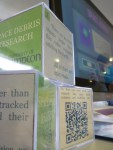
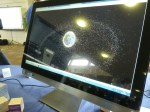
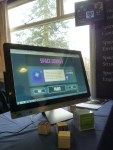
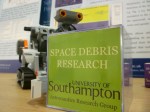
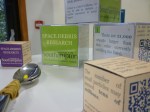
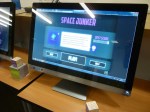
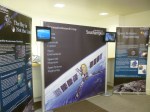
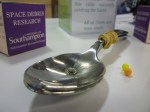
In terms of our regular activities, we had a lot of kids try out our Space Junker game on the large touch-screen PCs (developed by the Science Museum with our involvement), and plenty of parents and other adults reading our research posters and talking to us about our research into space debris and the problems that ‘space junk’ poses to space operations. Our other display materials also went down pretty well, which included our big stand, leaflets & pamphlets about the undergraduate programs in Space Systems Engineering, and these natty little cubes which I made to communicate some of our research into space debris and some of the problems:

P1180687

Anyway, a fun day was (I think) had by all, and we seemed to get a pretty great response from the Science & Engineering Day hordes that came to campus despite the dreary weather. For our point of view, it was yet again an entertaining, rewarding and uplifting outreach event, and getting a whole load of exposure for our research activities. A hugely exhausting event that seems to expend so much energy and brain/musclepower, but immensely fun.

Nonetheless, we’ll be doing it all tomorrow for our second activity in NSEW, which is the Big Bang Solent science fair, happening on campus at the University of Southampton. We’ve mainly got the same set-up, but this time Aquabot will be replaced by the second iteration of our Mindstorms display, Debrisbot: instead of wandering the Mars landscape looking for blue balls, Debrisbot will be navigating “outer space” (albeit an ‘outer space’ that has been transplanted into two dimensions), trying to “collision-avoidance” manoeuvres with various objects (“space debris”) placed in orbit. Not quite sure how Debrisbot will perform as yet, but hopefully it should be another entertaining and engaging day of science, engineering and being a big kid again.

Anyway, before I head off, here are some more photos from Saturday’s event; hopefully some of tomorrow will manifest in due course. Enjoy!

[Zinar7]
Tagged , , , , , , , , , ,

PhD Fraud #08: Songs in the Key of Strife

PhD8

It’s sometimes unnerving how much ‘music’ has me in its clutches, and purely at its bidding: often, I won’t know how much of a ‘low’ mood I’ve been feeling until I listen to something that delivers a ‘hit’ of pure energy (Exhibit A) or nostalgia (Exhibit B), that I’m mentally put into ‘overdrive’ and gain access to some unknown, hidden source of vitality with which to, at least for the duration of that song or record, overcome (almost) any obstacle. In this vein, I’ve at least learned a few tips about what tunes to put on when I’m struggling with work; of which I’ve provided a brief run-down of here:

1. Fixing Matlab and Shit

Coding is one of the key parts of many PhDs, primarily those in the sciences. However, sometimes you’re forced to use Matlab or something equally painful, and therefore writing, fixing or debugging code can often be a drag. Sticking on some sort of electronic/dance music usually helps; delivering a shot of both energy and mindlessness that kind of lets you see ‘through’ the code to see the inner workings of Matlab rather than the numbers, letters and symbols presented onscreen. Kind of like the Matrix, except it’s still Matlab we’re dealing with so you still have to put up with the constant desire to headdesk when your code fails for NO APPARENT REASON. But hey, at least you’ll have a better soundtrack to do it to, yeah?

2. Getting Shit Done

Sometimes, you just need a kick up the backside to get you going, or it’s getting towards the end of the day and you’re starting to slack off a bit. Well, thankfully, a man was placed on this Earth to help solve just that problem. His name is Andrew W.K. For a 35-minute burst of pure motivation, insert I Get Wet into your CD drive, push ‘play’ and let the productivity commence. WHEN IT’S TIME TO RESEARCH WE WILL RESEARCH HARD

3. Getting Inspired and Shit

Sometimes we all need some sort of muse with which to dig into our inner psyche and bring forth creativity, inspiration and ideas. Anyway, it turns out that my musical muse is Ke$ha. A slight disappointment, since it could so easily have been someone with an actual modicum of musical talent, but we all play the hands we’re dealt and instead of fighting it, I’ve come to embrace it. Animal/Cannibal is supremely glorious piece of work (essentially the I Get Wet of this decade), elevating me to a higher level of knowledge and reasoning, and while it continues to do so, I will feel no shame at bopping along to her white-trash, catchy slut-o-rama. Long may it reign.

4. Kicking Writer’s Block in the Face and Shit

Writing up research work is an essential part of being an academic. Getting gob-smacking results is all very well unless you’re able to communicate that to the general public or the rest of your field, and thus putting pen to paper, or finger to keyboard is essential. It can be a miserable business sometimes though, when you can’t figure out what to say, how to say or why.  I find that progressive metal is a delicious solution to this conundrum; offering a sense of elevated intellect and distinguished literary ability that is largely absent from, say, the works of Sir Snoop of Dogg-shire. Let it wash over you , and you’ll absorb complex time-signatures, lyrics and musical interludes almost by osmosis and as a result, see your written work flourish into a burgeoning manuscript of academic prowess. See, it works.

5. Calculating Shit with Maths and Stuff

The basis of most science is, somewhere, based on some sort of theory or set of equations which hope to explain the physical world in terms of a variety of numbers and letters. Often, calculating those numbers or deriving that set of formulae is boring as hell, and some sort of external energy drip is required to keep you on mission. Step in Anamanaguchi with the 16-bit chiptune punk, and the superlative Scott Pilgrim vs. the World: The Game original soundtrack. Suddenly, maths is made of brightly-coloured pixels, chirpy sound effects and SPEED RUNS. So, plug in your controller, give the cartridge a blow and press UP, UP, DOWN, DOWN, LEFT, RIGHT, LEFT, RIGHT, A, B to Falcon Punch those equations into touch.

6. Getting Shit in Just Before the Deadline

Despite best efforts, a lot of things which are produced to a deadline (abstract/paper for a conference, research proposal, getting stuff ready for a supervisor meeting) are often only finished and sent off seconds before their actually due, and there is an important lesson to be learnt about how to get it all done on time and not end up in a mad panic. Something calming, soothing but upbeat is the order of the day, and you can do a lot worse that drinking in the swirling, dream-like qualities of lo-fi, acoustic/electronic indie-pop. I recently discovered Gregory and the Hawk, whose floating melodies helped dispatch a journal paper right near the deadline whilst keeping me safe from full-blown insanity; may she rescue your mind from oblivion, too.

7. Crying and Shit When Things Inevitably Go Wrong

Okay, so you’re doing a PhD. Things will inevitably go wrong; that’s, like, programmed into the DNA of the PhD process. Quite possibly, like in my case, things will go horribly, horribly wrong and you’ll have to re-do months of work or start again from scratch. This can be seriously harrowing, and lead to severe doubts of depression and anxiety that are probably not great for the mental well-being of any sane person, let alone someone who was unstable enough (at least at some point) to think that doing a PhD would be an enjoyable thing to do. What’s the musical remedy for this, then?

Power metal. And lots of it.

Think about it, it’s like the perfect cure: catchy melodies, uplifting lyrics, powerful vocals; it’s pretty much just Katy Perry with bearded men, leather codpieces and songs about dragons. And if that’s not something to instantly warm the soul and make you forget about your plethora of research problems, then I don’t want to live on this planet anymore.

[Zinar7]
Tagged , , , , ,

PhD Fraud #07: That Sinking Feeling

PhD7

My attitude to this whole PhD business has calmed down a lot lately, despite the rapidly-ticking clock that’s now deafening me as it counts down to the final deadline I can submit a thesis. I’m yet to come to a conclusion as to whether this is a Good Thing or not.

I think I’ve just reached the point with my research that it’s just over, now, and that there’s not much more I can do with it (or time to do it in) except to just “finish it off” and hope that it’s good enough. I certainly don’t have time to go re-doing a lot of my work if it isn’t good enough, so in that respect, I’ve reached some sort of ‘epiphany’ that it doesn’t really matter anymore; the decision has essentially already been made as to whether I get this damned PhD or not, I just need to ride the train and see where it ends up. All I can do now is just continue with the work I’m still finishing off, continue with the thesis-writing I’m still in the process of, and make sure I keep turning up each day and picking away at it all. It’s too late to do anything major [not least because I’m also working part-time as a Senior Research Assistant on two EU space debris projects: ACCORD (Alignment of Capability and Capacity for Objective of Reducing Debris) and ReVuS (Reducing the Vulnerability of Space Systems)] so even if my work is all wrong, or just not ‘novel’ enough, then there’s not much I can do about it anymore.

I’ve also relaxed my position towards what my four years of research will get me in the end – in the beginning, it felt like  attaining a PhD was the be-all and end-all, and that if I didn’t achieve that, then I’d be some sort of ‘failure’; from both the point of view of my department/supervisor, but on a personal level as well. At around the 18-month stage, I successfully transferred from the original MPhil/PhD course everyone is registered on to begin with, and was stuck on the final PhD course: so, I’d like to think that, if my work isn’t quite enough to get me a doctorate, I will at least be awarded an MPhil for it. Depending on who you talk to in academia, getting an MPhil is either a legitimate qualification, or just a massive, neon sign saying “Hey, so I wasn’t good enough to get a PhD!” Previously, I was considerably worried that I’d end up with just an MPhil (or worse, nothing) and that I’d be considered a ‘failure’, particularly since so many of my RockSoc friends have successfully survived the PhD process and come out the other side. Such a result would be an acceptance that I’m not “clever enough,” or somehow less good than everyone else who tried and succeeded.

In the final years of my undergraduate degree, I’d kind of ended up feeling a little bit disappointed by my efforts on my individual and group projects (3rd and 4th years, respectively), and had built up a mental reputation of being someone who tries very hard at their research, but ultimately ends up with very little. Of course, when starting a PhD, everyone dreams that their research will change the world, or at least lead to some new way of thinking or solution to a problem; naturally, this rarely ever happens and it’s all about making an incremental step forward in your field, even if it’s just a minute step forward in a very specialised area. Have I managed that with my PhD work so far? Well, I kind of have ( I tried some new stuff, and some old stuff in a new way) and kind of haven’t (the stuff I did didn’t really work, and there are a bunch of problems with the theoretical basis of it all), so it’s very ambiguous. My thesis won’t be my greatest achievement ever, but I’ve kind of reached a plateau where (I think) I can finish it up in its current state without undertaking a major amount of new work. I think.

So, everything’s been kind of going okay recently until, today, I received a reviewer’s (uh, review) of my submitted journal paper and it was… not so good. This was a paper I submitted to an open-access journal around 5/6 months ago, and after receiving one critical but largely positive comment early on, there has no other review discussion since. The most recent comment, from an anonymous reviewer is, however, fairly critical and calls into question most of the results I’ve presented in the paper. I know that, technically, no criticism is bad criticism as it will strengthen the final product, but it’s still not easy to take negativity when it’s thrown quite liberally at your own endeavours. I’m yet to fully process the review (I only skim-read it, and need to sleep on it before I can start to think properly about what it means), but it’s not exactly what I want to hear. It’s amazing how quickly confidence can get knocked; particularly in academia, where your importance to your institution, or scientific field, is based almost purely on your ability to string together publications and gives rise to the “publish or perish” mantra.

So, what does this mean for me? Well, by and large, I think I’ve worked out that I don’t want to stay in academia after my current time is up; not in a direct-research role, anyway. I’ve got thoughts about what I want to do when I finish, and a lot of them revolve around teaching, or expanding on the outreach/public engagement activities I currently participate in. I’ve no idea whether this is a sustainable career, or indeed whether the ‘ideal’ job exists, but it’s worth a shot. With that in mind, then, perhaps I’ve reached the conclusion that it doesn’t matter whether I have a PhD or an MPhil; whether I’ve got journal publications under my belt or not. These things largely only matter in academia; so, who cares? Certainly,  the trauma of ‘doing’ a PhD is worth more than the letters after your name or the ‘published’ status anyway, so if I’ve already reached that conclusion, then I’ve got nothing to lose.

‘Dr.’ or no ‘Dr.’, by October I will have gone through the PhD process and be all the stronger for it: most people in my situation would have given up long ago, so if there’s one thing I’m good at, it’s Carrying On In The Face Of Vastly Superior Adversity. In fact, maybe that should be the tagline for my CV:

Simon George.
Good at facial hair, making a mean cup of tea and bloody well not giving up.

And if that doesn’t make me a shoo-in for any job placement ever, then there’s something very wrong with this World. Something very wrong, indeed.

[Zinar7]
Tagged , , ,

PhD Fraud #06: Hashtag Overly Honest Methods

PhD06

Okay, as we’ve just enter a new year, I thought that it was time for an update on my ride on this crazy PhD Research Train. What’s changed? Well, a few things, but not a great deal.

Around the end of October, I started doing some additional, part-time post-doctoral research work to help pay the bills now that my PhD funding has come to an end. Thankfully, it’s completely unrelated to my PhD work, which means it’s actually pretty interesting and a nice distraction from the thesis slog. The work is more temporal though, meaning that the post-doc stuff has weeks where lots of work needs to be done and 100% of my time is spent on it; and others, like now, where there’s not much to do at the moment and I’m focussing pretty much entirely on my thesis. This blog was always focussed on the PhD struggle, so I’m not going to talk too much about my other research commitments, but stick to my thesis work. t’s probably not a huge surprise to say that I’ve lost almost all my motivation and interest for finishing my PhD – this comes despite the fact that the sooner I can finish, the sooner I can work on something else; somehow, I’m finding it hard to muster even the motivation to just “GET IT DONE”), and can find infinite amount of other things that I’d rather spend my time on. This has been made doubly hard, since I technically already have the job (the post-doc position) that I needed a PhD for in the first place, so it’s not like I need that Certificate of Graduation for a job interview or anything.

So what’s going on? The past few months have been super frustrating, as some significant problems were been identified with my scientific technique and have led to me kind of not being sure whether what I’m doing is right, wrong or whatever. I’ve had doubts about my results for a while, but have largely put these to the back of my mind because the scientific models are complex and the theory is very confusing: recently, though, I’ve had to really tackle the mathematics and it’s left me completely baffled. It’s time like this that I wish that my project/thesis was on something that somewhere here (i.e. my university) knows about, because no-one aside from me really does and neither are there a bunch of resources (aside from those I’ve collected) that I can draw on if I’m in a bind. My work is quite distant from my supervisor’s field, and so he’s not really able to help with any of the technical details, use of models or analysis of results except in a vague quantitative way. My PhD always started from a position of isolation, as my main remit was to do some exploratory research into a dark region that no-one’s really looked into before, and essentially been given a flashlight and told: “right, go and find something interesting, and bring it back here when you’re done.”

It’s a matter of slight pride that, with everything I’ve done, I’ve done off my own bat: except some gentle comments from others, I’ve gotten where I have purely because of my own work. All the way, I’ve largely driven myself in the direction that I have, and have been given limited guidance on what exactly I should be looking at. From a research point of view, maybe that reflects well on me in that I’ve managed to be pretty much autonomous for the last 3 years, and developed things of my own accord; on the other side, though, this means that I’ve had to search everywhere for the ‘right’ way to do, hitting many dead ends along the way and absorbing considerable frustration. Of the work I have done with my results, I’m pulling together ideas and concepts from a number of fields and trying to make them compatible, but in a way that I’m not really an expert in any one of them and there are considerable problems in integrating the scientific model in the way that I have. I’m woefully aware of the meaninglessness of my results (or what results I’ve actually managed to get) and am not entirely convinced that my efforts are truly at the sort of standard to which they hand out doctorates. Maybe I’m overestimating how ‘good’ or ‘novel’ the final thesis needs to be, but I’ve got super-mega worries that what I have so far is painfully below the mark.

Over the whole of my PhD research, I kind of feel like I’ve squandered my time and expertise. I feel like if I’d have focussed on the right things, I could be somewhere good with my research, but that in reality, all I’ve managed to do is find problems everywhere with what I’m doing and flaws in the models/techniques that I’m using. Sure, this might be valid ‘research’ in finding out the wrong way to go about science/a PhD/[insert relevant title here] and technically no science is ‘useless’ science (unless someone already proved it), but it’s no match for actually doing something positive with your work. I kind of feel like the only positive thing that will have come out of my PhD is that someone, somewhere might read my thesis and not have to go through the same three years of frustration and errors and wrong directions that I did. I’m currently trying to formulate a title and general approach (the story, say) that my thesis will describe, and it’s a brain-breaking task. My work feels just like a smattering of ideas that people elsewhere already came up with, but thrown together in a way that things haven’t quite been looked at in this form before, or with these methods. Maybe my thesis can be called: ‘A Bunch of Science Thrown Together with Blunderbuss Accuracy‘ or ‘How Not to do a PhD (and 101 Other Useful Tips for Going Completely Crazy Before You’re Thirty)‘, and that’ll summarise things quite well.

Yes, yes, I know I’m being pessimistic. I know that I just need to Yvan Muller the PhD, and get the bloody thing down. Maybe it won’t be the best piece of research ever, but maybe I can fill it with enough pretty pictures or flattering writing that the examiners will overlook the significant lack of content and ‘pass’ me, largely out of pity. We can but hope.

[Zinar7]
Tagged , , ,

PhD Fraud #01: The Beginning

PhD01

Okay, I’ve refrained from posting much about my ongoing research-related struggles on this blog, despite the size and quantity of the struggles that I have encountered over the last two-and-a-half years. However, following my mission statement from the beginning of one of my recent posts, I’m going to correct this in the hope that either airing those struggles with the internet at large will give me a chance of vent some of the frustration and clear my head, that someone reading this blog may be able to give kind words (or better, solutions) to reinforce my sanity in the remaining six- to twelve-months of research, or that others in similar situations may be able to better understand the steps I’ve taken to solve my problems and may find some solace that they are not alone.

For a long time, I’ve had problems with stress and anxiety that apparently developed during my final years of my undergraduate degree and have been around ever since. I don’t really know what caused this change, but it’s likely that the continuing stresses of increasingly large workloads, rigorous examination schedules and ever-increasing expectations started a chain of anxiety over my intelligence, skills and abilities that I now regularly feel in all aspects of life. I must be mental, then, to accept the offer of studying for a PhD; and you’d be right, although it not for the same reasons you might expect. I signed on to the PhD process expecting hard work and close cooperation with my supervisors – essentially visions of both my supervisors riding on my back, whipping me left, right and centre into hard work. The reality is quite the opposite – relaxed supervisors who continually say reassuring things like “you’re doing fine,” and certainly no signs of the intensive slave-labour I’d come to expect. Which all sounds dandy, except for the aforementioned ‘performance anxiety’ that I feel about the work I produce and the progress I make.

Despite being two-and-a-half years down the line, I don’t really feel like I’ve gotten anywhere. Sure, time has passed and work’s been done, but in terms of how much of that has been useful and how far I’ve actually moved from where I started to where I am now, it’s disappointingly short – heck, I’m still not sure what the problem is I’m supposed to be solving. Some say that this is the same for all PhDs and I find some satisfaction in that, but that doesn’t stop you thinking that you could have spent that time so much better if you’d done things a different way; worked harder; been ‘cleverer’. Which is where the stress and anxiety comes in; forever making you second-guess your own work, tricking you into thinking that if anyone else had been given the same opportunities and tools, they’d have not only solved the problem you set out to achieve, but others as well and be well on the way to a fine career. It’s not like I’ve been slacking, and if you count the number of hours I’ve spent in the office since I started then I’d be no lower than average, but all my brain feels like doing is blaming myself .

The nature of research in tackling the ‘unknown’ means that, when the PhD proposal is written and the problem statement defined, this is being done after only a short amount of research into the subject – so the end result, the potential problems and the feasible timescale may not be accurate, or even present. In my case, my research was initiated by dual curiosity in two departments on the same problem, but both factions knowing essentially ‘zero’ about whether the problem could be solved, how, or indeed any of the finer details. When you’re coming into your first week of research with about the same level of knowledge about the problem as your academic supervisors, that can be a big challenge, and it only propagates through your study: A case of “the blind leading the blind”. For any undergraduate who’s used to rigorous testing/examination/coursework that has definitive ‘right’ and ‘wrong’ answers (I’m an engineer, and so used to definitive solutions to assessed work), stepping into the world of research where there is no ‘right’ way to go is difficult; particularly if you suffer from similar issues to myself, where constant re-assurance that you’re doing things right is necessary to keep me from stressing the fuck out. More and more over the last six to twelve months, I’ve found it harder to engage with my work – Having to step forward on my own and make decisions about the directions to take or methods to use is immensely stressful, perhaps because I still feel like I’m handling the whole project with kid-gloves. Making the step up to assuring yourself of what you’re doing rather than assurance from others is a tricky business, and one I’ve not yet mastered.

Thus ends my first foray into this adventure of sharing my thoughts, anxieties and faults with the world at large. It’s by no means the last word on this subject, since I’m already working on the follow-up to this. Hopefully it’ll chronicle my problems and offer some sort of solace when this adventure is all over and I can look back on my time here with a tear-filled eye. Who knows. Anyway, I’ve taken up enough of your time, so I will bid farewell. Godspeed.

[Zinar7]
Tagged ,