Tag Archives: Video Games

A Lament for the Video Game Manual

Lament

Next time you’re playing a new video game on one of those spangly-new, current-generation consoles, spare a thought for the poor, humble, forgotten video game manual. In this age of digital releases where physical copies of games are more at a premium, and pieces of floating paper coming bundled with the game disc are becoming more and more unwieldy and rare; the presence of printed DLC (Downloadable Content) codes, etc. aside. Even then, where disc-based games still come with some sort of instruction booklet, in many cases it’s woefully inadequate in providing context to the main game, given that many AAA-franchises now have so many complex facets of gameplay and control mechanics that you’d need most of a rainforest’s-worth of papyrus to catalogue them all. The days of gaming instructions being “press right to move right, press x to jump; jump on the enemy’s head to kill the enemy” are, sadly, behind us.

So: given that it’s someone’s job to reminisce about these archaic forms of printed communication and – in the absence of anyone else – that ‘someone’ may as well be me, let me take you on a journey of discovery and revelation about the mythical artform of the video game instruction manual. Together, perhaps, we can reclaim this forgotten land for the generations ahead.

P1030868

In the distant past, the instruction manual supplied with a video game was there to do one thing: to teach you how to play the game. Back in the 1980s and early 1990s, a game would rarely have any introductory backstory, let alone hints as to how to get along, before thrusting you headlong into some gameplay. Haunting back to the idea of the game being a machine and the means operation of that machine needing to be communicated to the user by means of some sort of instructive text, manuals were included in video game boxes as the conduit by which the user understood what the game was and how it worked, and also where to find contact information and telephone numbers to call when the software inevitably failed or caused her ZX Spectrum to spew out little bits of cartridge tape in a very violent manner.

As video games grew and became more cinematic and three-dimensional during the 1990s, the instruction manual became a way for more information about the plot, characters and universe to be documented, in addition to how to press the right buttons at the right time. Perhaps the reasons for this are down to the increasing ambition of video games to rival full-blown movie entertainment in terms of story and lore, and perhaps to save the developers time and money on creating extra hours of Full-Motion Video (FMV) cut-scenes or expensive animation by filling the instruction booklet with bonus information and history in written form (cf. Final Fantasy VII, Puppeteer, Chrono Trigger).

As a player who has passionately grown up amongst video games for twenty years now, I still reminisce about the thrill of buying a new video game at the shops and devouring the instruction manual (not literally; I’m not a monster) during the car ride home because, until I got home and could boot it up, reading the manual was the next closest thing to actually playing the game. This heritage naturally inspires me to view a game’s instruction manual more as a taster for the game itself than a simple set of operation codes for playing it; whetting the appetite with exciting artwork, design and (sometimes) additional game lore. As an aside, it’s worth noting that I’m like this with music, and physical media, too – I love leafing through an album’s sleeve flyer, awaiting what music will to come meet my ears and throwing myself headlong into the band’s artwork and lyrics.

However, whenever I’ve bought a pre-owned console game, particularly from the last couple of console generations, the manual is – with alarming regularity – often in mint condition and unsullied by human hand(s). It’s equally alarming how many pre-owned games are still delivered with pristine DLC/download codes hidden away in/with the user manual: a broad conclusion that may be drawn is that their owners are simply unaware that they exist; a symptom of gamers simply too impatient to get playing to investigate the other manual guff before they dive in. In these modern times, if a game isn’t packaged with an in-game tutorial teaching the user, step-by-patronising-step, how to do every little thing in the game, many players are likely to head to the internet at the first sign of confusion rather than consult the manual; or worse, ragequit and abandon the game entirely. Gamers expect a playable tutorial; not a written set of the rules and limits of the game and the primary operators and actions used to navigate it (unless it’s an in-game version that can called up from a start menu prompt). As a result, I’d wager that only a small proportional of video game manuals ever feel the touch of human flesh; merely the fleeting fondle of an excited gamer’s fingers as they scrabble through it.

Ain't Nobody Got Time Fo' That

In the last decade, I’ve noticed an increasing propensity for video game manuals (particularly from Western developers and publishers) to exist merely as a few sheets of paper held by some ragged staples; hastily thrown together to print the primary control mappings but with scant pickings of game-enhancing content. They’re now no longer a necessity, but a luxury; perhaps supplied in order to meet console licencing requirements or out of some, long-forgotten obligation to give the player something to look at before they properly delve into the game itself.

A manual is, by and large, one of the last things that will be created for a game’s release. It’s something to be done at the end, and with little effort spent on it in order to maximise the man-hours that are spent on the game itself. This means that plans for an engaging, informative instruction manual are often the first things to be cut from a development budget that’s pushing its time or financial deadline; with publishers typically finalising their printed material at the very last minute (right before shipping), seemingly assigning the task to the resident intern or work experience kid. Some culprits may be guilty of throwing a user guide together seemingly at random, with random or out-of-date concept art presented as the real thing, out-of-date screenshots and typos still embedded in the text, with no quality control. Also, some developers/publishers may eschew the opportunity to publish more of the games’ development/etc art in the manual; instead, choosing to use such content in coffee-table ‘art’ books for which the consumer may often pay a pretty penny for (Ubisoft, I’m looking at you).

Of course, game manuals must serve an important, legal purposes – details of guarantee, warranty, licencing details, epilepsy warnings, [ yada yada ] must all be presented to the consumer. For health/safety/Quality Assurance reasons, it is still – largely – necessary for every major video game to be packaged with something paper-based on which warranties, blah etc. are written for the consumer’s benefit. As such, a large number of manuals are merely this; no frills, just the facts. And, often, not even any facts about how to play the game at all: the user manual for the PlayStation 3 version of the BioShock – Ultimate Rapture Edition simply says: “Consult [url] for game instructions,” somewhat defeating the purpose of encouraging players to engage with the complex, rich world and artwork of the BioShock and Rapture universe. THANKS, 2K.

VideoGameManualNotes

But, despite the bleak message of this post so far, it’s good to see that some developers still like go to town on the accompanying user guide; seeing the instruction manual as a part of the game’s package and an equal part of the art and aesthetic of it as the game itself. Although this adds time and cost to the production of the final game, as a conscientious (and academic) gamer, this adds to my experience of the game and the value that I obtain from its universe:

Assassin’s Creed II (PlayStation 3 version tested) uses its instruction manual to enhance the experience of the game as a whole, being laid out in the form of a set of research notes from Abstergo Industries explaining how to operate the Animus 2.0 (the in-game ‘machine’ allowing Desmond Miles access to the memories of the historical assassin, Ezio Audiotore da Firenze) and annotated by Desmond’s Abstergo refugee, Lucy Stilman. For example, in one such annotation, the AC II manual makes fun of its preceding game and the insta-death the player experience upon landing in water by mentioning: “Please make sure to remove that annoying bug preventing swimming.” It may be just a small in-joke, but it rewards the stolid adventurer that delves into the user manual, and adds some local colour to an otherwise perfunctory explanation of the game’s operations and features.

More archaic instruction manuals also reflect other curiosities of gaming’s history: the ‘Notes’ section of pages which are common in many instruction guides, for example. These hark back to a time when it was necessary for players to write down level passwords or codes, when savegame functions weren’t a widespread feature of most console games and in-game cheat modes were abound. Back in the day, the instruction manual was also an important barrier against software piracy – I recall the efforts of publishers like LucasArts doing their best to stop pirates from distributing pirated games (copied from floppy disks) by requiring users to look up a code in the manual (randomised each time you play­; e.g. “page 34, line 3 ……….”) in order to access the game. Of course, there would be nothing to stop large-scale pirates simply reproducing the manual, as well, but it may have halted the disk-copying of bedroom pirates.

"Piracy harms consumers as well as legitimate developers, publishers and retailers."

Page one of the manual for Assassin’s Creed IV: Black Flag ~ “Piracy harms consumers as well as legitimate developers, publishers and retailers.” /FAIL

What place do instruction manuals have, though, in a world where control schemes for many video games can be edited and mapped to a player’s particular tastes? If the primary operators for in-game control are not fixed, then what worth is there in publishing a list of them in hard copy form? Furthermore, with future consoles likely to ditch physical game discs altogether (Microsoft nearly managed to get away with doing it in the current console generation, but not quite), will we see an absence of all printed materials, with a reliance purely on download-only games a la PC gaming on Steam?

Of course, I have nothing against tutorials an in-game manuals per se – if they can be presented in the context of the coherent storyline and with due care and attention, then a tutorial is a highly effective way of inducting the user into the gameworld and setting up the rest of the game. But why waste the opportunity to present extra content to the consumer? Maybe I’m in a minority. Perhaps the evidence that many players don’t look at modern game manuals is evidence that they’re an archaic artform that should be retired; perhaps alongside physical copies of videogames altogether, I don’t know. But if I’m a last bastion of a bygone era where the physical world still musters a round of applause, then I’m happy to be its final pillar of support. Godspeed.

[Zinar7]

Tagged , , , ,

Scary Monsters and Nice Sprites

Scary
Since tomorrow is the 2014 edition of the Capitalism-fest that is Hallowe’en and the “scary things” closet has already been opened once again and a whole bunch of horror media sent barrelling our way, I thought I’d consider the role that video games play in our annual celebration of creepiness. Hurrah!

I’m a sucker for horror movies: creepy ones, silly ones, gory ones; you name it, I’ll devour it. Horror video games, on the other hand, can GET THE FUCKING HELL AWAY FROM ME.

Joel Cuddles

Largely, horror films completely fail to give me the creeps: perhaps it’s the knowledge that it’s all just a big scam, and the girl being chased by the guy with the big axe isn’t really being chased, and the guy with the big axe doesn’t really want to examine the girl’s internal organs in minute detail and with the complete opposite of surgical precision. Like everything in the movies, it’s just a big ol’ fake and there’s really nothing to be scared about at all.

At best, a surprise set-piece will give a brief shock, but never nightmares: the only things in recent memory to actually, properly, scare me were the Spanish original of [.REC] (which, incidentally, I will never ever watch again; not because it was too scary, but because the next time I see it will be a disappointment and I want to maintain it as one of my favourite horror films of all time) and pretty much all of The Descent (which was largely an hour and a half of Scary Things Jumping Out at You in the Dark™). Aside from that, I’m pretty unshakeable even in the face of maddening terror. When it comes to horror video games though, then you can rewrite all the rule books and Consequences Will Never Be the Same.

It’s here that I should probably define what I mean when I say “horror game”:

Horror Game [hawr-er geym]

n.  A video game whose predominant function is to scare, or thrill, above and beyond a regular ‘action’ game.

“I played this horror game last night and it was so scary that I accidentally vomited out my internal organs.”

It’s not a necessary prerequisitive for horror-games to be action-based, but most fall under the well-trodden banner of ‘survival horror’: your Resident Evils, your Silent Hills and your Alone in the Darks. These (almost universally) place you in the scope of some city-wide outbreak of nasties keen to chew on your face; away from which you must navigate your way (from fixed camera angles) in a third-person manner whilst simultaneously trying to find your wife/daughter/dog and understand what the hell’s gone wrong with the world. Even so, there are plenty of other horror-filled titles that meander away from the standard ‘shoot at and run away from the monster things chasing you’ to encompass psychological horrors, as well as the physical ones. I can categorically say that I will never, ever ever ever play Amnesia: The Dark Descent: I may own it on Steam, thanks in some manner to some Humble Indie Bundle somewhere along the line, but I’ll never install it.

Broadly, I watch horror films to be amused (usually by their shocking production values, hilariously bad dialogue and entertaining special effects), not to sit on the edge of my seat. but I can at least appreciate that some find horror films “scary” in some way. Horror video games, on the other hand, require direct input and often an emotional attachment (likely with the main character or perhaps for a “damsel” in “distress” that provides the key focal point for the story slash action) which amplifies the terror through your desire to see them survive the ordeal.

With a horror film, you know everything’s on rails and that the horror will progress without your direct involvement; you’re just along for the ride until the credits roll. If you do get scared, the action will progress regardless and you’re safe in the knowledge that, in 1-2 hours’ time, it’ll be over; no matter how much (or little) you engage with the scares. Where horror movies largely stick to the same sort of tropes (meaning you can largely predict how and when the scares are going to take place, who’s going to die, when something’s going to jump out, yada yada), proper horror games don’t have the same heritage and traditions and are tend to be far more innovative and inventive with how they give you the creeps. Aside from the more direct input that the player has on the action in a horror game than horror movie, this might also arise because of the relative infancy in which horror games inhabit, at least when compared to the 100-odd-year history of cinema.

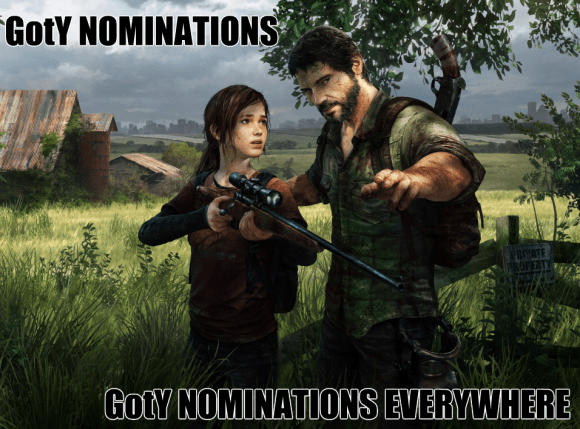
Around this time last year, Naughty Dog unleashed one of the defining games of the PS3 generation in the form of The Last of Us; a survival-horror (ish) adventure game combining tension, emotion and zombie-ish things into a snowball of praise and Game of the Year (GotY) nominations from gaming critics. A year on (and with its recent re-release on PS4 in the form of a ‘remastered’ edition), many critics still view it as the high point of the previous console generation, drawing comparison with some of the ‘greats’ of cinema and banding around nicknames like “the Citizen Kane of games”. Still, given that the first, proper, piece of horror cinema is almost a century old now (widely accepted to be the creepy, unsettling The Cabinet of Dr. Caligari), it’s unsurprising that video game developers have caught on to the main tricks of making a survival-horror game scare both physically and psychologically, becoming genuinely innovative with its horror engagement and leaving much of cinema’s generic horror output writhing in the dust.

LastOfUs

Given the immense (and almost universal) acclaim in which it is still held, I kind of feel I should play The Last of Us, but it just doesn’t grab me enough to give it a go (pun very much intended). I don’t go overboard for survival horror, and never have been: I think one reason why I dislike survival horror is that it takes itself so darned seriously (that Silent Hill dog ending aside), whereas all my favourite horror films (The Evil Dead, Saw, The Happiness of the KatakurisZombieland) are those ones that blow things over the top and deploy entertainment and/or comedy to complement the terror. The slow, tense styles of most survival horror titles hold no sway: the prospect of having to tensely save ammo/health and be frightened to death around every corner is often not the greatest motivator.

Instead, I prefer to be far more ‘gung-ho’ in my gaming style: it’s much more enjoyable to be charging around levels at full-tilt, full unloading clips of ammo in every available direction and trying to have as much fun (and cause as much chaos) as possible; preferably to a soundtrack delivered by Andrew W.K. or Turbonegro or something equally mental. This does, however,tend to make me a bit rubbish at stealth-based games like Thief and Hitman, let alone standard survival-horror games where you’re encouraged to save every last bullet and avoid alerting the entire zombie horde by careering around throwing grenades at the scenery. For shoot ’em ups of every colour and creed, I far prefer those that distribute copious amounts of ammunition and supply copious hordes of ghoulies/baddies to use it on; such as the glorious Bulletstorm or the masterpiece of Halo. “Saving some ammo for later” just isn’t in my dictionary, and I wouldn’t have it any other way.

When I do stray into the darkened realms of horror gaming, I tend to to fall back on my love for zombies and zombie movies as a crucial pivot and gossamer connection to the world I know and love. And, even then, I like my zombie games to be entertaining struggles rather than bleak journeys of mere survival based on scavenging for crumbs of survival; the likes of Dead Rising and Left 4 Dead providing far more amusement than any number of repetitive, po-faced Resident Evils. I’ve recently been playing through Organ Trail (Director’s Cut) once again; clocking ever more hours into its cheesy, tongue-in-cheek conversion of the classic Oregon Trail into a homage-filled zombie survival adventure and enjoying every minute of it. And even then, if Plants vs. Zombies still isn’t the best zombie game ever made, then I’m a giant heron.

Okay, so enough about full-on ‘horror’ games; what about scary monsters and nice sprites in mainstream gaming at large? There’s an increasing trope for so-called ‘regular’ (non-scary, or mainly non-horror-based) games to artificially use ‘scary’ sequences to add to the drama or tension of a regular ‘action’ game, particularly in first-person person shooters, to varying degrees of success. Half-Life 2‘s superlative Ravenholm sequence is still one of the scariest (and most memorable) sequence in a modern first-person shooter, whilst the Sander Cohen section from BioShock – with all of its weeping angel-style mannequin-splicers and haunted theatre props – is one of gaming’s most expertly-executed creep-fests. Whilst Treyarch’s Call of Duty titles – with their schlocky zombies and undead Nazi footsoldiers – just feel like a tired resurrection of the same old trope of taking a standard game and trying to shoehorn some shocks into it, Red Dead Dedemption‘s glorious DLC/story expansion ‘Undead Nightmare‘ managed to implement a superlative zombie mode with infinite more care and grace.

Aside from traditional survival-horror games, there’s still a whole bunch of originality to be found within the ‘horror’ genre; resisting the mainstream horror genre’s tropes of endless wandering through endless dark, tight, grey corridors shooting zombies and collecting herbs. The likes of Project Zero (multi-platform, 2001-), Eternal Darkness (GameCube, 2002) and Cursed Mountain (Wii, 2009) come critically acclaimed by those in the know, demonstrating that there’s innovation to be found if players wander off the beaten survival-horror path, and the indie community also seems to be leading the charge in horror gaming of late; with particular successes such as the aforementioned Amnesia series, Penumbra: Black Plague and, this Hallowe’en’s breakout hit, Five Nights at Freddy’s. The equally-fascinating and terrifying Slender: The Eight Pages (which I have played; although not for long) demonstrate that terror can be inflicted without a bullet ever being fired.

So, despite the fact that I’m active only in the fringes of horror gaming, I’d wager that the genre is in fair health; so long as you steer clear of the kind of trash that The Evil Within appears to be peddling. With the growing success of Oculus Rift and true-VR gaming, I can only imagine that the successes of immersive, truly scary video games will also go interstellar. Schlocky, jumpscare games might not be my exact cup of tea, but I’m fully in favour of the injection of psychological, unsettling horrors into video gaming as a whole and engaging stories that place less emphasis on shooting space marines and more on tapping into the brain’s psychological fears. Game designers, take note plz.

Anyway, since this post has mainly been about scary things and personal gripes, I thought I’d leave you with a wonderful scene of beauty and harmony and everything that is ‘right’ with the world; don’t have nightmares.

MemeCenter_1375716630592_653

[Zinar7]

Tagged , , , , , ,

Sinister Reviews #13: Indiana Jones and the Last Crusade – The Graphic Adventure

IndyTop

Genre: Point-and-Click Adventure
Platform: PC (version tested), Amiga, Atari ST, Mac
Release Date: July 1989
Developer: Lucasfilm Games
Publisher: Lucasfilm Games

Way back at the beginning of January, I made a promise to ‘Play More Point-and-Click Adventure Games (at least one per month) and Blog About Them.‘ As such, I felt that it was appropriate for my first adventure game, er, adventure to delve into the depths of time and unearth a relic that’s almost as I am and, as such, has long-since been forgotten by all but adventure game connoisseurs. With that in mind, for January’s point-and-click odyssey, I decided to dust off LucasArts’ Indiana Jones and the Last Crusade tie-in adventure, plunder its nostalgic treasures, and see what comes out in the wash.

IndyLstCrsde_1

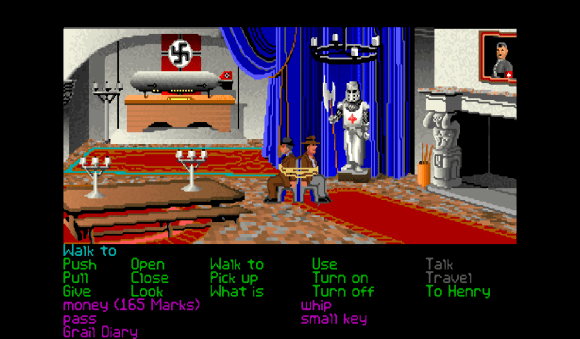
IJLCTGA finds LucasArts (then still known under ‘LucasFilm Games’) still very early in its adventure game career and it most certainly shows; not only graphically, but also in terms of writing, puzzle design and overall vision. That’s not to say that it’s a complete Neanderthal – indeed, IJLCTGA marked the introduction of the now-classic ‘Look’ and ‘Talk’ verbs to the LucasArts canon of adventure games – but, in comparison to the later SCUMM-engine classics of Day of the Tentacle and Sam and Max Hit the Road, it’s almost neolithic. Individual scenes and areas are sparse with objects to interact with, little in the way of deep conversation with NPCs, and experimentation with items isn’t rewarded with witty asides or funny dialogue in the same way that later games took so much pleasure in delivering. Despite the fabulous basis provided by John Williams’ superb score for the Last Crusade movie, music isn’t the IJLCTGA‘s strong point either (you’ll go forever without hearing a note, then some scenes have sound) but at least the primitive pixellised graphics show some solidity; even if Indy tends to stand out from the pretty backgrounds kind of like the cartoon archaeologist that he is in the movies.

That being said, the skeleton of the classic adventure game system is alive and well, and the constant back-and-forth of trailing between areas, picking up items and hulking them around in Indy’s TARDIS-like pockets will be immediately familiar to anyone who’s played an adventure game. As such, it’s easy to get going straight away and plough right into the adventuring; which is good, because you’re thrown in pretty much immediately without an introduction or prologue, save for a brief ‘third wall’-breaking message from Indy: “Hi, I’m Indiana Jones. Welcome to my game.”

IndyLstCrsde_9

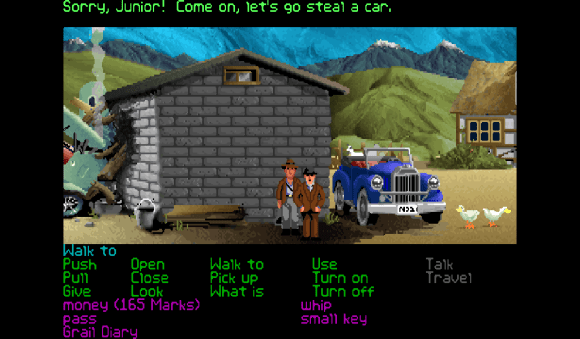
Not that you really need an introduction, given that the game accurately (if rather broadly) follows the major events of the third Indiana Jones movie. Although this breeds familiarity and instantly lets you dive into the main game, this seems to come at the expense of a proper, three-dimensional story and character development; neither of which can be found here. The story can be subjective, though, depending on certain actions: in some playthroughs (depending on what you do at various times) you’ll visit particular scenes and areas from the movie; in others, you might skip them entirely. There’s also a comedy of inconsistencies: for example, you’ll solve a Führer-based puzzle in Berlin by replicating the movie exactly; but in the Grail Temple, reaching for the obvious wooden cup isn’t necessarily the correct choice.

In fact, the movie’s pivotal point is warped beyond recognition, such that is literally random as to which is ‘true’ Holy Grail; unless you happened to stumbled on the entirely missable clues from way earlier in the game and unintuitively piece them together to work out the solution. If not, then you’ll have to keep re-playing the whole of the Grail Temple until you magically stumble across the correct Grail; which, as you can imagine, is a whole barrel of laughs if you choose poorly and have to replay the same three puzzles through up to ten times). It’s just another inconsistency in a game that often feels like a patchwork of ideas, crudely glued-together and shoved out of the door without the addition of any sort of depth or bolstering of either the gameplay itself, the overarching story or the playability of certain sections. A victim of its obligation to coincide with the release of the Indiana Jones and the Last Crusade movie? Perhaps.
Yes, because that's the rational thing to do when you've just crashed a biplane into the side of a house.

Yes, because that’s the rational solution when you’ve just crashed a biplane into the side of a house.

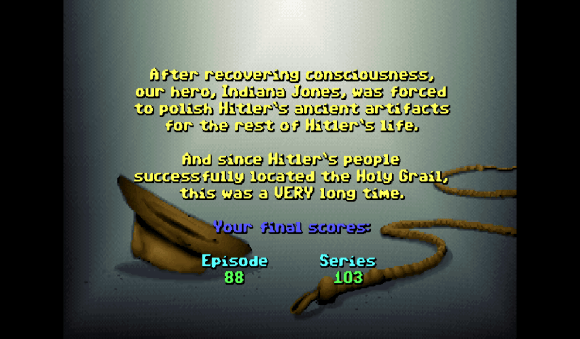
Naturally for a movie blockbuster, the original source material piles action on thick-and-fast and, so, it’s not surprising that this bleeds into the tie-in game. Where later LucasArts games held a strict rule that death was unattainable, the final third of the IJLCTGA descends into a mess of mandatory arcade sequences and scruffy 2D melee and aerial combat where you’ll see your fair share of ‘Game Over’ screens: take a wrong step, and you’ll be sent back to the title screen to re-load your latest game save. I’m led to believe that the combat sequences around Castle Brunwald and the escape from Germany can be avoided (with suitable dialogue choices within some of the sprawling conversation trees that develop when you cross a Nazi guard), but I rarely had such luck even when re-loading and repeating interactions to find each guard’s weak spot. Each time, you’re thrown out of the immersion and into a deep pond of frustration; the onset of each combat sequence inevitably leading to the ‘Game Over’ screen  and the loss of yet more patience.

The primary problem (aside from often-ridiculous difficulty spikes and sometimes-incomprehensible juxtaposition in context of the rest of the game) with mandatory arcade sequences in adventure games is that they tend to detract from the main thrust of the game; story-based point-and-click adventuring. I have to admit that I was forced to resort to the (lifesaving) Universal Hint System on more than a handful of occasions in order to circumnavigate the game’s second half of crippling, frustrating action segments. Whilst I relied on a complex web of savegames around Castle Brunwald and only sparingly leant on FAQs, the soul-crushing escape from Germany – and string of unskippable guard interactions – was enough to force me to throw trial-and-error out of the window and rely on a helpful walkthrough merely to save me (or my PC) from violent injury. The end result is that you end up feeling somewhat ‘robbed’ of an adventure game; so forceful is the game’s abandonment of traditional point-and-click action halfway through in exchange for sub-par arcade-style progression.

You'll see your fair share of these

You’ll see your fair share of ‘Game Over’ screens: don’t say I didn’t warn you.

Of course, it’s easy to criticise IJLCTGA with the benefit of twenty years of progress in video game design. I guess the problem is you can’t judge a twenty-four year-old game by today’s standards; no matter how you look at it, it just won’t add up. Considering IJLCTGA in the context of PC gaming (and, in parallel, the entire point-and-click genre) largely still in its infancy, it’s easy to see the influence it’s had in setting some of the key themes for the entire genre and, those pesky arcade sequences aside, there’s a solid adventure game buried amongst the archaelogical rubble.

As I hinted at in my opening sentences, Indiana Jones and the Last Crusade has somewhat been eroded by the ravages of time and, much like Dr. Jones in his most recent movie outing, Indiana Jones and the Last Crusade defiantly shows it age. However, like any archaeological artefact, look hard enough and you’ll find some gold beneath the grime, and there’s a sprinkling of (albeit somewhat primitive) charm to be found among the frustrations. The arcade sequences will always feel like a punch to the stomach, but there’s some fun to be had when you’re let loose to point-and-click to your heart’s content. Remember: it’s not the years, honey, it’s the mileage.

[Zinar7]

Tagged , , , , , ,

Sinister Sevens: Resolutions 2014


Sevens_1

Right, it’s that time of year; that time when people reflect on the past and vow to make positive changes for the future. A day late and a dollar short, I don’t usually go in for New Year’s resolutions; but since I managed to nudge The Thesis into touch at the end of 2013 and I’m keen to put in place a robust post-Thesis regime, I’m determined to make the start to 2014 a positive one and this means that it’s time for some challenges.

So, in the spirit of coming up with a bunch of things I’ve like to get done in 2014, here I’ve come up with a short, seven-heavy shortlist of the major challenges I’d like to overcome in the coming year. Let’s do this!

Divider

1. Get Fit.

The importance of this first resolution cannot be underestimated. It’s not so much about getting fit per se, but at least getting my mis-shapen body back to something resembling slimness: I’ve got a ton of clothes that my tummy has grown too large to fit in properly (including an awesome assassin/pirate coat) that I would like to wear more often, which therefore means application of the following sub-resolutions:

1 (a). Go out inline skating more often.
1 (b). Do more skanking to ska-punk songs (skankercise).
1 (c). Eat less crap.

Of course, these remain fairly vague and without any particular time constraints or individual goals, so I will qualify my resolution by aiming to do each of them at least once a week, with a more permanent focus on maintaining resolution (c) at something approximating 100 % of the time. Looking at the wider picture, I’d like to be able to fit (and look good in, though that’s a far more ambitious/impossible task) my new assassin/pirate coat by, say, March, and to still be able to wear it on Xmas Day 2014 without it feeling very much like a whale that’s been squeezed into a corset. Game on.

2. Play More Point-and-Click Adventure Games (at least one per month) and Blog About Them.

and

3. Read More Books (at least one per month) and Blog About Them.

By no means a surprise, Resolutions Two and Three are a natural response to the sudden increase in free time (and motivation) that I anticipate will come my way now that I don’t spend every waking – and unwaking – moment either fretting about The Thesis or busily doing it. When I first realised that I couldn’t do all the leisure activities I wanted to do when I entered the world of academia, ‘books’ and ‘point-and-click adventure games’ were among the first things to be abandoned, much to my sadness. As such, the number of books I’ve not read, and adventure games I’ve not played, have been steadily increasing and the time to stop the tide is now.

To guarantee my commitment to both causes, I’m vowing to write reviews and thoughts about both here: an adventure game review once per month, and a bi-monthly post describing my thoughts on two books. Even if no-one reads them, I hope they’ll encourage me to look at storytelling media in a more academic light and to contribute my own thoughts to literature and video game criticism.

4. Make a Gordon Freeman Costume.

This. This is happening.

There’s no particular reason why; only that I’ve kept meaning to do it for years and years and years, and that I’ve got the right beard and the right glasses to justify cosplaying as video games’ most famous silent protagonist. Since there’s no better motivator for making a costume than needing a costume for a convention, I’m also resolving to have it ready and made by May in order to head to either to the London Film and Comic Con or the MCM London Comic Con dressed in Dr. Freeman’s HEV suit from Half-Life; made even more poignant given that (hopefully) I will also be a fully-qualified PhD scientist by that point as well. It’s ambitious and achievable, and my enthusiasm for getting this done is remarkably high right now. To the workshop!

5. Properly Give up Coffee and Alcohol.

I think most people now are aware that I don’t drink alcohol because of the bad effects it seems to have on my body (specifically bad effects meaning ‘having an intolerance to digesting/assimilating it’ bad effects, not ‘holy shit I drank so much last night’ bad effects) but, disappointingly, I appear to be developing similar problems with respect to drinking highly-caffeinated beverages as well. So, in the interests of trying to keep myself just about as healthy and not making myself really ill from just one cup of coffee or one pint of cider, I’m hitting the nail on the head and removing them from my diet (and conscience) altogether. I’d love to inbibe both, but it’s just a sad fact that my body won’t handle it anymore so I have to stop 😦

6. Watch at Least 52 Movies from my Project 500 list (one for each week of 2014).

A few of you may be aware of my ongoing Project 500 film challenge to watch every one of the five-hundred greatest movies as selected by Empire magazine in a special feature that they published a few years back. 2011 and 2012 were prolific years for film-watching, but 2013 was comparatively fruitless and little progress was made. For 2014, I’d like to kick that back into gear by watching at least as many ‘great’ movies as there are weeks in the year: I’m currently on 360/500, so I’m aiming for 52 more movies from the list which will take me to 412/500. Of course, I’m still not closing in my 500 target just yet, but hopefully the process will once again reveal more of cinema’s treasures that I’ve managed to miss in my film-watching career thus far; it’s not about the destination, it’s about the journey.

7. Be Happy 100% of the Time, No Compromises.

This is an obvious one, really. Too often in 2013 was I feeling down, depressed or lonely; feeling adrift in the world and yet not making positive steps to change that. Well, I’m aiming for 2014 to be one of happiness, contentment and satisfaction, and not one of regret or self-pity: no dwelling on mistakes, no having regrets, no moping around; just a positive outlook and a willingness to make changes in areas I’m not happy. It sounds like a small thing, but to me it’s a big thing; probably the most challenging thing on this list altogether.

In many ways, Resolution Seven is just a commitment to Be Better At Stuff and Not Being Sad. It’s essentially the ultimate trump card, but also the easiest pitfall to fall down and the simplest resolution to dismiss or break. Hence, by writing it down here I therefore commit myself to keeping it through a written contract and through the rule of New Year’s resolutions that if other people know about them then it’s harder to just ignore them and pretend you never made them in the first place. So, with that in mind, I wish both you and I a happy, prosperous and glory-filled 2014; may we all be carried upon the backs of soaring dragons to a magical world of merriment, success and inexhaustable supplies of Toblerone. Godspeed!

[Zinar7]

Tagged , , , , , , , , , , ,

Sinister Reviews: Best of 2013

2013

As the new year approaches and 2013 draws to a close, it’s just about time for my annual review of the good, bad and ugly things from the past year (for reference, here’s my one from last year).

It’s been an eventful year: from finally finishing The Thesis and handing in the beast to partying hard at the likes of Iron Maiden, Black Sabbath and Knife Party; from jetting all around Europe on various work-related shenanigans, to gallivanting up and down the country to visit family, friends and loved ones; from finding gainful employment in academic research, to presenting that research at various important conferences and meetings including the UK Space Conference and the European Conference on Space Debris; from all of the good times with spent with the ones I love, to the lessons learned and the personal growth. 2013 has been spectacular, like a bright star in the night’s sky.

There’s a lot to wrap up so, without further ado, let’s boogie:

Mov

Best Movie ~ RUSH. Ron Howard, you did F1 proud.
Runners-Up ~ Wreck-It Ralph,  Alan Partridge: Alpha Papa, Star Trek: Into Darkness, The World’s End.
‘Didn’t Think Would be Good but was Actually Brilliant’ of the Year ~ Robot and Frank.
Movie Performance of the Year ~ Daniel Brühl getting Niki Lauda’s mannerisms down to a tea. Well played, Brühl.
Runner-Up ~ Tim Key as the flawless Sidekick Simon in Alpha Papa. “I think I handled it pretty well.”
Most Disappointing Movie of 2013 ~ I don’t think I went to see any bad movies in 2013. Sure, The Great Gatsby could’ve done with a few more car chases and buildings blowing up, but it was still pretty damned good.
Unnecessary Movie Sequel of the Year ~ A Good Day to Die Hard.
Debatable Physics of the Year ~ Gravity. Great film, but even the most die-hard fan must admit that the science is a little, well, shaky.
Best TV Show ~  Game of Thrones season three. That show just keeps getting better and better
Runners-Up ~ Top GearWeekly Wipe, The Ambassadors, QI.
TV Moment of the Year ~ Game of Thrones‘ Red Wedding. Nothing can ever compare. So many feels.

Review_Games

‘Didn’t Get To Play But Really Want To’ of 2013 ~ Assassin’s Creed IV: Black Flag, Tales of Xillia, The Legend of Zelda: A Link Between Worlds, The Stanley Parable, Broken Sword: the Serpent’s Curse, Gone Home, The Cave, Puppeteer.

Best Mainstream Game ~ Grand  Theft Auto V. So ambitious, so entertaining, so perfect.
Runners-Up ~ Ni No Kuni: Wrath of the White Witch, Bioshock Infinite.

Best Downloadable Game ~ Papers, Please.
Runners-Up ~  Organ Trail: Director’s Cut, DLC Quest, Lilly Looking Through, Anodyne.

Disappointment of 2013DuckTales: Remastered. It promised so much, but couldn’t deliver.

Video Game Character of 2013 ~ Trevor (Grand Theft Auto V). Unhinged, uncompromising, unbelievable.
Runner-Up – Elizabeth (Bioshock Infinite).
The 2013 ‘Development Hell’ Award ~ Team Ico’s The Last Guardian. Perhaps the rise of the PlayStation 4 will finally give us a release date to get excited about.
The 2013 ‘Hidden Gem’ Award ~  Lilly Looking Through: a delightful (but short) point-and-click adventure game, funded through Kickstarter and brought to life by Geeta Games.

Review_Music

Best Gig ~ Iron Maiden (London O2 Arena).
Runners-Up ~ Karnivool (Portsmouth Wedgewood Rooms), The Ataris (Southampton Joiners), [spunge] (Southampton Cellar), Knife Party [Haunted House] (London Brixton Academy), Black Sabbath (London O2 Arena).
Best (Rock/Metal) Album ~ Turisas – Turisas2013.
Runners-Up ~ AFI – Burials, Queens of the Stone Age – …Like Clockwork, Biffy Clyro – Opposites, Karnivool – Asymmetry.
Best (Electronic/Dance) Album ~ Daft Punk – Random Access Memories.
Runners-Up ~ Kavinsky – OutRun, How to Destroy Angels – Welcome Oblivion, Anamanaguchi – Endless Fantasy, Nine Inch Nails – Hesitation Marks, Chipzel – Spectra.
Disappointment of 2013 ~ Alkaline Trio – My Shame is True. Not bad, just disappointing.
Mash-Up of the Year ~ Isosine – ‘Little Sickness’ [Disturbed & Of Monsters and Men] (video link).
Song of the Year ~ Daft Punk – ‘Get Lucky’, VERY CLOSELY beating Turisas’ equally superb ‘For Your Own Good’.
Runners-Up ~ AFI – ’17 Crimes’, Sound City Players – ‘Mantra’, Nine Inch Nails – ‘Copy of A’.
Best Cover Art of 2013 ~ Kavinsky – OutRun (link).
Comeback of 2013 ~ Black Sabbath. The heavy metal Gods return, and what a return it is; a superb album (13) and an even more superb live show, the Sabbath once again prove why they’re not only the inventors of heavy metal, but also it’s saviours.
Steampunk Anthem of the Year ~ The Men That Will Not Be Blamed For Nothing – ‘The Gin Song’ (link)
‘Why Won’t it Go Away?’ of 2013 ~ Bloody Robin bloody Thicke’s bloody ‘Blurred Lines’.
Music Video of 2013 ~ Peter Serafinowicz’s glorious version of ‘Get Lucky’ (video link).

Review_Motosport

F1 Driver of the Year ~ How can it not be Sebastian Vettel? The man was flawless from lights to flag, and fully deserved to take his fourth consecutive title.
F1 Best Race ~ Monaco. It’s not often  that Monte-Carlo offers excitement and the spectacle, but this year it really nailed it.

F1 Overtake of the Year ~
Fernando Alonso’s stunning start in the Spanish GP. Shows what “home advantage” can do.
“Should’ve  Gone to Specsavers” of the Year ~ Hamilton stopping at the wrong (McLaren) pit box in Malaysia. LOLOLOLOLOL.
Most Improved of the Year – Romain Grosjean. The boy’s come of age, finally.
Team Orders of the Year ~ Sebastian Vettel in Malaysia. “Multi-21, Seb. Multi-21!”
Crash of the Year ~ Kamui Kobayashi on an empty circuit in Moscow :S (video link).
EverythingElse

Best Purchase ~ It’s a toss-up between my LEGO Sopwith Camel and my GeekyJerseys ‘Rogue Squadron’ hockey shirt. I love them both 😀

Best Book ~ Kaja & Phil Foglio – Agatha H and the Airship City // Davey Havok – Pop Kids // Toby Frost – Space Captain Smith: A Game of Battleships

Best Internet Video ~ BirgirPall’s superb I Broke Star Trek (video link). SPAK LET ME IN. HLEP ME KIRK.

Best Photo of 2013 ~ Bill Murray from ‘Reasons my Son is Crying’ (link).

Most Apt Phrase to Sum Up 2013 ~ “Pope Francis and the Chelyabinsk meteor totally came in like a wrecking ball but then the badgers moved the goalposts in one of their drunken stupors.”

Person of 2013 ~ Andrew W.K. The man is a complete god. He tweeted to me for my birthday, for crying out loud.

Looking Forward to in 2014 ~ Season four of Game of Thrones. Less Than Jake & Reel Big Fish at Portsmouth Pyramids. Turisas at Southampton Talking Heads. The Hobbit: There and Back Again.  (Hopefully) passing my PhD viva and becoming a proper Doctor of Philosophy and shit. Final Fantasy XV. Formula One getting shaken up to its core. Watch Dogs. The LEGO Movie. Porsche’s return to Le Mans and endurance racing. The Grand Budapest Hotel.

BEST MOMENTS (no order)

New Year’s fun and frolics in Southampton; The SUMMER Party; BTCC action at Thruxton; WEC 6 Hours of Silverstone; LEGOland wizardry for Ben’s stag do; Jorge Cham (PhD Comics)’s seminar at Southampton University on the ‘Power of Procrastination’; birthdaying in London and the QI Christmas special; #Ockfest frolics; weddings for Alice & Ben and Ben & Sarah; #IronSunday and #BlackTuesday with Maiden and Sabbath at The O2; adventures in London for Knife Party’s ‘Haunted House’ and the game of #GetTheHeckOutOfBrixton at 4am; Andrew O’Neill is Easily Distracted at The Art House; not-crashing the weddings of Alice & Ben and Ben & Sarah; emitting Eurovision-based LOLz at Shez’s place; THE SUMMER PARTY in sunny Lugwardine; work trips to Darmstadt, Friedrichshafen, Glasgow, Toulouse; gigs for [spunge], The Ataris and Karnivool; Many #TabletopNight meeple action with the usual crowd; and plenty more besides.

Everyone, you’ve been awesome.
Divider

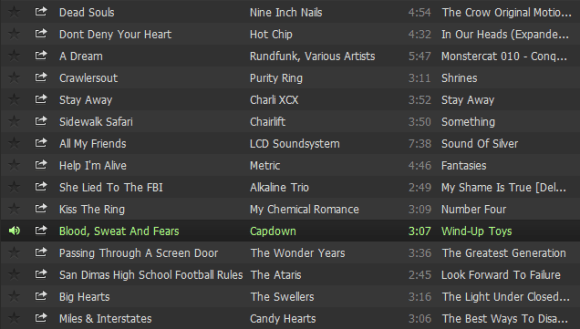
And, to finalise, here’s a delightful electronic/punk rock playlist to celebrate December and calibrate 2014. It’s called 013/12 – The Long Road to Redemption.

Playlist_01312

2013 is dead. Long live 2014. 

[Zinar7]

Tagged , , , , , , ,

Sinister Reviews: Best of 2012

2012

As the new year approaches and 2012 draws to a close, it’s just about time for my annual review of the good, bad and ugly things from the past year (for reference, here’s my one from last year).

So, without further ado, let’s boogie:

MOVIES & TV

Best Movie ~ The Dark Knight Rises
Runners-Up ~ The Raid, The Pirates! In an Adventure with Scientists, The Hobbit: An Unexpected Journey
‘Didn’t Think Would be Good but was Actually Brilliant’ of the Year ~ Sightseers. A masterpiece in British black comedy.
Movie Performance of the Year ~ Tom Hardy as Bane, The Dark Knight Rises. He can’t beat Ledger’s Joker, but still a chilling portrayal of the muscled maniac.
Most Disappointing Movie of 2012Skyfall. Just remarkably… average. Bond deserves better.
Unnecessary Movie Sequel of the Year ~ Taken 2. 
Crowdfunding Achievement of the Year ~ Iron SkyWhat a film. Glorious.
Best TV Show ~ Sherlock
Runners-Up ~ The Thick of It (series four), Game of Thrones (season two), Peep Show (series eight)
TV Moment of the Year ~ Sherlock‘s stunning misdirection and sleight-of-hand at the climax of ‘The Reichenbach Fall’.

VIDEO GAMES

I totally haven’t played many ‘new’ video games in 2012, so this section is looking rather bleak. Oh well, here’s to 2013!

‘Didn’t Get To Play But Really Want To’ of 2012 ~ Assassin’s Creed 3, The Walking Dead, ZombiU, LEGO Lord of the Rings, Theatrhythm: Final Fantasy, Black Mesa, Dishonoured, Fez, Journey

Best Mainstream Game ~ The Last Story (Wii)
Runners-Up ~ Pandora’s Tower (Wii), Dear Esther (PC)

Best Indie Game ~ Retro City Rampage (PC)
Runners-Up ~ Dustforce, Ticket to Ride, Botanicula (all PC)

Video Game Character of 2012 ~ The Slenderman (video link)
Crowdfunding Achievement of 2012 ~Double Fine Adventure (web link)
Best Non-Game Game of 2012 ~ Dear Esther (PC)

MUSIC

Best Gig ~ Andrew WK (HMV Forum, London). Best gig ever.
Runners-Up ~ Justice (Bestival, Isle of Wight), Alestorm (The Cellar, Southampton), 2:54 (The Jericho, Oxford)
Best (non-power metal) Album ~ Rush – Clockwork Angels
Runners-Up ~ Blaqk Audio – Bright Black Heaven, 2:54 – s/t, The Men That Will Not Be Blamed For Nothing – This May Be The Reason Why The Men That Will Not Be Blamed For Nothing Cannot Be Killed By Conventional Weapons
Best (power metal) AlbumSabaton – Carolus Rex
Runners-Up ~ Luca Turilli’s Rhapsody – Ascending to Infinity, Ascension – Far Beyond the Stars, Ensiferum – Unsung Heroes
Disappointment of 2012 ~ Yet another year passing by without a Daft Punk album (although I hear we might get one in 2013, fingers crossed)
Music Video of the Year ~ PSY – ‘Gangnam Style’ (video link)
Song of the Year~ Chairlift – ‘I Belong in Your Arms’ (video link)
Runners-Up ~ Blaqk Audio – ‘Fade to White’ (video link), Luca Turilli’s Rhapsody – ‘Dark Fate of Atlantis’ (video link), Rush – ‘Headlong Flight’ (video link)
Most Stealthy Penis-Laden Cover Art ~ Tenacious D – Rize of the Fenix (web link)
Breakthrough Band of 2012 ~ 2:54
Steampunk Anthem of the Year ~ The Men That Will Not Be Blamed For Nothing – ‘Brunel’ (video link)
‘Why Won’t it Go Away?’ of 2012 ~ Gotye – ‘Somebody that I Used to Know’ (video link)
‘Not Guilty At All’ Pleasure of 2012 ~ Ke$ha – Warrior
Mash-Up of the Year ~ Ke$ha vs. Lamb of God – ‘Tik Tok Redneck’ (by Isosine, video link)

MOTORSPORT

F1 Driver of the Year ~ Fernando Alonso. Drove the balls off that Ferrari, but just didn’t quite make the championship
Runners-Up ~ Kimi Raikkonen, Nico Hulkenberg, Sebastian Vettel
F1 Best Race ~ The final race in Brazil. What a spectacular close to the season.

F1 Overtake of the Year ~
Hulkenberg on Grosjean/Hamilton in Korea. The Hulk: You wouldn’t like him when he’s angry.
First-Lap Madness of the Year – Spa-Francorchamps and Grosjean’s Falcon Punch into most of the field. Earned him a one-race ban, but what a way to do it.
Crash of the Year ~ Antony Davidson at LM24 (video link)
Video ~ Gymkhana 5 (video link)
Nine-Times World Champion of the Year ~ Sebastian Loeb. What a driver, the likes of which may never be seen again in the World Rally Championship.

PROJECT 500

(see Empire’s 500 Greatest Movies of All TimeProgress: 350/500

Best Movies (I hadn’t seen) ~ The Bourne Identity, AI: Artificial Intelligence, Dog Day Afternoon, Zodiac, Schindler’s List, Paris Texas

New Discoveries ~ Sidney Lumet (Dog Day Afternoon, Network),

Disappointments ~ Killer of Sheep, Russian Ark, Andrei Rublev

Best Car Chase ~ The Bourne Identity

Most Out-of-Place Car Chase ~ Blow Out

Most in Need of a Car Chase ~ The Leopard

EVERYTHING ELSE

Best Purchase ~ Andrew W.K. bobblehead (web link). Just amazing.

Best Book ~ Yahtzee Croshaw – Jam

Best Internet Video ~ Counting Song (video link)
Runners-Up ~ Batman Maybe (video link), Vincent Van Dominogh – Starry Night (video link), C-Bomb – Bowl Date (video link)

Best Reaction Video of 2012 ~ Kermode’s and Transformers 4 (video link)

Tweet of the Year ~ Jim Howick: ‘I’ve lost my eggs and I can’t ring them because they’re on silent.’ (link)

Most Apt Phrase to Sum Up 2012 ~ “It’s a Gangnam Style world, we’re just living in it” – Josh Groban

Best Discovered Drink – Guinness Punch

Word of 2012 ~ ‘Pleb’. A welcome return for one of my favourite put-downs.

Man of 2012 ~ Andrew W.K. The man is a complete god.

Looking Forward to in 2013 ~ Potentially becoming a doctor (again, copy paste last year); Django Unchained; The Hobbit: The Desolation of Smaug; another thrilling F1 season; Daft Punk’s 4th album and potentially playing live shows (!!!); a new Karnivool album (hopefully); and a whole bunch more.

Best Moments (no order) ~
Autosport International at Birmingham NEC; Stewart Lee’s Carpet Remnant World; Alestorm at The Cellar; Andrew WK at London HMV Forum; Kayaking on the Wye; OckFest 2012; World Endurance Championship at Silverstone; Tim Key’s Masterslut at the Nuffield Theatre; the Bestival experience with the University of Southampton Roadshow (and being officially in the Bestival programme, no jokes); more awesome movies than you can shake a stick at; the November ‘Apocalypse’ weekend of 2:54 in Oxford followed by Hereford shenanigans; Charlie & Jade’s wedding and awesomeness; Farnborough Air Show; Goodwood Festival of Speed; Nuremberg, Freiberg, Devon; the list goes on…
Everyone, you’ve been awesome.

2012 is dead. Long live 2013. 

[Zinar7]

Tagged , , , , , , , ,

Sinister Reviews #11: The Last Story


Genre: JRPG. Third-Person Adventure
Platform: Wii
Release Date: March 2012
Developer: Mistwalker Studios
Publisher: Nintendo
The Last Story is a conundrum: brilliant in places; tragic in others. Pushing the graphical bar right to the top, Mistwalker’s latest JRPG  arrives just as the curtain’s beginning to drop for the Wii: while in the main it succeeds in the face of adversity, a few unforgiving niggles ultimately prevent it from achieving true greatness.

Continue reading

Tagged , , , , , ,

Sinister Future

Currently, it’s looking like my review of Destroy All Humans! might be my last, at least for a while. Time is quite precious to me at the moment and, as it turns out, playing games is a lot more fun than writing about them. It’s always been my intention to ‘up’ my use of this blog, and that I should update more regularly – but less formally – than what I’m doing currently. My first few reviews for No More Heroes and LEGO Harry Potter Years 1-4 pretty much wrote themselves: Indeed, I knocked those out during short breaks at work. Of late, however (starting with Epic Mickey, which took about six months before I actually posted it) I’ve found significantly higher barriers from me getting them done; partially because I’ve been so darned busy at work that I’ve no motivation to pseudo-‘work’ in my free time by writing reviews, and also partially because the backlog of EVERYTHING I currently have. I’d much rather this be a freeform blog in which I’m free to talk about whatever I want in a relaxed way and when I have something I want to say, rather than expending all my creative juices on formal reviews and having little time for more jolly fare. I’m hoping I can keep up reviews of new stuff (i.e. new music/videogame releases), such that my opinions will be useful to others who’re considering picking up the same release, but my experiences with other stuff may be documented in a more relaxed manner.

Continue reading

Tagged , ,

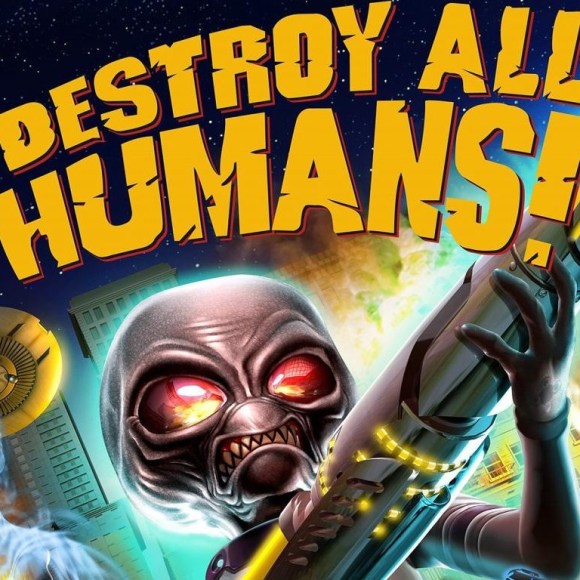
Sinister Reviews #10: Destroy All Humans!

#10: Destroy All Humans! (PS2)
Genre: Action-Adventure, Sandbox
Platform: PS2 (version tested), Xbox
Release Date: June 2005
Developer: Pandemic
Publisher: THQ

If Edward D. Wood Jr. could have made video games, he’d have produced Destroy All Humans!; heck, there’s even a trailer for Plan 9 from Outer Space included in the game’s bonus feautres. An homage to old, Fifties B-movies like Plan 9Day of the Triffids and Invasion of the Body Snatchers, the game focuses on the plight of Orthopox and Cryptosporidium from the planet Furon: two extra-galactic creatures with a lone flying saucer, charged with invading Earth and placing humanity under the iron fist of the Furon Empire. Like its B-movie counterparts, Destroy All Humans! is highly-entertaining with some cheesy action and even cheesier comedy, but ultimately won’t bring home the silverware.

Tagged , , , ,

Sinister Reviews #09: Prince of Persia – The Fallen King

#09: Prince of Persia: The Fallen King (Nintendo DS)
Genre: Platformer, Action
Platform: Nintendo DS
Release Date: December 2008
Developer: Ubisoft Casablanca
Publisher: Ubisoft
Falling within the second reboot of the Prince of Persia franchise in 2008, The Fallen King marks the Prince’s return to the two-dimensional world after the highly-rated Sands of Time trilogy embraced three dimensions and revolutionised the action-adventure genre. Being the first proper Persian outing onto handheld consoles (one turn-based strategy spinoff aside), fans will welcome the opportunity to dodge traps, leap chasms and die frequent jaggy-rock deaths while on the move as well, not just from the comfort of their sofa.

Tagged , , , , , ,